 Safekipedia
What is Drag?
In fluid dynamics, drag is a force that pushes against anything moving through a fluid, such as air or water. This force works in the opposite direction of the object's motion. Because of drag, objects moving through fluids often slow down.
How Drag Changes with Speed
[Drag](/wiki/Drag_(disambiguation) behaves differently depending on how fast something is moving. At slower speeds, the drag force changes in a simple way with speed. But at higher speeds, the drag force changes more quickly, related to the square of the speed. Scientists use something called the Reynolds number to study and predict how fluids move around objects.
Examples
Drag can be seen in many everyday situations. For example, when a car, airplane, or boat moves, it feels a push back from the air or water — this is called drag. This same push back can also happen to fluid moving through a pipe, slowing it down.
In sports, drag plays an important role. It affects how balls, javelins, arrows, and frisbees move through the air. Even runners and swimmers need extra energy to overcome the drag from the air or water around them.
Types
There are several types of drag that happen when an object moves through a fluid like air or water. Two main types are form drag and skin friction drag. Form drag happens because of the pressure on the object as the fluid flows around it. It depends on the shape of the object. Skin friction drag is caused by the friction between the fluid and the surface of the object.
For aircraft, two other important types of drag are lift-induced drag and wave drag. Lift-induced drag happens when wings or other lifting surfaces create lift. It increases as the angle of attack goes up. Wave drag appears at higher speeds when shockwaves form around the aircraft.
| Shape and flow | Form Drag | Skin friction |
|---|---|---|
 | ≈0% | ≈100% |
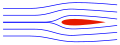 | ≈10% | ≈90% |
 | ≈90% | ≈10% |
 | ≈100% | ≈0% |
The drag equation
Drag is the force that slows down objects moving through a fluid, like air or water. The drag equation helps us understand this force: FD = ½ ρ v2 CD A, where FD is the drag force, ρ is the fluid’s density, v is the object’s speed, CD is the drag coefficient, and A is the object’s cross-sectional area.
The drag coefficient, CD, depends on the object’s shape and the Reynolds number. At low speeds, drag increases with speed. At high speeds, drag increases with the square of the speed.
At high velocity
Main article: Drag equation
When something moves very fast through a fluid like air or water, it feels a force pushing back on it. This is called quadratic drag because the force grows quickly as the speed increases. The force depends on how thick the fluid is, how fast the object is moving, and the shape of the object.
For example, a car going at 100 mph needs more power to push through the air than the same car going at 50 mph. This is because the force pushing back becomes four times bigger when the speed doubles. To keep moving, the car has to work much harder!
Low Reynolds numbers: Stokes' drag
Main article: Stokes' law
When objects move slowly through a fluid, they feel a force called drag. This force works against the motion of the object.
For very slow speeds, this force is directly related to how fast the object is moving.
Scientists have found equations to describe this force. For tiny particles or slow-moving objects, the drag force depends on the object's speed, its size, and the fluid it moves through. This helps us understand how small things, like tiny particles or bacteria, move in fluids such as water or air.
d'Alembert's paradox
Main article: d'Alembert's paradox
In 1752, a mathematician named d'Alembert discovered something interesting about how liquids and gases move. He found that one way of thinking about this movement suggested that nothing would slow down an object moving through a fluid. But experiments showed that this was not true. This surprise finding is called d'Alembert's paradox.
Later, scientists made new equations to better explain how fluids move when they touch surfaces. These helped us understand why drag happens, especially when the fluid moves very fast compared to the object. An important idea was the boundary layer, a thin layer of fluid close to the object's surface where the fluid sticks a little bit.
Images
This article is a child-friendly adaptation of the Wikipedia article on Drag (physics), available under CC BY-SA 4.0.
Images from Wikimedia Commons. Tap any image to view credits and license.