 Safekipedia
United States Army Air Forces
Adapted from Wikipedia · Adventurer experience
The United States Army Air Forces was the main air service of the United States Army during and after World War II. It started on June 20, 1941, replacing the older United States Army Air Corps.
The AAF grew very quickly during the war. It had many bases in the United States and operated from more than 1,600 airfields around the world by the end of the war in Europe, known as V-E Day.
The AAF was created to give the air arm more control and to solve problems inside the Army about how aviation should be organized. Even though it stayed part of the Army, it acted almost like an independent service by the end of the war. Other countries, like the United Kingdom with its Royal Air Force and Germany with its Luftwaffe, already had separate air forces. In 1947, after the war, the United States Air Force was created as its own branch of the military, following the National Security Act of 1947.
Creation
The United States Army Air Forces (USAAF) started to improve how air power was used in the military. Before this, ideas about strategic bombing were developed at the Air Corps Tactical School. Leaders like Brig. Gen. Billy Mitchell wanted an independent air force, but they faced resistance.
In 1935, all combat air units in the United States were grouped under the General Headquarters Air Force. This was a step toward a separate air force, but it still had to support ground forces.
When the United States entered World War II, it became clear that a better organized air force was needed. On 20 June 1941, the USAAF was created, led by Henry H. Arnold. This gave the air forces more control. After the attack on Pearl Harbor, Arnold got a seat on the Joint Chiefs of Staff, giving the USAAF more equality with other military branches.
The USAAF made several changes to improve its structure. By March 1942, it was organized into three main parts, and later reforms made its command simpler. These changes helped the USAAF become strong and effective during the war.
Main article: Air warfare of World War II
Expansion
The United States Army Air Forces grew quickly in 1939 under President Roosevelt’s direction. It started with just 800 combat airplanes. The goal was to build a strong air force to defend the Western Hemisphere. When World War II began, plans were ready to build many more airplanes and airfields.
As the war continued, the Army Air Forces grew very fast. By 1944, they had almost 2.4 million people and 80,000 airplanes. This big growth needed new training programs, better organization, and many new airfields. The Air Force became a major part of the U.S. military effort during World War II.
Main article: United States aircraft production during World War II
| Type of aircraft | 31 December 1941 | 31 December 1942 | 31 December 1943 | 31 December 1944 | 31 August 1945 | Date of maximum size |
|---|---|---|---|---|---|---|
| Grand total | 12,297 | 33,304 | 64,232 | 72,726 | 63,715 | July 1944 (79,908) |
| Combat aircraft | 4,477 | 11,607 | 27,448 | 41,961 | 41,163 | May 1945 (43,248) |
| Very heavy bombers | - | 3 | 91 | 977 | 2,865 | August 1945 (2,865) |
| Heavy bombers | 288 | 2,076 | 8,027 | 12,813 | 11,065 | April 1945 (12,919) |
| Medium bombers | 745 | 2,556 | 4,370 | 6,189 | 5,384 | October 1944 (6,262) |
| Light bombers | 799 | 1,201 | 2,371 | 2,980 | 3,079 | September 1944 (3,338) |
| Fighter aircraft | 2,170 | 5,303 | 11,875 | 17,198 | 16,799 | May 1945 (17,725) |
| Reconnaissance aircraft | 475 | 468 | 714 | 1,804 | 1,971 | May 1945 (2,009) |
| Support aircraft | 7,820 | 21,697 | 36,784 | 30,765 | 22,552 | July 1944 (41,667) |
| Military transport aircraft | 254 | 1,857 | 6,466 | 10,456 | 9,561 | December 1944 (10,456) |
| Trainer aircraft | 7,340 | 17,044 | 26,051 | 17,060 | 9,558 | May 1944 (27,923) |
| Communications | 226 | 2,796 | 4,267 | 3,249 | 3,433 | December 1943 (4,267) |
| Date | Total USAAF | Tot Officers | Tot Enlisted | # overseas | Officers o/s | Enlisted o/s |
| 31 July 1939 | 24,724 | 2,636 | 22,088 | 3,991 | 272 | 3,719 |
| 31 December 1939 | 43,118 | 3,006 | 40,112 | 7,007 | 351 | 6,656 |
| 31 December 1940 | 101,227 | 6,437 | 94,790 | 16,070 | 612 | 15,458 |
| 31 December 1941 | 354,161 | 24,521 | 329,640 | 25,884 | 2,479 | 23,405 |
| 31 December 1942 | 1,597,049 | 127,267 | 1,469,782 | 242,021 | 26,792 | 215,229 |
| 31 December 1943 | 2,373,882 | 274,347 | 2,099,535 | 735,666 | 81,072 | 654,594 |
| 31 March 1944 (Peak size) | 2,411,294 | 306,889 | 2,104,405 | 906,335 | 104,864 | 801,471 |
| 31 December 1944 | 2,359,456 | 375,973 | 1,983,483 | 1,164,136 | 153,545 | 1,010,591 |
| 30 April 1945 (Peak overseas) | 2,329,534 | 388,278 | 1,941,256 | 1,224,006 | 163,886 | 1,060,120 |
| 31 August 1945 | 2,253,182 | 368,344 | 1,884,838 | 999,609 | 122,833 | 876,776 |
| Type of facility | 7 December 1941 | 31 December 1941 | 31 December 1942 | 31 December 1943 | 31 December 1944 | VE Day | VJ Day |
|---|---|---|---|---|---|---|---|
| Total all installations | 181 | 197 | 1,270 | 1,419 | 1,506 | 1,473 | 1,377 |
| Main bases | 114 | 151 | 345 | 345 | 377 | 356 | 344 |
| Satellite bases | - | - | 71 | 116 | 37 | 56 | 57 |
| Auxiliary fields | - | - | 198 | 322 | 309 | 291 | 269 |
| Total CONUS airfields | 114 | 151 | 614 | 783 | 723 | 703 | 670 |
| Bombing & gunnery ranges | - | - | unk | - | 480 | 473 | 433 |
| Hospitals & other owned facilities | 67 | 46 | 29 | 32 | 44 | 30 | 30 |
| Contract pilot schools | unk | unk | 69 | 66 | 14 | 14 | 6 |
| Rented office space | - | - | unk | unk | 79 | 109 | 103 |
| Leased hotels & apartment bldgs | - | - | 464 | 216 | 75 | 75 | 75 |
| Civilian & factory tech schools | - | - | 66 | 47 | 21 | 17 | 16 |
| College training detachments | - | - | 16 | 234 | 2 | 1 | 1 |
| Specialized storage depots | - | - | 12 | 41 | 68 | 51 | 43 |
| Location | 31 December 1941 | 31 December 1942 | 31 December 1943 | 31 December 1944 | VE Day | VJ Day |
|---|---|---|---|---|---|---|
| US possessions | 19 | 60 | 70 | 89 | 130 | 128 |
| North America | 7 | 74 | 83 | 67 | 66 | 62 |
| Atlantic islands | 5 | 27 | - | 20 | 21 | 21 |
| South America | - | 27 | 28 | 22 | 32 | 32 |
| Africa | - | 73 | 94 | 45 | 31 | 21 |
| Europe | - | 33 | 119 | 302 | 392 | 196 |
| Australia | - | 20 | 35 | 10 | 7 | 3 |
| Pacific islands | - | 21 | 65 | 100 | 57 | 56 |
| Asia | - | 23 | 65 | 96 | 175 | 115 |
| Total overseas | 31 | 358 | 559 | 751 | 911 | 634 |
Organization and equipment
By the end of World War II, the United States Army Air Forces had created 16 numbered air forces around the world. These forces were in the United States and other places to support operations and provide air defense. They were organized into groups and squadrons for different tasks like bombing, fighting, and observation.
The USAAF used many types of aircraft, including bombers like the Boeing B-17 Flying Fortress and fighters like the North American P-51 Mustang. They also had planes for observation, transport, training, and other special duties. These aircraft helped the USAAF carry out its missions during the war.
Main article: List of military aircraft of the United States
| Type of unit | Type of aircraft | Number of aircraft | Number of crews | Men per crew | Total personnel | Officers | Enlisted |
|---|---|---|---|---|---|---|---|
| Very heavy bombardment group | B-29 | 45 | 60 | 11 | 2,078 | 462 | 1,816 |
| Heavy bombardment group | B-17, B-24 | 72 | 96 | 9 to 11 | 2,261 | 465 | 1,796 |
| Medium bombardment group | B-25, B-26 | 96 | 96 | 5 or 6 | 1,759 | 393 | 1,386 |
| Light bombardment group | A-20, A-26 | 96 | 96 | 3 or 4 | 1,304 | 211 | 1,093 |
| Single-engine fighter group | P-40, P-47 P-51 | 111 to 126 | 108 to 126 | 1 | 994 | 183 | 811 |
| Twin-engine fighter group | P-38 | 111 to 126 | 108 to 126 | 1 | 1,081 | 183 | 838 |
| Troop carrier group | C-47 | 80–110 | 128 | 4 or 5 | 1,837 | 514 | 1,323 |
| Combat cargo group | C-46, C-47 | 125 | 150 | 4 | 883 | 350 | 533 |
| Night fighter squadron | P-61, P-70 | 18 | 16 | 2 or 3 | 288 | 50 | 238 |
| Tactical reconnaissance squadron | F-6, P-40 L-4, L-5 | 27 | 23 | 1 | 233 | 39 | 194 |
| Photo reconnaissance squadron | F-5 | 24 | 21 | 1 | 347 | 50 | 297 |
| Combat mapping squadron | F-7, F-9 | 18 | 16 | 8 | 474 | 77 | 397 |
Role in World War II
The United States Army Air Forces (USAAF) was the main air force of the U.S. Army during World War II. It was created in 1941 and later became the United States Air Force.
The USAAF helped by flying bombing missions against Germany and Japan. Early plans aimed to weaken Germany’s factories from the air. Later, they also targeted places like U-boat bases. These missions supported soldiers on the ground and cut off enemy supplies.
The USAAF also helped troops in many parts of the world. In Europe, they flew bombing missions and gave air support to soldiers. In the Pacific, they helped both soldiers and ships, moving troops and supplies between islands. Long-range bombers like the B-29 Superfortress showed how powerful air forces had become.
Culture
USAAF uniforms came in different styles for men and women, and for different weather. In winter, members wore olive-drab wool uniforms. In summer, they wore lighter khaki cotton clothes. Officers had special uniforms with darker fabrics and extra details like shoulder straps.
Women in the USAAF, called “Air WACs,” wore uniforms similar to other women in the Army. These included dresses, jackets, and skirts in olive drab or khaki colors. They also had special flight clothing, like jackets and pants for flying missions.
The USAAF had special badges and insignia to show a person’s rank or job. These included wings for pilots and other air crew members, as well as patches worn on the shoulder. These patches showed which air force a person belonged to, such as the First Air Force in the Northeast United States, the Second Air Force in the Northwest United States, the Third Air Force in the Southeast United States, the Fourth Air Force in the Western United States, the Fifth Air Force in the Philippines and Australia, the Sixth Air Force, the Seventh Air Force in Hawaii, the Eighth Air Force in Europe, the Ninth Air Force in the Middle East, North Africa and Europe, the Tenth Air Force in India and Burma, the Eleventh Air Force in Alaska, the Twelfth Air Force in North Africa and the Mediterranean, the Thirteenth Air Force in the South Pacific, the Fourteenth Air Force in China, the Fifteenth Air Force in the Mediterranean, and the Twentieth Air Force in India, China, and the Mariana Islands.
| 11th Grade | 10th Grade | 9th Grade | 8th Grade | 7th Grade | 6th Grade | 5th Grade | 4th Grade | 3rd Grade | 2nd Grade | 1st Grade |
|---|---|---|---|---|---|---|---|---|---|---|
 |  |  | 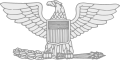 |  |  |  |  |  | ||
| General of the Army | General | Lieutenant General | Major General | Brigadier General | Colonel | Lieutenant Colonel | Major | Captain | First Lieutenant | Second Lieutenant |
| GA | GEN | LTG | MG | BG | COL | LTC | MAJ | CPT | 1LT | 2LT |
| 2nd Grade | 1st Grade | |
|---|---|---|
| Chief Warrant Officer | Warrant Officer | Flight Officer |
| W2 | W1 | FO |
| 1st Grade | 2nd Grade | 3rd Grade | 4th Grade | 5th Grade | 6th Grade | 7th Grade | ||||
|---|---|---|---|---|---|---|---|---|---|---|
 |  |  |  |  |  |  | No Insignia | |||
| Master Sergeant | First Sergeant | Technical Sergeant | Staff Sergeant | Technician Third Grade | Sergeant | Technician Fourth Grade | Corporal | Technician Fifth Grade | Private First Class | Private |
| M/Sgt. | 1st Sgt. | T/Sgt. | S/Sgt. | T/3. | Sgt. | T/4. | Cpl. | T/5. | Pfc. | Pvt. |
Lineage of the United States Air Force
The United States Air Force began as the Aeronautical Division, Signal Corps on 1 August 1907. It changed names several times. These included the Aviation Section, Signal Corps, the Division of Military Aeronautics, the Air Service, United States Army, and the United States Army Air Corps.
The United States Army Air Forces started on 20 June 1941 and ended on 18 September 1947. After that, it became the United States Air Force, which has served since 18 September 1947.
Images
This article is a child-friendly adaptation of the Wikipedia article on United States Army Air Forces, available under CC BY-SA 4.0.
Images from Wikimedia Commons. Tap any image to view credits and license.