 Safekipedia
Antarctica
Adapted from Wikipedia · Discoverer experience
Antarctica is Earth's southernmost and least-populated continent. It sits almost entirely south of the Antarctic Circle and is surrounded by the Southern Ocean. Antarctica is the fifth-largest continent, about 40% larger than Europe, covering an area of 14,200,000 km2. Most of the continent is covered by a thick ice sheet, with an average thickness of about 1.9 km.
Antarctica is one of the coldest, driest, and windiest places on Earth. It holds the record for the lowest temperature ever measured on our planet, at −89.2 °C. Even so, coastal areas can get quite warm in the summer, sometimes reaching over 10 °C. The continent is home to many unique animals such as penguins, seals, and tiny creatures like mites and tardigrades. Plants are rare, with most vegetation consisting only of lichen or moss.
People have known about Antarctica's ice shelves since 1820, when a Russian expedition led by Fabian Gottlieb von Bellingshausen and Mikhail Lazarev first spotted them. Over the years, many explorers from different countries have journeyed there. Today, about 30 countries work together under the Antarctic Treaty System, which stops military activity, mining, and nuclear tests on the continent. Most people visit Antarctica for tourism, fishing, or scientific research. During the summer, around 5,000 people live at research stations, but this number drops to about 1,000 in the winter. Human actions, such as pollution and climate change, are affecting this distant and delicate region.
Etymology
The name "Antarctica" comes from the word antarctic, which means "opposite to the Arctic." This word has roots in many languages, including Middle French, Latin, and Greek. Ancient writers like the Greek philosopher Aristotle wrote about an "Antarctic region" long ago.
People in Europe once believed in a large southern land called Terra Australis to balance the lands in the north. This idea lasted until Europeans discovered Australia. The name "Antarctica" was finally used in the 1890s. The continent is sometimes called the Great White South, a name inspired by the Great White North of Canada.
Geography
Main article: Geography of Antarctica
See also: Extreme points of Antarctica, List of mountains in Antarctica, List of ultras of Antarctica, and List of places in Antarctica
Antarctica is the southernmost continent on Earth, positioned around the South Pole and surrounded by the Southern Ocean. It is the fifth-largest continent, covering more than 14.2 million km2 (5,500,000 sq mi), almost double the size of Australia. Much of Antarctica is covered by a thick ice sheet, with only a few rocky areas visible.
The continent is divided into West Antarctica and East Antarctica by a mountain range called the Transantarctic Mountains. Antarctica has many lakes hidden beneath its ice, including Lake Vostok, one of the largest subglacial lakes in the world. The highest peak in Antarctica is Vinson Massif, standing at 4,892 meters (16,050 feet). Mount Erebus on Ross Island is an active volcano and the southernmost volcano in the world.
Geologic history
Main article: Geology of Antarctica
Further information: Geology of the Antarctic Peninsula
Antarctica was once part of the ancient supercontinent Gondwana, which began breaking apart about 183 million years ago. For much of its early history, Antarctica had a warm climate and was covered with forests.
During the Paleozoic era, Antarctica had a mild climate with sandstones, limestones, and shales forming. By the late Paleozoic, it began to cool and glaciate as it moved closer to the South Pole. Forests of plants like glossopterids grew there until the end of the Permian period.
In the Mesozoic era, Antarctica was warm again with many different plants and the first tetrapods, or four-legged animals, appeared. Dinosaurs lived in Antarctica during the Jurassic and Cretaceous periods.
As Antarctica drifted further south, the climate cooled dramatically. By around 30 million years ago, the Antarctic Circumpolar Current formed, leading to the growth of ice sheets that eventually covered most of the continent. Today, scientists study Antarctica's hidden geology using remote sensing and radar to learn about its past and its rocks and mountains.
Climate
Main article: Climate of Antarctica
Antarctica is the coldest, windiest, and driest continent on Earth. Along the coast, temperatures can be above 10 °C in summer but drop below −40 °C in winter. Far inland, temperatures can rise to about −30 °C in summer but fall well below −80 °C in winter.
The continent is a polar desert, receiving very little snowfall—about 150 mm (6 in) of water each year. Some areas are even drier, getting less than 50 mm (2 in) yearly. Strong winds are common across Antarctica.
Climate change
Antarctica's ice has been changing, losing about 100 billion metric tons each year since 2002. In 2023, the area of Antarctic sea ice was much smaller than usual, reaching a new low. During the Antarctic summer that year, the sea ice covered only about 60% of what it used to cover on average from 1981 to 2010.
Ozone depletion
Main article: Ozone hole
Scientists have studied the ozone layer above Antarctica since the 1970s. In 1985, they found a large area with less ozone, called the 'ozone hole.' This happens because certain chemicals break down the ozone. Very cold temperatures in Antarctica help create special clouds that speed up these reactions. An international agreement from 1987 has helped reduce these harmful chemicals. The ozone hole is expected to slowly heal and return to earlier levels by the 2060s.
The changes in the ozone can affect the weather above Antarctica. They can cool the air high up, which helps keep very cold air near the South Pole. This can also influence how much sea ice forms around Antarctica.
Biodiversity
See also: Antarctic realm, Antarctic microorganism, and Wildlife of Antarctica
Most species in Antarctica are descendants of species that lived there millions of years ago. They survived many extremely cold periods by living in isolated warmer areas, such as those with geothermal heat or areas that stayed ice-free.
Antarctica is home to many different animals, including microscopic mites, lice, fleas, nematodes, tardigrades, rotifers, krill, and springtails. The largest land animal is the flightless midge Belgica antarctica, which grows up to 6 mm long. Antarctic krill is a key part of the Southern Ocean's ecosystem, providing food for whales, seals, leopard seals, fur seals, squid, icefish, and many bird species like penguins and albatrosses. Marine life includes penguins, blue whales, orcas, colossal squids, and fur seals. There are about 40 bird species that breed near Antarctica, including petrels, penguins, cormorants, and gulls. The emperor penguin is the only penguin that breeds during the winter in Antarctica.
About 1,150 species of fungi have been found in Antarctica, with many living in rock cavities and helping shape the landscape. These fungi can survive in extreme cold and resist harmful radiation. Antarctica's plants are limited due to the harsh climate, with most being bryophytes like liverworts and mosses. There are only three species of flowering plants, all found on the Antarctic Peninsula. Algae are common, especially in coastal areas and sea ice, and bacteria have been found deep under the ice, suggesting the possibility of life in similar environments elsewhere in space.
History of exploration
Main articles: History of Antarctica, Colonization of Antarctica, and Farthest south
See also: List of Antarctic expeditions, Women in Antarctica, and List of polar explorers
People have imagined a southern land for a long time. Early maps showed a place called Terra Australis, which was thought to balance the lands in the north.
In the late 1700s, Captain James Cook came close to Antarctica but could not land because of the ice. In the early 1800s, several explorers began to sight the icy lands. By the mid-1800s, people had started landing on parts of Antarctica.
In the 1900s, many famous explorers visited Antarctica. Roald Amundsen reached the South Pole in 1911. Since then, many others have explored the continent, making important discoveries and helping us learn more about this icy world.
Demographics
Main article: Demographics of Antarctica
See also: Religion in Antarctica
Antarctica has very few permanent residents. Most people living there are scientists and support staff working at research stations. The number of people there changes with the seasons, with around 1,200 people in the winter and about 4,800 in the summer. There are two special bases where only civilians live.
The first baby born in Antarctica was a Norwegian girl named Solveig Gunbjørg Jacobsen, born in 1913. Another important milestone was the birth of Emilio Marcos Palma in 1978, who was the first person born on the Antarctic mainland.
Politics
Antarctica's status is regulated by the 1959 Antarctic Treaty and other related agreements, called the Antarctic Treaty System. Antarctica is defined as all land and ice shelves south of 60° S for the purposes of the Treaty System. The treaty was signed by twelve countries, including the Soviet Union, the United Kingdom, Argentina, Chile, Australia, and the United States. Since 1959, a further 42 countries have acceded to the treaty. Decisions are based on consensus, instead of a vote. The treaty set aside Antarctica as a scientific preserve and established freedom of scientific investigation and environmental protection.
In the present, sovereignty over regions of Antarctica is claimed by seven different countries. While a few of these countries have mutually recognised each other's claims, the validity of the claims is not recognised universally. New claims on Antarctica have been suspended since 1959. The Argentine, British, and Chilean claims overlap and have caused friction. The claims by Britain, Australia, New Zealand, France, and Norway do not overlap and are recognised by each other. Other member nations of the Antarctic Treaty do not recognise any claim, yet have shown some form of territorial interest in the past.
| Date | Claimant | Territory | Claim limits | Map |
|---|---|---|---|---|
| 1840 |  France France |  Adélie Land Adélie Land | Originally undefined; later specified to be 142°2′E to 136°11′E |  |
| 1908 |  United Kingdom United Kingdom |  British Antarctic Territory British Antarctic Territory | 80°0′W to 20°0′W 80°0′W to 74°0′W claimed by Chile (1940) 74°0′W to 53°0′W claimed by Chile (1940) and Argentina (1943) 53°0′W to 25°0′W claimed by Argentina (1943) |  |
| 1923 |  New Zealand New Zealand | Ross Dependency | 160°0′E to 150°0′W |  |
| 1931 |  Norway Norway | Peter I Island |  | |
| 1933 |  Australia Australia | Australian Antarctic Territory | 44°38′E to 136°11′E, and 142°2′E to 160°00′E | 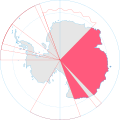 |
| 1939 | Norway | Queen Maud Land | 20°00′W to 44°38′E | 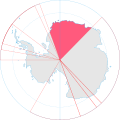 |
| 1940 |  Chile Chile |  Chilean Antarctic Territory Chilean Antarctic Territory | 90°0′W to 53°0′W 80°00′W to 74°00′W claimed by the United Kingdom (1908) 74°00′W to 53°00′W claimed by the United Kingdom (1908) and Argentina (1943) | 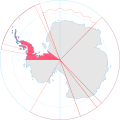 |
| 1943 |  Argentina Argentina |  Argentine Antarctica Argentine Antarctica | 74°0′W to 25°0′W 74°0′W to 53°0′W claimed by the United Kingdom (1908) and Chile (1940) 53°0′W to 25°0′W claimed by the United Kingdom (1908) |  |
| – | (Unclaimed territory) |  Marie Byrd Land Marie Byrd Land | 150°0′W to 90°0′W (except Peter I Island) |  |
Economy and tourism
Main article: Tourism in Antarctica
See also: Telecommunications in Antarctica, Transport in Antarctica, and Crime in Antarctica
Antarctica has deposits of coal, hydrocarbons, iron ore, platinum, copper, chromium, nickel, gold, and other minerals, but they are not found in large enough amounts to mine. The Protocol on Environmental Protection to the Antarctic Treaty, which began in 1998, limits the use of Antarctic resources.
Tourists have visited Antarctica since 1957. They come to see wildlife, especially Adélie, King, and Gentoo penguins. Over 74,000 tourists visited in the 2019–2020 season, many on cruise ships. The number of visitors dropped quickly after the start of the COVID-19 pandemic. Some groups worry that too many visitors could harm the environment and suggest limits on tourism.
Research
Main article: Research stations in Antarctica
In 2017, more than 4,400 scientists worked in Antarctica, but this number dropped to just over 1,100 during the winter. There are over 70 research stations there, with the largest being the United States' McMurdo Station, which can house more than 1,000 people. Countries like Argentina, Australia, Chile, and Russia also have many scientists working in Antarctica.
Researchers study many topics, including how glaciers and ice move, how animals survive in cold places, and how space looks from Antarctica. The IceCube Neutrino Observatory at the Amundsen–Scott South Pole Station is the world's largest neutrino detector, helping scientists learn about space particles. Antarctica's dry, icy landscape is also great for finding meteorites, which give clues about the early Solar System.
Culture
The first motion-picture footage of Antarctica was made in 1904 by an unknown member of the Scottish National Antarctic Expedition. Some famous Antarctic documentaries include South (1919), the Oscar-winning With Byrd at the South Pole (1930), 90° South: With Scott to the Antarctic (1933), the Oscar-winning The Secret Land (1948), and the IMAX Endurance: Shackleton's Legendary Antarctic Adventure (2000).
Among the fiction films shot partly or entirely in Antarctica are Mr. Forbush and the Penguins, a 1971 British comedy, and Antarctica, a 1983 Japanese survival story. The Antarctic Film Festival is held annually among the 48 bases of the continent and features short films of 5 minutes or less.
The southernmost music festival in the world, Icestock, has been held at McMurdo Station since 1989. In 2011, Australian classical harpist Alice Giles became the first professional musician to perform in Antarctica.
Sporting events on Antarctica include the Antarctic Ice Marathon & 100k ultra race, Antarctica Marathon and Antarctica Cup Yacht Race. Association football has been played since the early twentieth century.
There are two principal holidays celebrated across Antarctica: Midwinter Day on the day of the southern winter solstice (June 20 or 21) and Antarctica Day on December 1, which commemorates the signing of the Antarctic Treaty in 1959.
Images
This article is a child-friendly adaptation of the Wikipedia article on Antarctica, available under CC BY-SA 4.0.
Images from Wikimedia Commons. Tap any image to view credits and license.