 Safekipedia
Marine microorganisms
Adapted from Wikipedia · Discoverer experience
Marine microorganisms are tiny living things that live in the saltwater of seas and oceans, or in the mix of fresh and salt water found in coastal areas called estuaries. These tiny creatures are so small that you need a microscope to see them. They include many different types of life, such as bacteria, tiny plants called algae, and even some very small animals.
Even though they are small, marine microorganisms are extremely important. They make up a huge part of the living material in the ocean and play a big role in keeping our planet healthy. They help recycle nutrients, produce oxygen, and control carbon levels all around the world. Without them, life in the ocean—and on land—would be very different.
Scientists are still learning about these tiny ocean inhabitants. In 2016, they discovered a set of genes that are shared by all life on Earth, including marine microorganisms. Even today, much about their roles and behaviors remains a mystery, showing just how much we have yet to discover about the microscopic world under the waves.
Overview
Marine microorganisms are tiny living things that live in the salt water of oceans and seas. They are so small that you need a microscope to see them. These tiny creatures include bacteria, tiny plants called algae, and other simple life forms. They play a big role in keeping our planet's ecosystems healthy by helping to recycle nutrients and produce food for other sea creatures.
Microbial mats, which are layers of tiny life forms, are some of the earliest known forms of life on Earth. These mats can create structures called stromatolites as they move upward to avoid being covered by sand. Even though we have learned a lot about these tiny sea creatures, there is still much we do not know about them. They are found almost everywhere, from the surface of the ocean to the deepest parts, like the Mariana Trench, and they help control important processes in the world's oceans.
Marine viruses
Main article: Marine viruses
A virus is a tiny living thing that can only grow by entering the cells of other organisms. Viruses can infect animals, plants, and even tiny organisms like bacteria. When they are not inside a cell, viruses look like small particles made of genetic material, a protective coat, and sometimes a layer of fats.
Viruses are found everywhere there is life, and they play an important role in nature. They help move genes between different species, which keeps life diverse and changing. Some very large viruses, called giant viruses, were discovered in the deep ocean and can be much bigger than typical viruses. Scientists are still learning about where these giant viruses come from and how they evolved.
Prokaryotes
Main article: Marine prokaryotes
Bacteria and archaea are tiny living things called prokaryotes that live in the ocean. Bacteria come in many shapes, like spheres, rods, and spirals, and they are among the oldest life forms on Earth. They can survive almost anywhere, including very hot or very cold places. Unlike animal cells, bacterial cells do not have a nucleus or other parts enclosed in membranes.
Archaea are another group of tiny ocean organisms. They look similar to bacteria but have some different traits. Some archaea can live in very salty water or very hot places. Both bacteria and archaea play important roles in the ocean, helping to keep the environment balanced.
Eukaryotes
All living organisms are grouped as either prokaryotes or eukaryotes. Life began as single-celled prokaryotes and later evolved into more complex eukaryotes. Unlike prokaryotic cells, eukaryotic cells are highly organized. Prokaryotes include bacteria and archaea, while eukaryotes include protists, plants, fungi, and animals. Protists are usually single-celled, while plants, fungi, and animals are usually multi-celled.
Marine protists are eukaryotes that cannot be classified as plants, fungi, or animals. They are typically single-celled and microscopic. Protists can have different ways of getting food, similar to plants, animals, or fungi, or a mix of these. They are found in many places, such as oceans and river sediments, and scientists think there are many more types waiting to be discovered. Some protists, like diatoms, produce a lot of the world's oxygen. Others, like seaweed, are larger and can grow very big.
Marine fungi are also important. Over 1,500 species of fungi live in the ocean. They can live on algae, animals, or dead matter, and they help break down materials and cycle nutrients. Mycoplankton, a type of marine fungi, plays a big role in keeping the ocean's food web healthy.
Marine microanimals include very small creatures like copepods, which are tiny crustaceans, and tardigrades, also known as water bears. These tiny animals are important for the ocean's balance and help support larger life in the sea.
Protists according to how they get food | |||||||
|---|---|---|---|---|---|---|---|
| Type of protist | Description | Example | Some other examples | ||||
| Plant-like | Algae (see below) | Autotrophic protists that make their own food without needing to consume other organisms, usually by using photosynthesis | Green algae, Pyramimonas | Red and brown algae, diatoms and some dinoflagellates. Plant-like protists are important components of phytoplankton discussed below. | |||
| Animal-like | Heterotrophic protists that get their food consuming other organisms (bacteria, archaea and small algae) | Radiolarian protist as drawn by Haeckel | Foraminiferans, and some marine amoebae, ciliates and flagellates. | ||||
| Fungal-like | Saprotrophic protists that get their food from the remains of organisms that have broken down and decayed | Marine slime nets form labyrinthine networks of tubes in which amoeba without pseudopods can travel | Marine lichen | ||||
| Mixotrops | Various | Mixotrophic and osmotrophic protists that get their food from a combination of the above | Euglena mutabilis, a photosynthetic flagellate | Many marine mixotrops are found among protists, particularly among ciliates and dinoflagellates | |||
Protists according to how they move | ||||||||
|---|---|---|---|---|---|---|---|---|
| Type of protist | Movement mechanism | Description | Example | Other examples | ||||
| Motile | Flagellates | A flagellum (Latin for whip) is a lash-like appendage that protrudes from the cell body of some protists (as well as some bacteria). Flagellates use from one to several flagella for locomotion and sometimes as feeding and sensory organelle. | Cryptophytes | All dinoflagellates and nanoflagellates (choanoflagellates, silicoflagellates, most green algae) (Other protists go through a phase as gametes when they have temporary flagellum – some radiolarians, foraminiferans and Apicomplexa) | ||||
| Ciliates | A cilium (Latin for eyelash) is a tiny flagellum. Ciliates use multiple cilia, which can number in many hundreds, to power themselves through the water. | Paramecium bursaria click to see cilia | Foraminiferans, and some marine amoebae, ciliates and flagellates. | |||||
| Amoebas (amoeboids) | Amoeba have the ability to alter shape by extending and retracting pseudopods (Greek for false feet). | Amoeba | Found in every major protist lineage. Amoeboid cells occur among the protozoans, but also in the algae and the fungi. | |||||
| Not motile | none | 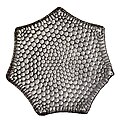 | Diatom | Diatoms, coccolithophores, and non‐motile species of Phaeocystis Among protozoans the parasitic Apicomplexa are non‐motile. | ||||
Primary producers
Main article: Marine primary production
See also: Evolution of photosynthesis
Primary producers are organisms that can make their own food instead of eating other organisms. They are the starting point in the food chain for other organisms that need to eat to get energy. Some marine primary producers are special bacteria and other tiny life forms that make food by gathering around hot spots in the ocean and using chemical processes. But most marine primary producers use sunlight to make food from carbon dioxide in the water. This process gives us oxygen and helps create food for many sea creatures.
The main marine primary producers are tiny blue-green bacteria called cyanobacteria, different kinds of algae, and marine plants. These organisms release oxygen into the air, which almost all living things need to stay alive. They also help keep the planet healthy by recycling water and carbon. Some of these tiny plants float in the ocean and form the base of the food chain, providing energy for many animals.
Marine microplankton
Plankton are tiny living things that float in the water of oceans and lakes. They can't swim against the current, so they move with the water. Plankton are very important because they are food for many bigger animals, like fish and whales.
Phytoplankton are a type of plankton that make their own food using sunlight. They are very important because they create much of the oxygen we breathe and help control carbon dioxide in the air. Phytoplankton can sometimes grow very fast and create big groups called blooms. They come in many shapes and sizes, including tiny plants and some types of bacteria. One common type is diatoms, which have glass-like shells and help make up a lot of the oxygen on Earth. Another type is coccolithophores, which have tiny plates made of chalk that help with the carbon cycle in the ocean.
Mixotrophic plankton that combine phototrophy and heterotrophy – table based on Stoecker et al., 2017 | |||||||
|---|---|---|---|---|---|---|---|
| General types | Description | Example | Further examples | ||||
| Bacterioplankton | Photoheterotrophic bacterioplankton | Vibrio cholerae | Roseobacter spp. Erythrobacter spp. Gammaproteobacterial clade OM60 Widespread among bacteria and archaea | ||||
| Phytoplankton | Called constitutive mixotrophs by Mitra et al., 2016. Phytoplankton that eat: photosynthetic protists with inherited plastids and the capacity to ingest prey. | Ochromonas species | Ochromonas spp. Prymnesium parvum Dinoflagellate examples: Fragilidium subglobosum,Heterocapsa triquetra,Karlodinium veneficum,Neoceratium furca,Prorocentrum minimum | ||||
| Zooplankton | Called nonconstitutive mixotrophs by Mitra et al., 2016. Zooplankton that are photosynthetic: microzooplankton or metazoan zooplankton that acquire phototrophy through chloroplast retentiona or maintenance of algal endosymbionts. | ||||||
| Generalists | Protists that retain chloroplasts and rarely other organelles from many algal taxa | Most oligotrich ciliates that retain plastidsa | |||||
| Specialists | 1. Protists that retain chloroplasts and sometimes other organelles from one algal species or very closely related algal species | Dinophysis acuminata | Dinophysis spp. Myrionecta rubra | ||||
| 2. Protists or zooplankton with algal endosymbionts of only one algal species or very closely related algal species | Noctiluca scintillans | Metazooplankton with algal endosymbionts Most mixotrophic Rhizaria (Acantharea, Polycystinea, and Foraminifera) Green Noctiluca scintillans | |||||
| aChloroplast (or plastid) retention = sequestration = enslavement. Some plastid-retaining species also retain other organelles and prey cytoplasm. | |||||||
Marine sediments and microfossils
Further information: Marine sediments, microfossils, and protist shells
The bottom of the ocean is covered with sediments that come from two main places: land and tiny ocean creatures. Land-based sediments, called terrigenous sediments, make up about 45% of ocean sediments. They come from rocks on land that are worn down by water, wind, or ice and then carried into the ocean.
The other 55% of ocean sediments come from the remains of tiny ocean creatures, called biogenous sediments. These include the shells of single-celled organisms like diatoms and foraminifers. When these tiny creatures die, their shells pile up on the ocean floor. Some of these special mixtures are called "ooze" because they come from these tiny creatures, not because they are slimy.
Main types of biogenic ooze | ||||||||
|---|---|---|---|---|---|---|---|---|
| type | mineral forms | protist involved | name of skeleton | typical size (mm) | ||||
| Siliceous ooze | SiO2 silica quartz glass opal chert | diatom | 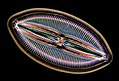 | frustule | 0.002 to 0.2 | diatom microfossil from 40 million years ago | ||
| radiolarian |  | test or shell | 0.1 to 0.2 | elaborate silica shell of a radiolarian | ||||
| Calcareous ooze | CaCO3 calcite aragonite limestone marble chalk | foraminiferan | 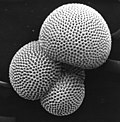 | test or shell | Calcified test of a planktic foraminiferan. There are about 10,000 living species of foraminiferans | |||
| coccolithophore | 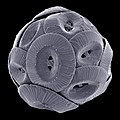 | coccoliths | Coccolithophores are the largest global source of biogenic calcium carbonate, and significantly contribute to the global carbon cycle. They are the main constituent of chalk deposits such as the white cliffs of Dover. | |||||
Marine microbenthos
See also: Seabed § Sediments, bioturbation, and bioirrigation
Marine microbenthos are tiny living things that live near or on the seafloor, or inside or on the surface layers of seafloor dirt. The word benthos comes from an old word meaning "depth of the sea". You can find microbenthos everywhere on the seafloor, from shallow areas to deep waters, and they are especially many where the seafloor dirt is rich.
In shallow waters, places like seagrass meadows, coral reefs, and kelp forests give microbenthos good homes to live. In areas where sunlight reaches, a type of microbenthos called benthic diatoms are common because they can make their own food using sunlight. In places where the ocean meets the land and the water level changes with the tides, called intertidal zones, the tides control when and where microbenthos can live.
Some of these tiny creatures, like Elphidium and Heterohelix, have shells that scientists study to learn about Earth’s past climate. By looking at the chemistry of these shells, researchers can figure out what the ocean was like long ago. Even after these tiny creatures die, their shells fall to the seafloor and tell us stories about the past.
Marine microbiomes
Main article: Marine microbiomes
Further information: marine microbial symbiosis and holobiont
Marine microbiomes are tiny living things that live in the ocean. They can work together with bigger animals in a special way called symbiosis. This means they help each other live better.
One example is corals, which are animals that build reefs. Corals have tiny plants called zooxanthellae living inside them, along with helpful bacteria and viruses. Together, they form a group called a holobiont, which works as one team to stay healthy and strong. Other animals like sponges and seagrass also have their own teams of tiny helpers.
Marine food web
Further information: marine food web
Marine microorganisms are very important in the ocean's food web. They help keep the balance by recycling materials so that many different tiny plants and animals can survive. One way they do this is through a process called the viral shunt, which breaks down big pieces of organic material into smaller pieces that microorganisms can use.
One special type of bacteria, Pelagibacter ubique, is the most common bacteria in the ocean. It plays a big role in the Earth's carbon cycle by helping move carbon through the ocean.
Niche communities
Black smoker in the High Rise portion of the Endeavour Hydrothermal Vents.
Bacteria can be very helpful. The Pompeii worm, an extremophile, lives only at hydrothermal vents and has a protective cover of symbiotic bacteria.
Sea ice microbial communities are groups of tiny living things that live within and around sea ice at the poles. They survive in a changing environment with differences in salt, light, temperature, and food. Many of these microbes are found in the lower parts of the ice.
Hydrothermal vents are places where the Earth's plates move apart, allowing ocean water to heat up deep underground. This hot water comes back out, carrying minerals and chemicals. These areas support special microscopic life, including tiny organisms that live in mats, float freely, or have close relationships with animals. Since there is no sunlight, these communities rely on chemical processes for energy.
Viruses are also found around hydrothermal vents and play an important role in these ecosystems. They are very common in the ocean and carry lots of genetic information. In these extreme places, viruses may help microbes survive by sharing genes.
Deep biosphere and dark matter
See also: deep biosphere, rare biosphere, microbial dark matter, SLiME, and marine cryptic interactions
The deep biosphere is the part of the world of living things that lies deep below the surface. It goes down at least 5 kilometers under land and 10.5 kilometers under the ocean, where it can be very hot—over 100 °C!
Unlike surface life, deep-life doesn’t eat plants or use oxygen. Instead, it uses simple chemicals from rocks, like hydrogen and methane, and “breathes” other chemicals such as nitrates. Because there is so little energy deep down, these tiny creatures live very slowly—sometimes taking thousands of years to grow and change.
Scientists discovered in 2018 that up to 70% of all tiny life on Earth, weighing 23 billion tonnes of carbon, lives deep underground. In 2019, they even found life 7,900 feet below the surface that eats rocks and breathes sulfur! In 2020, researchers found tiny life that had been almost frozen in time for over 101 million years, deep below the ocean floor in one of the emptiest places in the sea.
Many of these deep-life creatures cannot be grown in labs, so scientists call them microbial dark matter. Even though we know they exist, we still don’t fully understand them. Researchers are working hard to learn more by studying their DNA from samples taken from the environment.
Microbial diversity
Bacteria are one of the oldest and most diverse groups of tiny living things in the sea, along with Archaea and Fungi. Scientists used to think there were about 3 million kinds of living things on Earth, but newer studies suggest there could be as many as 1 trillion kinds of tiny organisms, including those in the ocean.
We are still learning about how many different types of these tiny sea creatures exist, and much of this diversity remains unknown.
Sampling techniques
Scientists use special tools to collect tiny sea creatures and other tiny living things from the ocean. One common tool is called a plankton net, which helps catch small organisms floating in the water. Another tool is the video plankton recorder, which uses cameras to record these tiny creatures without catching them. These tools help scientists learn more about the microscopic life in our oceans.
Main articles: niskin bottle, plankton net, video plankton recorder, and continuous plankton recorder
Identifying microorganisms
Scientists can study lots of tiny sea creatures, called plankton, quickly using special cameras and tools that read their DNA, called sequencing techniques. In the past, people tried to group these tiny creatures by looking at their shapes, but that was hard because many don’t have obvious shapes like animals or plants do. Now, scientists look at the DNA of these creatures to learn more about them.
New tools help scientists study the DNA of tiny sea creatures directly from the water, without needing to grow them in a lab. This has helped us learn a lot more about how many different kinds of tiny creatures live in the ocean and how they help keep the ocean healthy.
Methods of identifying microorganisms | |||
|---|---|---|---|
| Chromogenic media  | Microscopy techniques  | Biochemical techniques  | Molecular techniques  |
Traditional media | Bright field Dark field SEM TEM CLSM ATM Inverted microscopy | Spectrometry – FTIR – Raman spectrometry Mass spectrometry – GC – LC – MALDI-TOF – ESI Electrokinetic separation Microfluidic chip Propriety methods – Wickerham card – API – BBL Crystal – Vitek – Biolog | PCR Real-time qPCR Rapid PCR PCR sequencing RFLP PFGE Ribotyping WGS MALDI-TOF MS |
Using omics data
Further information: Omics, environmental DNA, metabarcoding, metagenomics, and metatranscriptomics
Omics is a fun way to talk about different areas of biology that all end with the suffix "-omics" — like genomics and proteomics. These areas help scientists study many tiny parts of living things all at once. For example, functional genomics looks at what lots of genes do in an organism.
Scientists use many different omics methods together to understand how tiny sea creatures and their friends work. This helps them learn about the microbiome — all the tiny living things that live together. Methods like metagenomics, metatranscriptomics, metaproteomics, and metabolomics all give clues about what these tiny creatures are up to.
Anthropogenic impacts
Marine microorganisms play an important role in balancing the amount of carbon in our atmosphere. They help take carbon from the air and store it, and they also release carbon back into the air. This process is part of the carbon cycle.
When humans burn fossil fuels, we put carbon back into the air much faster than natural processes can remove it. This upsets the balance and causes more carbon to stay in the atmosphere. Scientists have warned that understanding these tiny life forms is very important for protecting our planet and dealing with climate change.
History
Marine microorganisms known as cyanobacteria first appeared in the oceans about 2 billion years ago during the Precambrian era. Their ability to create oxygen through a process called photosynthesis changed the chemical makeup of Earth's environment, which helped shape the development of plants, animals, and many other living things. These tiny ocean creatures were first seen in the year 1675 by a Dutch scientist named Antonie van Leeuwenhoek, who used a simple microscope to observe them.
Images
Related articles


This article is a child-friendly adaptation of the Wikipedia article on Marine microorganisms, available under CC BY-SA 4.0.
Images from Wikimedia Commons. Tap any image to view credits and license.