 Safekipedia
In geometry, a skew polygon is a special kind of shape made up of straight lines connected end-to-end, forming a closed loop. Unlike regular polygons, which all lie flat on a single plane, a skew polygon has vertices that are not all on the same flat surface. Instead, its points and connecting lines create a curved path through space. This makes a skew polygon a three-dimensional shape, even though it is made of straight lines.
A skew polygon must have at least four points, called vertices, and the lines connecting these points are known as edges. Because the vertices are not all on one plane, the shape does not have a single, clear interior space or area like a flat polygon does. This unique property makes skew polygons interesting to mathematicians and helps them study more complex shapes in three dimensions.
There are special types of skew polygons, such as the zig-zag skew polygon or antiprismatic polygon, where the vertices switch back and forth between two parallel flat surfaces. These shapes must always have an even number of sides. In three dimensions, certain regular skew polygons always follow this zig-zag pattern, making them both symmetrical and three-dimensional.
Skew polygons in three dimensions
A regular skew polygon is a special kind of shape that lives in three dimensions. Unlike regular flat polygons, its points switch between two parallel flat surfaces. You can think of it like a polygon that has been lifted up and down between two layers.
These shapes can be described using something called a Schläfli symbol, which mixes a regular polygon with a straight line. They appear in shapes like uniform square and pentagon antiprisms, and even in the five Platonic solids, which have skew polygons with 4, 6, and 10 sides.
| Skew square | Skew hexagon | Skew octagon | Skew decagon | Skew dodecagon | ||
| {4}#{ } | {6}#{ } | {8}#{ } | {10}#{ } | {5}#{ } | {5/2}#{ } | {12}#{ } |
| s{2,4} | s{2,6} | s{2,8} | s{2,10} | sr{2,5/2} | s{2,10/3} | s{2,12} |
Regular skew polygon as vertex figure of regular skew polyhedron
A regular skew polyhedron has regular polygon faces, and a regular skew polygon is used as its vertex figure.
There are three infinite regular skew polyhedra that fill all of 3-dimensional space, and other regular skew polyhedra exist in 4-dimensional space, sometimes as part of uniform 4-polytopes.
| {4,6|4} | {6,4|4} | {6,6|3} |
|---|---|---|
Regular skew hexagon {3}#{ } | Regular skew square {2}#{ } | Regular skew hexagon {3}#{ } |
Regular skew polygons in four dimensions
In 4 dimensions, a regular skew polygon can have its vertices on a Clifford torus and be moved using a Clifford displacement. These special polygons can have an odd number of sides, unlike some other types.
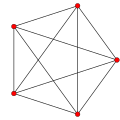
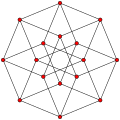
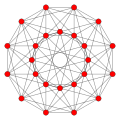
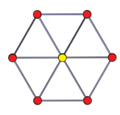
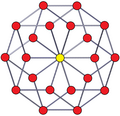
The Petrie polygons of regular 4-polytopes are examples of regular zig-zag skew polygons. The number of sides in these polygons is given by the Coxeter number for each coxeter group symmetry. For example, they have 5 sides for a 5-cell, 8 sides for a tesseract and 16-cell, 12 sides for a 24-cell, and 30 sides for a 120-cell and 600-cell. When shown in a certain way, these polygons look like regular shapes in a flat space.
The n-n duoprisms and dual duopyramids also have special Petrie polygons with many sides. (The tesseract is a 4-4 duoprism, and the 16-cell is a 4-4 duopyramid.)






Images
This article is a child-friendly adaptation of the Wikipedia article on Skew polygon, available under CC BY-SA 4.0.
Images from Wikimedia Commons. Tap any image to view credits and license.