 Safekipedia
Solid geometry, also known as stereometry, is the study of three-dimensional space and the shapes that exist within it. It focuses on figures that have length, width, and height, unlike flat shapes which only have length and width. These three-dimensional shapes are called solid figures, and they include everyday objects like balls, boxes, and cans.
In solid geometry, we learn how to measure the space inside these shapes, which is called volume. We also study their surfaces and other properties. Some of the most common solid figures include pyramids, prisms, cubes, cylinders, and cones. By understanding solid geometry, we can solve many real-world problems, such as figuring out how much material is needed to make a container or how much space something will take up.
This branch of geometry helps us visualize and describe the three-dimensional world around us. From building structures to designing everyday products, solid geometry plays an important role in many fields, including architecture, engineering, and art.
History
The ancient Pythagoreans studied special 3D shapes called regular solids. Later, thinkers called the Platonists began studying pyramids, prisms, cones, and cylinders. A man named Eudoxus discovered that a pyramid or cone has one-third the volume of a prism or cylinder with the same base and height. He also found that the space inside a sphere grows in proportion to the cube of its radius.
Topics
Solid geometry, also known as stereometry, studies shapes in three-dimensional space. Basic topics include understanding how planes and lines meet, angles between flat surfaces, and different 3D shapes like cubes, pyramids, prisms, and spheres.
Advanced topics explore projective geometry in three dimensions, more complex polyhedra, and descriptive geometry.
List of solid figures
For a more complete list and organization, see List of mathematical shapes.
A sphere is the surface of a ball. When talking about other solid figures like a cylinder, it can sometimes be unclear if we mean just the outer surface or the space inside that surface, too. Solid geometry studies these three-dimensional shapes and how to measure their sizes.
| Figure | Definitions | Images | |
|---|---|---|---|
| Parallelepiped | A polyhedron with six faces (hexahedron), each of which is a parallelogram A hexahedron with three pairs of parallel faces A prism of which the base is a parallelogram |  | |
| Rhombohedron | A parallelepiped where all edges are the same length |  | |
| Cuboid | A convex polyhedron bounded by six quadrilateral faces, whose polyhedral graph is the same as that of a cube Some sources also require that each of the faces is a rectangle (so each pair of adjacent faces meets in a right angle). This more restrictive type of cuboid is also known as a rectangular cuboid, right cuboid, rectangular box, rectangular hexahedron, right rectangular prism, or rectangular parallelepiped. |  | |
| Polyhedron | Flat polygonal faces, straight edges and sharp corners or vertices |  Small stellated dodecahedron |  Toroidal polyhedron |
| Uniform polyhedron | Regular polygons as faces and is vertex-transitive (i.e., there is an isometry mapping any vertex onto any other) |   (Regular) Tetrahedron and Cube | 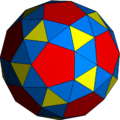 Uniform Snub dodecahedron |
| Pyramid | A polyhedron comprising an n-sided polygonal base and a vertex point | 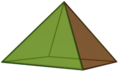 square pyramid square pyramid | |
| Prism | A polyhedron comprising an n-sided polygonal base, a second base which is a translated copy (rigidly moved without rotation) of the first, and n other faces (necessarily all parallelograms) joining corresponding sides of the two bases | 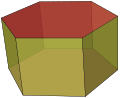 hexagonal prism hexagonal prism | |
| Antiprism | A polyhedron comprising an n-sided polygonal base, a second base translated and rotated.sides]] of the two bases |  square antiprism square antiprism | |
| Bipyramid | A polyhedron comprising an n-sided polygonal center with two apexes. | 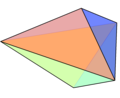 triangular bipyramid triangular bipyramid | |
| Trapezohedron | A polyhedron with 2n kite faces around an axis, with half offsets | tetragonal trapezohedron | |
| Cone | Tapers smoothly from a flat base (frequently, though not necessarily, circular) to a point called the apex or vertex | A right circular cone and an oblique circular cone | |
| Cylinder | Straight parallel sides and a circular or oval cross section |  A solid elliptic cylinder | A right and an oblique circular cylinder |
| Ellipsoid | A surface that may be obtained from a sphere by deforming it by means of directional scalings, or more generally, of an affine transformation | Examples of ellipsoids | x 2 a 2 + y 2 b 2 + z 2 c 2 = 1 : {\displaystyle {x^{2} \over a^{2}}+{y^{2} \over b^{2}}+{z^{2} \over c^{2}}=1:} sphere (top, a=b=c=4), spheroid (bottom left, a=b=5, c=3), tri-axial ellipsoid (bottom right, a=4.5, b=6, c=3)]] |
| Lemon | A lens (or less than half of a circular arc) rotated about an axis passing through the endpoints of the lens (or arc) |  | |
| Hyperboloid | A surface that is generated by rotating a hyperbola around one of its principal axes |  | |
Techniques
In solid geometry, different tools and methods help us study shapes in three dimensions. Two important ones are analytic geometry and vector techniques. These tools let us use linear equations and matrix algebra, which are useful for understanding more complex spaces.
Applications
Solid geometry has many important uses. One big example is in 3D computer graphics, where shapes and spaces are designed and shown on screens. This helps create video games, movies, and other digital images that look three-dimensional.
This article is a child-friendly adaptation of the Wikipedia article on Solid geometry, available under CC BY-SA 4.0.
Images from Wikimedia Commons. Tap any image to view credits and license.