 Safekipedia
White blood cell
Adapted from Wikipedia · Discoverer experience
White blood cells, also known as leukocytes or immune cells, are important parts of the body's immune system. They help protect the body from infectious disease and foreign substances. White blood cells are larger than red blood cells and have nuclei, which sets them apart from red blood cells and platelets.
There are several types of white blood cells. They include granulocytes, lymphocytes, and monocytes. Granulocytes are made up of neutrophils, eosinophils, and basophils. Agranulocytes include monocytes and lymphocytes, which have important roles like fighting infections. All white blood cells come from special multipotent cells in the bone marrow called hematopoietic stem cells.
The number of white blood cells in the blood can tell doctors about a person's health. A normal white blood cell count is usually between 4 billion/L and 11 billion/L. When this number goes up, it often means the body is fighting an infection or dealing with inflammation. White blood cells are much fewer in number than red blood cells, but they are vital for keeping the body safe and healthy.
Etymology
The name "white blood cell" comes from how blood looks after it has been spun in a machine. When blood is spun, white cells form a thin, white layer called the buffy coat, which sits between the red blood cells at the bottom and the liquid part of blood, called plasma, at the top. The scientific name for these cells is leukocyte, which comes from Greek words meaning "white" and "cell". Sometimes, this white layer can look green if there are many neutrophils, a type of white blood cell, because of a special material they produce.
Types
White blood cells, also called leukocytes, are larger than red blood cells and come in several types. They can be grouped by structure into granulocytes (which have granules) and agranulocytes (which do not). Another way to group them is by cell lineage into myeloid cells and lymphoid cells. The five main types of white blood cells are neutrophils, eosinophils, basophils, lymphocytes, and monocytes.
Neutrophils are the most common type and help fight bacterial and fungal infections. Eosinophils mainly fight parasitic infections and are important in allergic reactions. Basophils are involved in allergic responses and release chemicals like histamine to help the body react to injuries. Lymphocytes include B cells, which make antibodies, and T cells, which help coordinate the immune response and kill infected cells. Monocytes are the largest white blood cells and help clean up dead cells and fight infections by presenting pieces of pathogens to other immune cells.
| Type | Appearance | Approx. % in adults See also: Blood values | Diameter (μm) | Main targets | Nucleus | Granules | Lifetime | |
|---|---|---|---|---|---|---|---|---|
| (micrograph) | (illustration) | |||||||
| Neutrophil |  |  | 62% | 12–15 | Multilobed | Fine, faintly pink (H&E stain) | 6 hours – few days (days in spleen and other tissue) | |
| Eosinophil |  | 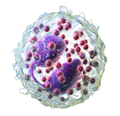 | 2.3% | 12–15 (slightly bigger than neutrophils) | Larger parasites Modulate allergic inflammatory responses | Bi-lobed | Full of pink-orange (H&E stain) | 8–12 days (circulate for 4–5 hours) |
| Basophil |  | 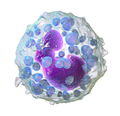 | 0.4% | 12–15 (slightly smaller than neutrophils) | Release histamine for inflammatory responses | Bi-lobed or tri-lobed | Large blue | A few hours to a few days |
| Lymphocyte |  |  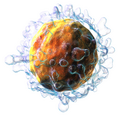 | 30% | Small lymphocytes 7–8 Large lymphocytes 12–15 | B cells: releases antibodies and assists activation of T cells T cells: CD4+ T helper cells: activate and regulate T and B cells Regulatory T cells: Returns the functioning of the immune system to normal operation after infection; prevents autoimmunity | Deeply staining, eccentric | NK-cells and cytotoxic (CD8+) T-cells | Years for memory cells, weeks for all else. |
| Monocyte |  |  | 5.3% | 15–30 | Monocytes migrate from the bloodstream to other tissues and differentiate into tissue resident macrophages, Kupffer cells in the liver. | Kidney shaped | None | Hours to days |
Fixed leucocytes
Some white blood cells move into different parts of the body and stay there permanently. For example, in the liver, they become special cells called Kupffer cells that help protect the body. These cells still work as part of the immune system, even though they are not moving around in the blood anymore.
Other types of fixed white blood cells include Histiocytes, Dendritic cells, Mast cells, and Microglia. Each type has its own important job in keeping the body healthy.
Disorders
White blood cell disorders can be grouped in two main ways. One way looks at how many white blood cells there are. Too many white blood cells, called proliferative disorders, can happen when the body is fighting an infection or because of other health issues. Too few white blood cells, called leukopenias, can make it harder for the body to fight off germs.
Another way to look at these disorders is by how well the white blood cells work, even if their numbers are normal. Sometimes, white blood cells can develop cancers, which are grouped into leukemias and lymphomas. These conditions can be serious and need special care from doctors.
Counting and reference ranges
A complete blood cell count is a test that measures the number of white blood cells in your blood, along with the numbers of each type of white blood cell. This helps doctors see if your immune system is working well. In healthy adults, the total number of white blood cells is usually between 4,000 and 11,000 per cubic millimeter of blood. Doctors also look at how many of each kind of white blood cell there are to make sure everything is in balance.
Images
This article is a child-friendly adaptation of the Wikipedia article on White blood cell, available under CC BY-SA 4.0.
Images from Wikimedia Commons. Tap any image to view credits and license.