 Safekipedia
Albania
Adapted from Wikipedia · Adventurer experience
Albania, officially the Republic of Albania, is a country in Southeast Europe. It lies in the Balkans, along the Adriatic and Ionian Seas within the Mediterranean Sea. It shares land borders with Montenegro to the northwest, Kosovo to the northeast, North Macedonia to the east, and Greece to the south. The country covers 28,748 km2 and has many different landscapes, from tall mountains to flat coastal plains. Its capital and largest city is Tirana, with other important cities including Durrës, Vlorë, and Shkodër.
Albania has a long and interesting history. It was first home to several Illyrian tribes, such as the Ardiaei and Taulantians. Ancient Greeks set up trading towns along the coast, like Apollonia. Later, the area became part of the Roman Empire and then the Byzantine Empire. In the 15th century, a famous leader named Gjergj Kastrioti Skanderbeg led resistance against invaders. Albania declared independence in 1912 after centuries under other powers.
Today, Albania is a developing country with a growing economy. Many people work in services, but tourism is also important. The country provides universal health care and free schooling for children. Albania is working toward joining the European Union, with discussions ongoing since 2022.
Etymology
Main article: Names of the Albanians and Albania
The name "Albania" comes from old stories and maps. Long ago, people called the Illyrians lived in this area. One of their tribes was named the Albani. A writer named Ptolemy wrote about a place called Albanopolis near the city of Durrës. There was also a place called Albanon, which might be the same as Albanopolis.
In the year 1079, a writer named Michael Attaliates wrote about people called Albanians. They lived in a big city named Constantinople. Over time, people called their home Arbëri or Arbëni. They called themselves Arbëreshë. Later, they began using the words Shqipëri or Shqipëria. These words mean "Children of the Eagles" or "Land of the Eagles".
History
Main article: History of Albania
Prehistory
Main article: Prehistory of Albania
The first people in Albania lived near the coast and in caves. They used tools made from stone and bone. Around 7000 BC, people began to raise sheep and goats and started small farms. Over time, they used natural materials like bitumen for decorating pottery and fixing things.
Antiquity
Main article: Antiquity in Albania
Albania was home to many groups, including Illyrian and Epirote tribes, and Greek colonies along the coast. The Illyrian tribe called the Taulanti was one of the first powerful groups. They fought against leaders like Alexander the Great. Later, the Ardiaei tribe grew powerful under King Agron and his wife Teuta. The Romans took control of the area by 167 BC, dividing it into three parts.
Middle Ages
After the Roman Empire split, new groups moved into the area. In the 11th century, differences grew between two big churches. The Principality of Arbanon was created in 1190 as an early Albanian state. Later, other groups tried to control the land. By the 14th century, several Albanian principalities formed, and then the Ottoman Empire began to invade.
Ottoman Empire
See also: Albanian rebellion against the Ottoman Empire
The Ottoman Empire took control of Albania in the 15th century. Many Albanians moved to Europe, and others faced heavy taxes. Despite this, Albanian leaders like Skanderbeg resisted for many years. The Ottomans later took over, changing the lives of the people.
Rilindja
See also: League of Prizren
The Albanian Renaissance was a time of growth in culture and learning in the late 18th and 19th centuries. Albanians wanted to protect their lands and create a united nation. They formed groups like the League of Prizren to defend their territory. This period helped lay the groundwork for an independent Albania.
Independence
Main article: Independent Albania
See also: Albanian Declaration of Independence
Albania declared independence from the Ottoman Empire in 1912. The country faced challenges from neighbors and internal struggles. A prince was chosen to lead, but his rule was short. The years after independence were marked by political instability.
First Republic
See also: World War I and World War II in Albania
After World War I, Albania had economic and political problems. Different leaders tried to bring stability, but foreign countries like Italy had strong influences. In 1939, Italy invaded Albania, leading to years of occupation during World War II. Resistance groups helped liberate the country.
Socialist Republic
Main article: Communism in Albania
In 1944, Enver Hoxha established a government with strict rules. His regime controlled many parts of life, including the economy and schools. Despite some progress, the country faced hard times and strict control.
Fourth Republic
Main article: Fall of communism in Albania
When communism ended in the late 1980s, Albania went through big changes. Many people lost money in risky investments, leading to protests and a civil war in 1997. International help brought peace, and the country began to rebuild.
Contemporary
See also: Accession of Albania to the EU and NATO
Further information: 2019 Albania earthquake and COVID-19 pandemic in Albania
Albania has worked toward joining the European Union and became a member of NATO in 2009. The country has focused on improving its economy and government. In 2019, a strong earthquake caused damage, and in 2020, Albania faced challenges from the COVID-19 pandemic. Despite these difficulties, Albania continues to move forward with reforms.
Geography
Main article: Geography of Albania
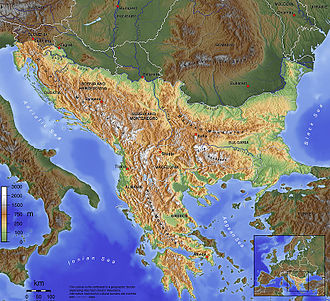
Albania is a country in Southeast Europe. It is on the Balkan Peninsula near the Mediterranean Sea. It borders Montenegro, Kosovo, North Macedonia, and Greece. The country is 28,748 km2 (11,100 sq mi) in size.
Albania has many different landscapes. There are mountains, hills, and lakes. The north has the Albanian Alps. The east has the Korab Mountains. Important lakes include the Lake of Shkodër. Rivers like the Drin flow to the Adriatic and Ionian Seas.
Climate
Main article: Climate of Albania
Albania has both Mediterranean and Continental climates. The coast is warm, but the mountains are colder. There are four seasons. Winter can be below 0 °C, and summer is around 22 °C. Rain is common in winter and varies in different parts of the country.
Biodiversity
Main article: Biodiversity of Albania
See also: Ecoregions in Albania
Albania has rich wildlife because of its many landscapes. Animals include the lynx, brown bear, and golden eagle, which is the national animal. Birds such as the greater flamingo and dalmatian pelican live there. Forests have oak, beech, and pine trees.
Conservation
Albania works with other countries to protect nature. It has many protected areas, like national parks such as Butrint, Vjosa, and Prespa. These help protect wildlife and natural places. Albania is part of global efforts to preserve biodiversity and solve environmental problems.
Protected areas
Main article: Protected areas of Albania
Albania has 12 national parks and many other protected areas. These include the Albanian Alps National Park, Prespa National Park, and Butrint National Park. The parks protect mountains, lakes, and coasts, helping to keep Albania’s natural beauty and wildlife safe.
Environmental issues
Main article: Environmental issues in Albania
Albania has environmental problems like air and water pollution, climate change, and waste management. The country is trying to reduce these problems and protect its natural resources. Climate change can cause more floods and other natural disasters, which can affect people and the economy.
Politics
Main article: Politics of Albania
See also: Government of Albania
Since 1912, Albania has had many changes in its government. It has been a monarchy, a communist country, and is now a democracy. In 1998, Albania became a constitutional republic. The government follows rules in a constitution and has three main parts: the Parliament makes laws, the President is the head of state, and the Prime Minister runs the government. There are also courts to make sure laws are followed.
Albania works with other countries. It joined the United Nations in 1955 and became a member of NATO in 2009. Albania is working to join the European Union. The country supports Kosovo.
Main article: Armed Forces of Albania
Albania has land, air, and naval forces. Their job is to protect the country and help keep peace in the world. People can join the military when they are 19 years old.
Main article: Administrative divisions of Albania
See also: Counties of Albania, Regions of Albania, Municipalities of Albania, Communes of Albania, and Villages of Albania
Albania is divided into twelve counties. The largest county is Tirana County, and the smallest is Gjirokastër County. These counties are divided into municipalities that help with local needs and services.
| Emblem | County | Capital | Area (km2) | Population (2023) | HDI (2022) | ||||||||||||||
|---|---|---|---|---|---|---|---|---|---|---|---|---|---|---|---|---|---|---|---|
 | Albania (total) | Tirana | 28,748 | 2,402,113 | 0.806 | ||||||||||||||
 | Berat | Berat | 1,798 | 140,956 | 0.793 | ||||||||||||||
 | Dibër | Peshkopi | 2,586 | 107,178 | 0.765 | ||||||||||||||
 | Durrës | Durrës | 766 | 226,863 | 0.813 | ||||||||||||||
 | Elbasan | Elbasan | 3,199 | 232,580 | 0.795 | ||||||||||||||
 | Fier | Fier | 1,890 | 240,377 | 0.779 | ||||||||||||||
 | Gjirokastër | Gjirokastër | 2,884 | 60,013 | 0.806 | ||||||||||||||
 | Korçë | Korçë | 3,711 | 173,091 | 0.801 | ||||||||||||||
 | Kukës | Kukës | 2,374 | 61,998 | 0.760 | ||||||||||||||
 | Lezhë | Lezhë | 1,620 | 99,384 | 0.780 | ||||||||||||||
 | Shkodër | Shkodër | 3,562 | 154,479 | 0.795 | ||||||||||||||
 | Tirana | Tirana | 1,652 | 758,513 | 0.832 | ||||||||||||||
 | Vlorë | Vlorë | 2,706 | 146,681 | 0.814 | ||||||||||||||
| References: | |||||||||||||||||||
Economy
Main article: Economy of Albania
Albania changed from a planned economy to a more open market system. It is now a developing country with middle-income status. The service sector is a big part of the economy. This includes trade, tourism, real estate, and logistics. Industry, especially construction, and agriculture, such as farming and fishing, are also important.
In 2025, Albania's economy was worth about $26.9 billion. The country has grown by about 3.8% each year recently. It has made trade deals with the European Union, Turkey, the United Kingdom, and others. Challenges include corruption and needing better rules for businesses.
The biggest economic area is around the cities of Tirana, Durrës, and Laç. Other important places include Elbasan and coastal towns like Sarandë and Vlorë. Tourism has grown a lot. Millions of visitors come to enjoy beaches, mountains, and historic cities each year.
Demographics
Main article: Demography of Albania
See also: Albanian people and Origin of the Albanians
Albania’s population in 2023 was 2,402,113. This is smaller than the 2011 count of 2,821,977. The decrease started after the end of communist rule and is linked to changes in politics, economy, and society. Fewer babies are being born and many people are moving out of the country. Most people live in Tirana and Durrës. These two counties hold about 41% of all Albanians, with Tirana alone having 32% and Durrës 9%. Rural areas like Gjirokastër and Kukës have fewer people.
Albanians have lived in many parts of Southern Europe for a long time. After communism ended, many moved to countries such as Australia, Canada, Switzerland, the United Kingdom, and the United States. There are also Albanians in North Macedonia, Montenegro, Kosovo, and Serbia. Today, more Albanians live outside Albania than inside, and about a third of people born in Albania now live elsewhere.
Urbanisation
Main article: List of cities and towns in Albania
Since 1991, when communism ended, Albania’s cities have grown fast. The Tirana–Durrës area along the western coast is the most crowded part of the country. It attracts many people from smaller towns and villages. Even though the total number of people in Albania has gone down, the part living in cities rose from 47% in 2001 to 65% in 2023. This growth has caused problems, with some areas like Dibër and Kukës losing people.
Language
Main article: Languages of Albania
See also: Albanian language
Albanian is the official language, spoken by most people. It has two main types, Gheg and Tosk, with Tosk used more in writing. The river Shkumbin separates the two. Some people speak other languages at home, such as Greek, Aromanian, Serbo-Croatian, Macedonian, Bulgarian, Gorani, and Roma. In schools, children learn Albanian first, then a foreign language like English, Italian, French, or German.
Minorities
Main article: Minorities of Albania
Albania recognizes several minority groups, including Aromanian, Greek, Macedonian, Montenegrin, Serb, Roma, Egyptian, Bosnian, and Bulgarian people, as well as Gorani and Jews. The 2023 census showed most people were Albanian (91.04%), with smaller groups making up the rest.
Religion
Main article: Religion in Albania
See also: Albanian paganism
Albania has no official religion and allows all religions. Many people follow different beliefs. In 2023, about 45.86% were Sunni Muslims, 8.38% were Catholics, 7.22% were Eastern Orthodox, and 4.81% were Bektashi Muslims. Other groups include Evangelicals, and some people have no religion or are not sure. Overall, Albania is one of the least religious countries in the world.
Education
Main article: Education in Albania
Education in Albania is free and required for children from age six to sixteen. Students learn Albanian first, then a foreign language such as English, Italian, French, or German. After primary school, students can choose to study many subjects, including arts, sports, languages, sciences, and technology. There are both public and private universities where students can study for a bachelor’s, master’s, or doctorate degree.
Health
Main article: Health in Albania
Albania’s government provides free healthcare to all citizens. The healthcare system is improving. People in Albania live about 77.8 years on average. The most common cause of death is heart disease. Albania has a good supply of fruits and vegetables and a lower rate of obesity compared to many other countries, partly because of its Mediterranean-style diet.
Culture
Main article: Culture of Albania
The red and black national colours are shown on the flag of Albania, which features a double-headed eagle. This eagle stands for bravery and strength. The red field shows the courage of the Albanian people. The eagle connects to Gjergj Kastrioti, known as Skanderbeg, who fought against Ottoman rule. The design dates back to the Middle Ages and became a symbol when Albania became independent in 1912.
Albanian clothes change between the north and south. Northern men wear light shirts and loose trousers called Tirq, with a wide belt. They also wear a woolen vest called Xhamadan and a dome-shaped hat called Qeleshe. Southern men wear a knee-length white pleated garment called Fustanella, with a white shirt and knee-high socks. Both men and women wear colorful earrings, rings, and necklaces. Women also wear long shirts, aprons, and headscarves. One famous dress is the Xhubleta, a bell-shaped black dress with embroidered patterns, recognized by UNESCO.
Albania's art and buildings have been shaped by many old and medieval influences. The country’s art includes painting, pottery, sculpture, and ceramics. The Byzantine and Ottoman Empires brought Christian and Islamic art to Albania, seen in churches and mosques. The Albanian Renaissance in the 19th century brought new art and writing, with artists inspired by Impressionism and Romanticism. Albania’s buildings show the influence of many peoples, from old castles and churches to modern structures. Three Albanian places are UNESCO World Heritage Sites, including Butrint and the old parts of Berat and Gjirokastër.
Albanian folk music is important to the country, with north and south styles sounding different. Many songs tell stories from Albanian history, with themes of honor and welcome. The Festivali i Këngës is a yearly song contest that has helped many Albanian singers begin their careers. Today, artists like Rita Ora, Dua Lipa, and Bebe Rexha are famous around the world.
Albanian literature started in the Middle Ages, with religious books and stories written in the Albanian language. Important works include books about Skanderbeg. The 20th and 21st centuries have seen famous writers like Ismail Kadare.
Albanian cuisine is shaped by the land and history, with north and south having different foods. Common ingredients are olives, herbs, fruits, vegetables, and seafood from the Adriatic and Ionian Seas. Lamb is eaten on special days, and dishes like Tavë kosi (a baked lamb and rice dish) and Fërgesë (a mix of peppers, tomatoes, and cheese) are loved by many. Coffee and tea are popular drinks, and Albania has a long history of making wine.
Popular sports in Albania include football, weightlifting, basketball, volleyball, tennis, swimming, rugby union, and gymnastics. Football is the most popular sport, and the national team played in a big tournament for the first time at UEFA Euro 2016. Weightlifting has won many medals for Albania in European and world competitions.
Images
Related articles


This article is a child-friendly adaptation of the Wikipedia article on Albania, available under CC BY-SA 4.0.
Images from Wikimedia Commons. Tap any image to view credits and license.