
American frontier
The American frontier, also known as the Old West and popularly called the Wild West, refers to the history, stories, and culture that grew as people moved westward across North America. This movement started with European colonial settlements long ago and lasted until the early 1900s.
President Thomas Jefferson helped encourage people to move west, especially after the Louisiana Purchase. This idea of moving west became known as "manifest destiny", and it shaped how many Americans thought about expanding the country.
The stories and events from this time have become important in American culture. Many books, movies, and TV shows are based on the American frontier, making it a key part of how Americans see their history and identity. The adventures and traditions from this period continue to capture people's imaginations today.
Periodization
Historians have talked about when the frontier began and ended. Some say it started after the American Civil War in 1865 and ended after the 1890 U.S. census. Others think it lasted until the early 1900s, before World War I.
The idea of the frontier shaped American culture. The Western United States, like the Southwest, got a lot of attention from the 1850s to the 1910s. Stories made things seem more exciting.
The frontier was where settlers found new land. It moved westward over time, starting from the East Coast in the 1600s. Some cities, like Los Angeles and Salt Lake City, were settled far from the main frontier.
Maps of United States territories
Here are some maps showing how the United States grew over time. Each map shows a different period:
- 1789: The new nation after independence.
- 1819–1820: After the War of 1812.
- 1845–1846: Just before the Mexican–American War.
- 1859–1860: Before the Civil War began.
- 1884–1889: After the Civil War.
- 1912: When all the western territories became states.
The maps use different colors to show states, territories, disputed areas, and other countries.
History
Colonial frontier
Main article: Thirteen Colonies
In the early days of European settlement along the Atlantic coast, the frontier was any part of the interior beyond the settlements. The American frontier began when Jamestown, Virginia was settled by the English in 1607.
Different groups, such as the English, French, Spanish, and Dutch, expanded and settled in different ways. The French set up small villages along the St. Lawrence River, while the Dutch created fur trading posts in New York.
Frontier areas often had poor transportation, making farming hard. These areas were mostly based on small farms and had more equal societies.
New nation
After the Revolutionary War ended in 1781, the United States developed a system for expanding westward. The Northwest Ordinance of 1787 ended slavery north of the Ohio River and promised statehood when territories grew large enough, as Ohio did in 1803.
Pioneers moved west into areas like Pennsylvania, Virginia, and North Carolina. They lived in simple homes and hunted for food before starting farms. The land policy aimed to grow the economy and distribute land wisely.
Louisiana Purchase
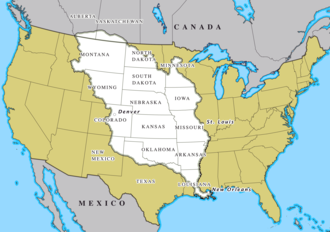
Thomas Jefferson wanted to expand the West. His Louisiana Purchase in 1803 doubled the size of the nation. Jefferson sent explorers like Lewis and Clark to map and study the new lands.
Oregon Trail
To reach the West Coast, many travelers used the Oregon Trail. This long route was over 2,000 miles (3,200 km) and could be dangerous.
Mormons and Utah
Mormons settled in the valley of the Great Salt Lake after facing trouble elsewhere. They built a community in what became Utah Territory.
Pony Express and the telegraph
The Pony Express was a fast mail service started in 1860. It was later replaced by the transcontinental telegraph in 1861.
Bleeding Kansas
In the 1850s, people argued over whether the new territory of Kansas would allow slavery. Both groups moved there, and there was violence. This conflict helped lead to the Civil War.
Civil War in the West
During the Civil War, the West saw several important battles. There was fighting in places like Missouri and Texas.
Postwar West
After the Civil War, the government worked to improve governance in the western territories. New territories were prepared for statehood.
Transcontinental railroads
The first transcontinental railroad was completed in 1869. It connected the East and West and changed travel and settlement.
Migration after the Civil War
After the Civil War, many people moved west for better opportunities. Farmers looked for larger, cheaper land, while others sought new jobs. They faced challenges like harsh weather.
Alaska Purchase
In 1867, the United States bought Alaska from Russia. Though developed slowly, discoveries later brought prosperity.
Oklahoma Land Rush
In 1889, the U.S. government opened land in Oklahoma for settlement. On one day, thousands of people raced to claim land, quickly establishing towns like Oklahoma City.
Indian Wars
Throughout the 19th century, there were conflicts between Native American tribes and settlers. These wars happened across the West, with battles in states like Arizona and Texas.
Social history
Democratic society
Western states were often more democratic. They were the first to grant women the right to vote.
Urban frontier
Cities like Denver and Butte grew quickly as centers of trade and industry.
Race and ethnicity
European immigrants, African Americans, Asians, and Hispanics all contributed to the diverse population of the West.
Family life
Family life on the frontier was important for survival. Women managed households, and children helped with chores.
Law and order
Law enforcement on the frontier varied. Towns had sheriffs, while rural areas relied on local groups. Crimes were common.
Cattle
Cattle ranching became a major industry. Ranchers drove herds north for shipment to markets in the East. The Chisholm Trail was a key route.
Conservation and environmentalism
As the West developed, people became concerned about protecting nature. Conservationists like Theodore Roosevelt and John Muir worked to preserve forests and parks.
End of the frontier
By the early 20th century, the frontier as a line of advancing settlement had largely disappeared. The last territories became states, and the era of westward expansion ended.
American frontier in popular culture
The stories, art, and music about the American Old West are very important in American culture. Many artists and writers have been inspired by the real and imagined West. Famous composers like Aaron Copland and Roy Harris made music influenced by these ideas.
The West became popular through shows, music, and books in the 1800s. Books called "dime novels" told exciting stories about heroes and villains, like brave cowboys and settlers. These books were very popular and helped create images of the West.
In the 20th century, movies, especially Westerns, became a big part of how people picture the American West. Directors like John Ford made famous films showing wide, open landscapes. The cowboy became a symbol of independence and bravery. Presidents like Theodore Roosevelt also helped shape these ideas through their writing and adventures. Today, the stories and images of the Old West still influence American culture in many ways.
Historiography
Many students of Frederick Jackson Turner became history teachers in western states and shared his ideas about the frontier. Over time, scholars found that many frontier stories are not completely true, but these stories are still part of local traditions, tales, and books.
In the 1970s, historians began discussing how to study the frontier. Some thought the frontier shaped all of American history and culture, while others focused only on areas west of the Mississippi River after 1850. They also studied how different groups, like Native Americans and Hispanics, interacted with white settlers. Today, the study of the American frontier includes many more voices and stories from groups that were not included before.
Environmental history has also become important, looking at how people and nature affected each other during this time.
Pictures
Keep exploring



This article is a child-friendly adaptation of the Wikipedia article on American frontier, available under CC BY-SA 4.0.
Images from Wikimedia Commons. Tap any image to view credits and license.