 Safekipedia
Analytic number theory
Adapted from Wikipedia · Adventurer experience
Analytic number theory is a fun part of mathematics that mixes ideas from number theory and mathematical analysis. It uses methods from calculus and other types of analysis to learn about integers, the whole numbers we use every day.
One big moment in analytic number theory happened in 1837 when Peter Gustav Lejeune Dirichlet introduced something called Dirichlet L-functions. This helped him prove an important theorem about arithmetic progressions, which are number patterns that increase by a constant amount.
Analytic number theory is well-known for studying prime numbers. Prime numbers are numbers greater than 1 that can only be divided by 1 and themselves, like 2, 3, 5, and 7. This area of math has produced important results such as the Prime Number Theorem and research about the Riemann zeta function.
It also explores additive number theory, which looks at how numbers can be written as sums of other numbers. Two famous questions in this area are the Goldbach conjecture, which suggests that every even number greater than 2 can be written as the sum of two primes, and Waring's problem, which asks about writing numbers as sums of squares, cubes, and higher powers.
Branches of analytic number theory
Analytic number theory has two main parts. The first part, multiplicative number theory, studies how prime numbers are arranged. This includes big ideas like the prime number theorem and Dirichlet's theorem on primes in arithmetic progressions.
The second part, additive number theory, looks at how whole numbers can be added together. A famous question here is Goldbach's conjecture, which says that every even number bigger than 2 can be written as the sum of two primes. Another important result in this area is the solution to Waring's problem.
History
Analytic number theory studies integers using tools from mathematical analysis. It started with Peter Gustav Lejeune Dirichlet's work in 1837. He used new methods to prove ideas about numbers in sequences.
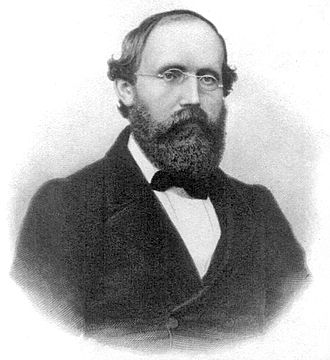
The prime number theorem is a big idea in this field. It says that the number of primes up to a certain value can be guessed by dividing that value by the natural logarithm of the value. This helps us learn how primes are spread out among numbers. Famous mathematicians like Carl Friedrich Gauss and Adrien-Marie Legendre also studied prime numbers before Dirichlet. Later, Bernhard Riemann's work on the Riemann zeta function helped us understand primes better. Proofs of the prime number theorem were finally given by Jacques Hadamard and Charles Jean de la Vallée-Poussin in 1896.
Main article: Johann Peter Gustav Lejeune Dirichlet
Main article: Pafnuty Chebyshev
Main article: Bernhard Riemann
Main articles: Jacques Hadamard and Charles Jean de la Vallée-Poussin
Problems and results
Theorems and results in analytic number theory often give approximate answers about numbers, instead of exact ones. They help us estimate how numbers behave.
One big question is about prime numbers—special numbers greater than 1 that can only be divided by 1 and themselves. Mathematicians wanted to know how many primes are smaller than a certain number. A famous result called the prime number theorem says that for a large number N, the number of primes up to N is roughly N divided by the natural logarithm of N. This helps us understand how primes are spread out.
Another interesting problem is Waring's problem, which asks whether every number can be written as a sum of squares, cubes, or higher powers. For example, every number can be written as the sum of at most four squares. Analytic number theory helps find answers to such questions by using clever mathematical tools.
Methods of analytic number theory
Main article: Dirichlet series
Main article: Riemann zeta function
Analytic number theory uses math to study numbers, especially whole numbers. One important tool is called a Dirichlet series. It is a special math expression that helps solve problems about numbers that can be multiplied together. These tools help mathematicians link different number properties.
The Riemann zeta function is another key idea. It connects whole numbers and their prime factors in a special way. This function helps mathematicians understand how prime numbers are spread out. One famous question about it is called the Riemann Hypothesis. Solving this could help prove many other important facts in number theory.
Related articles


This article is a child-friendly adaptation of the Wikipedia article on Analytic number theory, available under CC BY-SA 4.0.
Images from Wikimedia Commons. Tap any image to view credits and license.