
Ancient Macedonian army
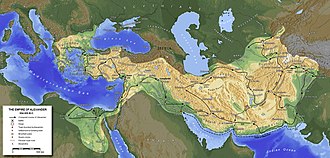
The Kingdom of Macedon had a very strong army in ancient times. It started small but grew fast under leaders like Philip II and his son Alexander the Great. They were able to conquer large areas from Egypt in the west to India in the east.
Philip II changed the army in many ways. He made soldiers train often, so they could work together better. He also brought new ideas and weapons, like a long spear called the pike or sarissa. This helped soldiers in battle. Philip also made cavalry, or soldiers on horses, very important for the first time in Greek fighting.
The Macedonian army used many types of soldiers together, like foot soldiers with long spears, archers, and different kinds of cavalry. This made their battles very effective. They also used special machines to attack cities. Soldiers came from many places, not just Macedon, including Ancient Macedonians, Thessalian cavalry, and people from the Aegean and the Balkans.
Origins
If Philip II of Macedon had not been the father of Alexander the Great, he would still be known as a great leader and thinker. Philip built a strong army that helped his son do great things. Before Philip, the Macedonians were not seen as very important by other Greeks. But they were strong fighters with special training.
When Philip took control, he made the army very important. He trained his soldiers often to make them very skilled. Philip also asked people from other parts of Greece to join his army. With the money he earned, he could support a large, professional army. By the time he died, Philip had made Macedonia bigger and ready for his son's big adventures. One of his smart ideas was to make the soldiers carry lighter bags so they could move faster.
Troop types and unit organisation
Heavy cavalry
Companion cavalry
The Companion cavalry were important soldiers in the Macedonian army. They led attacks in battles under Alexander the Great. They were known for their skill in staying balanced and controlling their weapons while charging at high speed. Along with cavalry from Thessalia, the Companions were the main heavy cavalry. Philip II improved their training and tactics, making them very effective. The Companions were split into groups called ilai, each with 200 soldiers, except the Royal Squadron, which had 300. Alexander took eight of these groups with him to Asia, leaving seven groups in Macedon.
The Companion cavalry usually formed a wedge shape when attacking. This shape helped them crash into enemy lines. The main weapon of the Companion cavalry was a long lance called the xyston. They wore armor and helmets in battle.
Thessalian cavalry
After Philip II became leader of the Thessalian League, the Thessalians were considered the best cavalry in Greece. The Thessalian heavy cavalry went with Alexander and helped the Macedonians. They fought similarly to the Companion Cavalry but used javelins more. The Thessalian cavalry were known for using rhomboid formations, which let them change direction quickly. For Alexander’s invasion of the Persian Empire, there were 1,800 Thessalian cavalry. They usually protected the left side of the army. They faced strong attacks but held their ground.
Other Greek cavalry
Allied Greek states and hired mercenaries also provided heavy cavalry for Macedon. Alexander started his campaign against Persia with 600 Greek cavalrymen. These cavalrymen were equipped similarly to the Thessalians and Companions but fought in a square formation.
Light cavalry
Light cavalry, such as the prodromoi, protected the army’s sides during battles and went on scouting missions. The term prodromoi might have meant any cavalry on scouting or attacking missions. Besides the prodromoi, other horsemen from subject or allied nations filled various battle roles. By the time Alexander fought in India, the cavalry changed greatly and included many horse-archers from Iranian peoples like the Dahae.
Prodromoi/Sarissophoroi (cavalry unit)
The prodromoi acted as scouts when the army was moving. In battle, they protected the right flank of the Companion cavalry. After Persian light cavalry joined the Macedonian army, the prodromoi took on a main battlefield role as shock cavalry. They had four groups of 150 soldiers each with Alexander’s army in Asia.
Paeonian cavalry
These light cavalry came from Paeonia, a region north of Macedonia. Philip II conquered the Paeonians, and they became tributepayers. Led by their own leaders, the Paeonian cavalry usually fought with the Prodromoi. They had javelins, swords, and unusually, shields.
Thracian cavalry
Mostly from the Odrysian tribe, the Thracian cavalry also scouted when the army moved. In battle, they did similar things to the Prodromoi and Paeonians but protected the left flank of the Thessalian cavalry. The Thracians fought in wedge shapes and had javelins and swords.
Horse archers
In 329 BC, Alexander created a unit of 1,000 horse archers from various Iranian peoples. They were very good at scouting and protecting the army. Riding and shooting arrows, they could attack from a distance. At the Battle of Hydaspes, their arrows helped break up the Indian cavalry and chariots.
Heavy infantry
The Foot Companions
Suitable men from Macedonian farms were chosen for an infantry group called the phalanx. Philip II created it, and Alexander used it to conquer the Persian Empire. These soldiers were called Pezhetairoi, meaning 'Foot Companions'.
Philip turned the Macedonian army from farmers into a well-trained fighting force. Foot Companions were taken from Macedonian farms. Once chosen, they became full-time soldiers. Under Philip, they didn’t get regular pay, but by Alexander’s time, they earned “good pay.” Through lots of training, they could move and fight together perfectly.
These foot soldiers fought in tight rectangular or square groups, with the smallest unit being the syntagma or speira, having 256 men. Each line of 16 men, called a lochos, was led by a lochagos. The syntagma leader fought on the far right. A syntagma had five extra people to help pass orders in battle. Six syntagmata formed a taxis of 1,500 men led by a strategos, and several taxeis formed a phalanx under a phalangiarch. Alexander had a phalanx of 6 veteran taxeis, totaling 9,000 men.
Each phalangite’s main weapon was a sarissa, a very long pike. It was used with two hands. At close range, long weapons weren’t useful, but a solid phalanx could keep enemies far away. Phalangites also carried swords for close fighting if the phalanx broke. The phalanx was weak on the sides and back.
Phalangites had shields and helmets but didn’t wear body armor under Philip II. Later, body armor appeared. Alexander didn’t use the phalanx as the main attack force but to hold and weaken the enemy while his heavy cavalry attacked chosen targets. The phalanx needed open flat land to work well.
Hypaspists
The Hypaspists were the elite foot soldiers of Macedon. The word means ‘shield-bearers’. In battles, they guarded the right flank of the phalanx and linked the phalanx to the Companion cavalry. They did many special jobs for Alexander and were important in sieges close to Alexander. The Hypaspists were from good Macedonian families.
Before 331, the hypaspist regiment was in units of 500, but by 327, it was split into three battalions of 1,000 men. They were probably equipped like traditional Greek hoplites, with thrusting spears, large round shields, and swords. This made them great for broken battles, sieges, and special missions.
Greek hoplites
Alexander’s army included Greek heavy infantry from allies in the League of Corinth and hired mercenaries. These soldiers had the traditional hoplite gear: thrusting spears, bronze-faced Argive shields, and body armor. In battle, Greek hoplites had a less active role than Macedonian phalangites and hypaspists. At Gaugamela, the Greek infantry formed the defensive back of Alexander’s box formation. They were important in stopping Persian cavalry from surrounding the Macedonian army.
Light infantry
Peltasts
Peltasts from the Agrianes, a Paeonian tribe, were the elite light infantry of the Macedonian army. They often protected the right flank, placed to the right of the Companion cavalry. They were usually part of any fast-moving mission. Other nationalities, like Thracians, also provided peltasts. Peltasts had javelins, swords, light shields, and sometimes helmets. They were good at skirmishing and often guarded flanks of heavier infantry.
Archers
Philip II also had archers, including hired Cretan archers. Crete was known for its skilled archers, whose services were popular as mercenaries. Cretan archers had strong bows and shot arrows with large bronze heads. They carried arrows in quivers with flaps. Cretan archers carried small bronze-faced shields. Archers came from Macedonia and Balkan peoples. Alexander used Cretan archers from his father’s time, and later, native Macedonian archers were mentioned.
The use of Asiatic soldiers under Alexander the Great
Alexander the Great used soldiers from many different places, including Arachosia, Bactria, Parapamisadae, Sogdia, India, and Scythia. These troops were part of his army in 324 BC. Alexander was impressed by 30,000 Persian soldiers who learned to fight like his Macedonian troops. At one time, his army had about 120,000 fighting soldiers, not counting those who followed the army.
There was some disagreement among Alexander's soldiers when he included Persian troops, especially young Persians from noble families who were trained to fight like Macedonians. Alexander planned to use local soldiers to rule Asia, but he passed away before he could put this plan into action. After his death, his successors mostly recruited Greeks and Macedonians for their armies.
Arms and armour
Philip II's soldiers had shields, helmets, and long spears called sarissas. Some wore heavier metal armor. Soldiers in Alexander the Great's army had similar armor.
Most soldiers carried swords for fighting up close. There were three main types of swords: the xiphos, kopis, and machaira. Cavalry soldiers used long spears called xystons. These spears had two points so they could be used from either end.
Phalangites, a type of soldier, used very long spears called sarissas. These spears were over 6 meters long and had a special weight at the end. They also used swords and shorter spears. Light soldiers, like those from Thrace, used javelins and small shields made of leather and wood.
Helmets were made of bronze and came in many styles. Some looked like hats, while others had face coverings. Cavalry soldiers sometimes wore open-faced helmets. Body armor was usually made of stiff linen or, for important leaders, of bronze plates shaped like a muscular body.
The main shield for phalangites was round and made of bronze on the outside and wood or leather inside. Elite soldiers used larger, more curved shields. Light soldiers used small, round or oval shields made of leather and wood.
Siege warfare
Further information: Polyidus of Thessaly and Diades of Pella
See also: Military tactics of Alexander the Great and Battle of Jaxartes
The Macedonians found new ways to attack cities with strong walls. Before this, Greek armies could not break through such defenses. Philip II brought in skilled engineers like Polyidus of Thessaly and Diades of Pella. They built special war machines to help break through city walls.
Artillery
Main article: Greek and Roman artillery
These new war machines made a big difference. They could throw heavy stones and bolts to attack city walls and defenders. One type, called the oxybeles, shot bolts. Another, called the lithobolos, could throw very heavy stones—up to 80 kg (180 lb)! These machines helped break through walls and protect soldiers.
Other siege engines
The Macedonians also used tall, moving towers called helepolis during sieges. These towers let soldiers get closer to enemy walls safely. The towers were covered to protect them from attacks. They also used special tools called rams to break down gates or knock holes in walls, making it easier to capture cities.
Battle tactics
See also: Military tactics of Alexander the Great, Hammer and anvil, and oblique order
The Macedonian army was one of the first to use special groups of soldiers together in battles. This helped them work as a team to defeat their enemies. Philip II learned from other armies and used new ways to fight, like a special shape called the 'embolon'. This helped their cavalry move better and gave them an advantage in fights.
In different battles, the Macedonians changed their tactics based on who they were fighting and where the battle happened. But some of their main ideas stayed the same, from early battles in 358 BC to later ones in 331 BC. For example, in the Battle of Erigon Valley, Philip used his cavalry to surprise the enemy and help the Macedonians win.
Later developments and decline
Further information: Antigonid Macedonian army, Seleucid army, Ptolemaic army, Pyrrhic army, and Hellenistic armies
After Alexander the Great’s empire broke apart, Macedon became a kingdom again. Its army, the Antigonid Macedonian army, kept many ideas from the armies of Philip and Alexander. Other armies from this time, called Hellenistic armies, also used similar tools and ways of fighting.
One famous fight happened when Pyrrhus of Epirus beat the Romans in 280 BC. Later, these armies started to rely more on a special group of foot soldiers called the phalanx. These soldiers used longer spears, but this made them slower. When they met new armies from places like Rome, which used different methods, the old ways of fighting were not as strong. The phalanx’s time as the main fighting force ended when Roman ways of battle helped defeat Macedon in the 2nd century BC.
Macedonian Navy
Macedon was not a big sea power, even when Philip II ruled. But when Alexander took over, he led many Greek cities. In 334 BC, Alexander crossed a narrow sea channel called the Hellespont with his army. He used a fleet of 120 ships and had soldiers from different places, including Macedon and Athens.
Alexander needed to capture the strong city of Tyre, which was on an island close to the coast. Alexander built a special road to reach the island. Later, he got more ships and used them to block Tyre's harbors. With his new fleet, he broke through Tyre's walls and his soldiers took over the city. After these events, Alexander's navy kept growing.
Major battles and campaigns
- Expansion of Macedonia under Philip II
- Battle of Erigon Valley (358 BC)
- Battle of Crocus Field (353/352 BC)
- Battle of Chaeronea (338 BC)
- Wars of Alexander the Great
- Alexander's Balkan campaign
- Battle of the Granicus (334 BC)
- Battle of Issus (333 BC)
- Siege of Tyre (332 BC)
- Siege of Gaza (332 BC)
- Battle of Gaugamela (331 BC)
- Battle of Megalopolis (331 BC)
- Battle of Jaxartes (329 BC)
- Battle of the Hydaspes (326 BC)
- Alexander's Indian campaign
Pictures
Keep exploring




This article is a child-friendly adaptation of the Wikipedia article on Ancient Macedonian army, available under CC BY-SA 4.0.
Images from Wikimedia Commons. Tap any image to view credits and license.