 Safekipedia
Archaeoastronomy
Adapted from Wikipedia · Adventurer experience
Archaeoastronomy is the study of how people in the past looked at the sky and used it in their lives. It looks at how ancient cultures saw stars, sunrises, moons, and other sky events, and why these events were important to them. Unlike modern astronomy, which uses science to study space, archaeoastronomy looks at the meanings and symbols that different cultures gave to the sky.
This field brings together many areas of study, such as archaeology, anthropology, and astronomy, to learn about the past. By looking at old buildings, art, and stories, scientists can find out how people long ago thought about the sky and its events. For example, they study how the Mayan astronomy linked the sky with farming and nature.
Archaeoastronomy can be studied in every culture and time period, even though the sky meant different things to different people. It helps us understand how ancient beliefs about the sky shaped their world and how they saw the universe around them.
History
People have always been curious about the stars and how old buildings might connect to them. Over time, studying how ancient cultures saw the sky has grown from simple ideas to important research.
Early thinkers noticed that old places like Stonehenge seemed to line up with the sun or stars. In the 1900s, researchers like Alexander Thom and Gerald Hawkins thought places such as Stonehenge might have been used to follow the seasons or mark special days. Some of their ideas were debated, but they helped start serious study in this area.
Later, scientists studied how Native American cultures used the sky, using old records and new research tools. This led to many talks among experts about the best ways to study ancient sky watching. Today, archaeoastronomy brings together many experts to learn not just if ancient people watched the sky, but why it mattered to them.
Relations to other disciplines
Archaeoastronomy is a field that connects many different areas of study. It looks at how ancient people understood the sky and used what they saw there. It brings together ideas from archaeology, history, and anthropology.
Some researchers study old buildings and landscapes to find clues about ancient sky watching. Others look at old writings or talk to people today to learn about past sky traditions.
People who study archaeoastronomy come from many backgrounds. Some are archaeologists, others are historians, and some are astronomers. They all ask different questions and use different ways to understand the past. Some focus on numbers and measurements, while others look more at the stories and meanings behind ancient sky traditions. This can sometimes cause debates, but it also helps us learn more about how people in the past saw the world around them.
Methodology
There is no single way to study archaeoastronomy. Researchers use what information they can find, like where ancient sites are or old records.
One way is called green archaeoastronomy. This uses numbers to study ancient sites, especially when there are few clues about people’s lives. It looks at how ancient people may have used the sky for important dates. For example, some think ancient people could guess special days by watching where the Sun set behind mountains. This helps us see if ancient people cared about the sky, but it doesn’t always tell us why.
Another way is brown archaeoastronomy. This uses old stories and records to learn about ancient sky watching. For example, at Chichen Itza, researchers used records to find out which parts of the sky mattered to the Mayans. They learned that buildings sometimes matched special sky events, like when the planet Venus appeared. This can find sky patterns that numbers alone might miss, but it can sometimes be less exact. Both ways help us understand how ancient people saw and used the sky.
Source materials
Archaeoastronomy is the study of how people in the past watched the sky and used it. There are many ways we learn about these sky-related practices.
One way to study this is by looking at alignments. This means checking if buildings or structures were built to point toward special places in the sky, like where the sun rises or sets. Some researchers study old writings to support this idea, while others look for patterns at many sites.
Artifacts, such as special objects, can also give clues. For example, the Sky Disc of Nebra is thought to show the sky from a long time ago. By comparing it to other old objects and writings, researchers try to understand its meaning. Another example is the Antikythera mechanism, an ancient device that may have been used to track the movements of the stars and planets.
Art and writings on walls or stones can also help. Some writings even tell us how a place was used. For instance, a writing from Greece explains that a stone was put up to mark the winter solstice, when the sun is at its lowest point in the sky.
Ethnographies, which are reports from people who visited or studied other cultures, are also important. They can tell us about how people in the past thought about the sky. For example, some people in Mesoamerica believed that certain days when the sun was directly overhead were very important for farming. This knowledge helps us understand why some ancient buildings might be pointed in certain directions.
Ethnographies also help us avoid misinterpreting symbols. For example, some believe a drawing in Chaco Canyon shows a star event from the year 1054, but others think it means something else entirely. Studying how living cultures use similar symbols can help us understand these ancient marks better.
Recreating the ancient sky
Main article: Declination
Main article: Precession of the equinoxes
When we study how ancient people saw the sky, we sometimes need to imagine how the sky looked long ago. This helps us understand their ideas and buildings better.
To know which stars or parts of the sky ancient buildings faced, scientists look at the stars' positions. Stars seem to move in circles around the North or South Celestial Pole. The distance of a star from this pole is called its declination. By knowing the declination of a building’s direction, we can tell which stars or the Sun might have been seen there.
The Sun’s position changes during the year, moving between limits marked by the solstices. By calculating the declination a site was built to face, researchers can see if it matches important solar events.
The Moon’s path is more complicated. It moves faster than the Sun and follows a different route, called lunistices, which changes over an 18.6-year cycle. Moon phases also have their own cycle, called the Synodic month.
Over many years, the positions of the stars seem to shift because of a slow wobble in Earth’s axis, called precession. This means stars rise and set in slightly different places over time. For example, the Egyptian pyramids were once aligned with a star called Thuban, which is not the North Star today.
Other sky events, like solar eclipses, can help us learn about old events. Comets, like Halley’s Comet, are somewhat easy to predict, but many others appear suddenly. Ancient people also watched meteor showers, auroras, and rainbows, even though these are hard to predict.
Major topics of archaeoastronomical research
What has looking at the stars meant for different groups in history? The answers are many.
One big reason people looked at the sky was to make calendars. Ancient farmers, like those in Hesiod’s farming guide, used the Sun’s position and signs from nature, like bird migrations, to know when to plant and harvest crops. For example, the Hopi people of the southwestern United States watched where the Sun rose and set to decide when to plant. Calendars helped groups plan events together.
Stories and myths about the universe also came from watching the sky. Different cultures used these stories to explain their world. For example, the Incas arranged their empire around their beliefs about the cosmos. Their capital city, Cusco, was the center, with lines called ceques pointing to different places. These lines matched the way the Milky Way looked in the sky.
People also used the sky to show power. Leaders sometimes wore special clothes with star symbols. In some places, buildings were made so that the Sun would shine in a special way on important days, showing the power of leaders and sacred places.
Major sites of archaeoastronomy interest
Main article: List of archaeoastronomical sites sorted by country
Clive Ruggles and Michel Cotte wrote a book about special places linked to the stars. They talked about sites around the world that show how ancient people thought about the sky.
At places like Stonehenge in England and Carnac in France, and also in Egypt and Yucatán, we find old buildings that seem to point to stars and the Sun. These places show how much effort people put into understanding the sky, just like how we explore space today.
Newgrange
Main article: Newgrange
Newgrange is an old tomb in Ireland from around 3,300 to 2,900 BC. For a few days around the Winter Solstice, light shines through a special opening into the tomb. This light does not come in through the main door but through a small hole above it. This shows that the tomb was built to include the Sun in its design.
Egypt
Since measurements of the Giza pyramids were first made, people have wondered how the ancient Egyptians decided where to build them. One idea is that they watched two stars in the Plough, which they called the thigh. They might have used these stars to find true north. Some think the pyramids were arranged like stars in Orion's belt, but this idea is debated. The pyramids may also connect to special moments when the Sun shines in certain ways.
The tomb of Senenmut has a ceiling with drawings of stars arranged in circles, showing how ancient Egyptians saw the night sky.
El Castillo
Main article: El Castillo, Chichen Itza
El Castillo, also called Kukulcán's Pyramid, is a step-pyramid in the Mayan city of Chichen Itza in Mexico. The pyramid has 365 steps, which might connect to the number of days in a year. During the equinoxes in March and September, a shadow appears on the pyramid that looks like a snake descending the steps.
Stonehenge
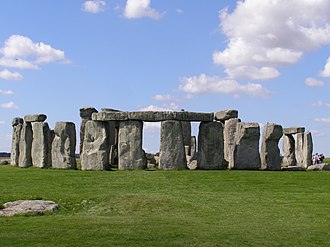
Stonehenge in England has many possible connections to the Sun and Moon. The most famous is when the Sun rises over a special stone during the summer solstice. Some think the winter solstice might be more important. Stonehenge is widely accepted as having astronomical meaning.
Maeshowe
Main article: Maeshowe
Maeshowe is an old tomb in Scotland. During the winter solstice, the Sun shines into the tomb through the entrance. Studies show that the tomb’s design points toward special sunset views and may have been used as a calendar.
Uxmal
Main article: Uxmal
Uxmal is a Mayan city in Mexico. The Governor's Palace there points toward where the planet Venus appears in the sky. This alignment happens every eight years and may connect to important events like the start of the rainy season.
Chaco Canyon
In Chaco Canyon, home of the ancient Pueblo culture, many buildings and roads seem to point toward the Sun and Moon. One famous site uses sunlight and shadows to mark important days like the solstices and equinoxes.
Lascaux Cave
Recent studies suggest that paintings in the Lascaux Cave in France might show pictures of stars. Some dots and shapes could represent constellations like Taurus and the Pleiades. Researchers think these paintings might be very old star maps.
Fringe archaeoastronomy
Archaeoastronomy can sometimes get a bad name because people have used it to support unusual ideas that aren’t based on solid facts. In the 1930s, a person named Otto S. Reuter wrote a book claiming that ancient Germanic people knew more about the stars than others, like those from the Ancient Near East.
More recently, some people tried to say that writings in West Virginia described special star events, but other experts said these ideas didn’t make sense.
Sometimes, archaeoastronomy is linked to trying to find secret math rules in old buildings like Stonehenge.
India
For a long time, some have tried to use star studies to show that ancient Indian culture went back even further than people thought, to around 4000 BC. But experts have warned against these uncontrolled theories.
Organisations
There are groups for people who study how past cultures understood the sky.
The ISAAC – the International Society for Archaeoastronomy and Astronomy in Culture started in 1996 to support this field. It helps organize meetings and publishes a journal.
SEAC, or La Société Européenne pour l'Astronomie dans la Culture, began in 1992 to focus on Europe. It holds yearly meetings and publishes reports.
SIAC, or La Sociedad Interamericana de Astronomía en la Cultura, started in 2003 to study Latin America.
SCAAS, the Society for Cultural Astronomy in the American Southwest, was created in 2009 to explore the sky knowledge of native peoples in the Southwestern United States. It has held many meetings and workshops.
AAAC, the Australian Association for Astronomy in Culture, began in 2020 in Australia to study Aboriginal and Torres Strait Islander sky traditions.
The Romanian Society for Cultural Astronomy started in 2019 and holds yearly meetings.
SMART, the Society of Māori Astronomy Research and Traditions, was founded in Aotearoa/New Zealand in 2013 to focus on Maori sky knowledge.
Native Skywatchers began in 2007 in Minnesota, USA, to share the star knowledge of Native American peoples like the Lakota and Ojibwe.
Publications
Some journals publish papers about archaeoastronomy. The Journal for the History of Astronomy has published many papers about this topic. Other journals, like the Journal of Astronomical History and Heritage, also share research about archaeoastronomy.
Academic programs
Many universities around the world have special programs to study how ancient cultures understood the sky. One example is the Sophia Centre for Cosmology in Culture at the University of Wales - Trinity Saint David in the UK. Another is the Cultural Astronomy Program at the University of Melbourne in Australia. The Tata Institute of Fundamental Research has also made interesting discoveries in this area.
Images
Related articles




This article is a child-friendly adaptation of the Wikipedia article on Archaeoastronomy, available under CC BY-SA 4.0.
Images from Wikimedia Commons. Tap any image to view credits and license.