
Beehive
A beehive is a special home where honey bees live, grow, and make honey. The word beehive is often used to talk about any bee home, but experts have different words for different kinds of homes. A nest is where bees live in natural spaces or hanging places. A hive is a home that people make for honey bees.
The western (Apis mellifera) and eastern honey bees (Apis cerana) are the main kinds of bees kept in beehives.
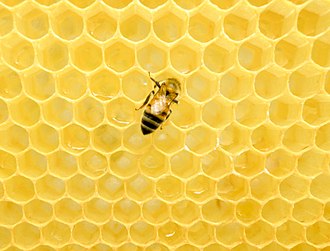
Inside a beehive, there are many small, tight cells made of beeswax. These cells are shaped like hexagons and are called a honeycomb. Bees use these cells to store food like honey and pollen. They also use the cells to care for their young, called the brood, which includes eggs, larvae, and pupae.
People use beehives for many good reasons. They help make honey, help plants grow by pollination, and give homes to bees used in apitherapy. Beehives also help fight problems that affect bee colonies, like colony collapse disorder. In North America, beehives are often moved between farms so bees can help different plants bloom. Over time, many patents have been given for new beehive designs.
Honey bee nests
Honey bees build their homes in caves, rock spaces, and hollow trees. In warm places, they sometimes make nests that hang in the open. These nests usually have just one entrance.
The bees make the area around the entrance smooth and cover the walls with a special sticky substance called propolis. They build wax combs inside where they store honey and pollen, and where their babies grow. The queen bee has her own special space at the bottom of the comb.
Ancient hives
Long ago, people in Egypt kept bees in special homes called hives. Pictures on old temple walls show people using smoke to get honey from the bees. We also find writings about honey stored in jars and special round hives.
Archaeologists found 30 complete hives in the ruins of a place called Tel Rehov in modern-day Israel. These hives were made from straw and clay and were used about 4,000 years ago. They were lined up neatly, showing that people long ago had good ways of taking care of bees. This discovery helps us learn about how ancient beekeeping worked.
Traditional hives
Traditional beehives were simple homes for bees. The bees built their own honeycomb inside because these hives had no special parts inside. This type of hive is called a fixed-frame hive, unlike modern movable-frame hives. Getting honey from these old hives often meant breaking them apart, but some designs let beekeepers take out top baskets filled with honey.
Honey from these hives was gotten by pressing the wax honeycomb to squeeze out the sweet stuff. This way gave more beeswax but much less honey than modern hives.
There were four main types of traditional beehives: mud hives, clay/tile hives, skeps, and bee gums.
Mud hives are still used in places like Egypt and Siberia. They are long cylinders made from a mix of unbaked mud, straw, and dung.
Clay tiles were used as homes for bees in the eastern part of the Mediterranean. Long baked clay cylinders were used in ancient Egypt, the Middle East, and also in Greece, Italy, and Malta. Keepers would smoke one end to guide the bees to the other while collecting honey.
Skeps were baskets, open at the bottom, used for about 2000 years to keep bees. They were first believed to be used in Ireland, made from wicker coated with mud and dung, but later mostly from straw. In northern and western Europe, they were made from coils of grass or straw. Skeps had no inside parts, so bees built their honeycomb inside.
Bee gums were sections of hollow trees used in the eastern United States, especially in the Southeast, until the 20th century. These were often from black gum trees.
Other kinds of hives were also used. In New Zealand, native Māori beekeepers made hives from straw, using skills from weaving baskets.
Modern hives
The first modern beehives appeared in the 1800s, building on improvements from the 1700s.
Early advances were made by Thomas Wildman between 1768 and 1770. He described ways to keep bees alive while harvesting honey, instead of older methods that killed the bees. Wildman used wooden bars in straw hives, letting bees build combs on them. He also described stacking hives and using sliding frames, ideas that influenced modern designs. Wildman learned from earlier bee experts like Swammerdam, Maraldi, and de Reaumur, and shared ideas from Brittany in the 1750s.
In 1814, Petro Prokopovych from Ukraine created one of the first frame designs that made honey harvesting easier.
Jan Dzierżon described the ideal space between combs in 1845, and in 1848 he added grooves to hive walls to hold the frames. These ideas were used by August Adolph von Berlepsch in Thuringia and L.L. Langstroth in the United States to develop movable-frame hives. Langstroth used about half an inch between frames and the hive body.
Hives can be arranged vertically or horizontally. The three main modern hive types used around the world are:
- the Langstroth hive
- the top-bar hive
- the Warre hive
Most hives are made for two types of bees, Apis mellifera and Apis cerana. Some special hives are made for other bees like Melipona beecheii, such as the Nogueira-Neto hive and the UTOB hive.
Vertical hives
Langstroth hives
Main article: Langstroth hive
Langstroth hives are named after Lorenzo Langstroth, who patented his design in the United States in 1852. His design was based on ideas from Johann Dzierzon and others. Langstroth hives have a top-worked style with hanging frames and spaces between frames called bee spaces. These hives have become the standard for many beekeepers worldwide, both professional and amateur. Langstroth hive bodies are rectangular and can be stacked to give bees more space. They are often made from wood. A typical Langstroth hive includes:
- Bottom board: this has an entrance for the bees.
- Boxes with frames for eggs and honey: the lowest box is where the queen lays eggs, and boxes above store honey
- Inner cover and top cap to protect from weather
Inside the boxes, frames are hung side by side. Langstroth frames are thin, rectangular pieces of wood or plastic, often with a plastic or wax foundation for bees to build their comb. The frames hold the honeycomb made by the bees from beeswax. Eight or ten frames fit side by side in a box, leaving the right amount of space between each frame and the hive walls. This space stops the bees from gluing parts together or building extra comb in the gaps. Reusing comb saves bees energy, as making new comb needs a lot of honey.
The sizes of hive bodies and frames vary, but many follow Langstroth’s original sizes. Some common variations include:
- BS National Beehive: A smaller hive for a specific type of bee, with square boxes and frames that are 17 inches long.
- BS Commercial hive: Similar to the BS National but with a deeper brood box and simpler design.
- Rose Hive: A variation of the BS National with a single-depth box for both eggs and honey.
- Smith hive
- German Normal: Used in central and northern Germany, with several regional variants.
- Zander: Developed by Enoch Zander, mainly used in southern Germany
- D.E. hive Designed by David Eyre
- Dadant hive: Developed by Charles Dadant in the US in 1920 from the Dadant-Blatt hive
- B-BOX: Developed by the Italian company Beeing for urban locations and uses Dadant frames
- Hyper Hyve: Designed by Mike James and includes insulation and monitoring features.
Warré hives
The Warré hive was invented by Émile Warré and is also called ruche populaire ('the people's hive'). It is a modular design with boxes stacked vertically. Unlike other stacked hives, the Warré hive adds new boxes at the bottom when the colony grows, which helps keep the nest warm.
WBC hives
The WBC hive, invented by William Broughton Carr in 1890, has an outer shell that spreads out at the bottom to cover a standard hive inside. Despite its extra insulation, many beekeepers find it hard to use because they have to remove the outer layer to check the hive.
CDB hives
In 1890, Charles Nash Abbott designed the CDB hive in Dublin, Ireland. It was named after the Congested Districts Board, which supported rural areas.
AZ hives
Anton Žnideršič, a famous Slovenian beekeeper, developed the AZ hive widely used in Slovenia. This style of beekeeping was added to UNESCO’s list of important cultural traditions in 2022.
Horizontal hives
These are single, long boxes with bars hanging parallel. The hive body is often shaped like an inverted trapezoid but can be rectangular and hold normal frames. These hives were developed as a cheaper alternative to Langstroth hives and don’t require lifting heavy boxes. They are popular in the US for their simplicity and alignment with organic beekeeping. They can often be built from scrap wood. Horizontal hives allow beekeepers to check and care for the hive without lifting heavy boxes. In areas where large animals like honey badgers and bears might attack bees, single-box hives can be hung out of reach. Otherwise, they are often raised for easy access.
However, these hives have some drawbacks. The combs usually cannot be spun in a honey extractor, and it’s hard to expand the hive for more honey storage. Most horizontal hives also can’t be easily carried by one person.
Top-bar hives
Main article: Top-bar hive
Horizontal hives often use top-bars instead of frames. Top bars are simple pieces of timber, often made from scrap wood, cut to size. They form a continuous roof over the hive, unlike regular frames which leave gaps for bees to move between boxes. Beekeepers usually don’t provide wax for the bees to start building from, though sometimes a small piece is given. Bees build the comb hanging down from the top bar, similar to how they build in natural cavities.
Because the comb built from a top bar usually can’t be spun in a honey extractor, honey is often taken by crushing and straining instead of centrifuging. After harvesting, bees rebuild their comb, so a top-bar hive also gives a harvest of beeswax. Queen excluders might or might not be used, but bees usually keep most honey separate from areas where they raise young, so honey can be taken without harming the bees or their young.
- Cathedral Hive: A modified top bar where the bar is split into three parts joined at 120° angles to form half a hexagon.
Long box hive
The long box hive is a single-story hive that holds enclosed frames and is worked horizontally, similar to Kenya/Tanzanian top-bar hives. This style was popular a century ago in the Southeast United States but declined because it wasn’t easy to move. With the recent rise in popularity of horizontal top-bar hives, the long box hive is being used again, though still limited. Other names for it include "new idea hive", "single story hive", "Poppleton hive", or "long hive".
Variations:
- Long Langstroth Hive: Uses 32 standard Langstroth deep frames without any extra boxes on top.
- Dartington long deep (DLD) hive: Made by joining two Deep National hives back-to-back, it can hold up to 21 frames each 14 by 12 inches. It can have two colonies in one brood box, separated by a loose board, with an entrance at each end. It uses smaller honey boxes that are easier to lift than full-sized ones. The Dartington hive was developed by Robin Dartington for keeping bees on his London rooftop.
- Beehaus Hive: A design launched in 2009 that combines features of top-bar and Langstroth hives.
- Layens Hive: Developed by Georges de Layens in 1864. Popular in Spain and Romania, and was also used in Russia in the early 1900s.
- ZEST Hive:
- Lazutin Hive: Developed by Fedor Lazutin
- Golden Hive: Ukrainian Hive or Einraumbeute Hive uses Dadant size frames rotated ninety degrees.
Symbolism
Further information: Bee (mythology)
The beehive is a symbol in many cultures. The ancient Romans used it. It appears in designs for family coats of arms, like those of Börger, Hengelo, and Tambov Oblast in Russia.
People connect bees and beehives with ideas like hard work, wealth, giving, and wisdom. In groups like Freemasonry, the beehive stands for working together and helping others. It is also a symbol for the Church of Jesus Christ of Latter-day Saints and one of the symbols of the state of Utah.
Population, relocation and destruction
Population
A beekeeper starts a new hive by moving parts from an old one. They take combs with worker bees and put them in a new, empty hive. The worker bees can change some cells to help make queen bees. When the queens hatch, they fight until only one stays.
Relocation
Main article: Bee removal
Beekeepers and companies sometimes move honey bee nests from buildings into special hives. This process is called a "cut out".
Destruction
Animal destruction
Black bears sometimes destroy hives looking for honey and protein-rich larvae. Grizzly bears also eat beehives and are harder to stop. Hives can be protected with special electric fences. These fences can use regular power or solar power.
Hives used to protect crops from elephants can sometimes be destroyed by elephants. These hives are hung on a wire around crop fields in areas where elephants live. This idea was created by Lucy King.
Human destruction
People have often destroyed beehives to get honey and beeswax. Today, better methods are used that are less harmful to the bees. Sometimes, beehives must be destroyed to keep people safe or to stop diseases from spreading. For example, the state of Florida destroyed hives of a special type of bee in 1999. In Alaska, rules say that diseased hives must be treated in certain ways. In New Zealand and the United Kingdom, hives with a serious disease must be destroyed by fire.
Pictures
Keep exploring



This article is a child-friendly adaptation of the Wikipedia article on Beehive, available under CC BY-SA 4.0.
Images from Wikimedia Commons. Tap any image to view credits and license.