 Safekipedia
Camera obscura
Adapted from Wikipedia · Adventurer experience
A camera obscura is a cool natural effect. It happens when light goes through a tiny hole in a dark room or box. This makes a picture of what is outside on the wall opposite the hole. The picture is upside down and reversed.
People have used camera obscuras for many years. Artists liked them because they could help draw or paint. By looking at the picture inside, artists could trace it and make very accurate drawings.
In the early 1800s, camera obscuras helped create the modern camera. Special boxes with special materials were used to catch the images the camera obscura made.
Besides art, camera obscuras were also used to study solar eclipses. They let people watch the eclipse safely without looking right at the Sun.
Today, camera obscuras are still fun to explore. They show us how light and shadows work and remind us of the smart ways people used science long ago to learn about the world.
Physical explanation
Light travels in straight lines. When it hits an object, it can bounce off or be absorbed, keeping the object's color and brightness. If light from objects goes in all directions, only the light that goes straight through a tiny hole can pass through. This makes an image of the scene on the other side of the barrier.
Our eyes work like a camera obscura. Light enters through the pupil, goes through a lens, and makes an upside-down image on the retina. People began comparing the eye to a camera obscura in the 1500s. This idea helped explain how the universe was created like a machine with a special purpose. This comparison changed how we understand seeing and thinking. Images appearing upside-down is a natural rule of light and optics that has always existed.
Technology
A camera obscura is a box, tent, or room with a small hole on one side or the top. Light from outside passes through this hole and makes a picture inside. This picture is upside-down and left-to-right reversed, but it keeps the colors and how far away things look.
To get a clear picture, the hole is usually very small. Making the hole smaller makes the picture sharper but also dimmer. If the hole is too small, the picture gets blurry. In real use, a lens is often used instead of a tiny hole. This lets in more light while keeping the picture in focus. The picture can be shown on a screen or a table, and mirrors can be used to make it right-side-up. Some old tents had mirrors to show the picture upright.
History
Prehistory to 500 BC: Possible inspiration for prehistoric art and possible use in religious ceremonies, gnomons
There are theories that camera obscura effects (through tiny holes in tents or screens of animal hide) inspired paleolithic cave paintings. Distortions in animal shapes in many paleolithic cave artworks might be from distortions seen when the image surface was not straight or at the right angle. It is also suggested that camera obscura projections could have played a role in Neolithic structures.
Perforated gnomons projecting a pinhole image of the sun were described in the Chinese Zhoubi Suanjing writings (1046 BC–256 BC with material added until c. 220 AD). The location of the bright circle can be measured to tell the time of day and year. In Middle Eastern and European cultures its invention was much later attributed to Egyptian astronomer and mathematician Ibn Yunus around 1000 AD.
500 BC to 500 AD: Earliest written observations
One of the earliest known written records of a pinhole image is found in the Chinese text called Mozi, dated to the 4th century BC, traditionally ascribed to and named for Mozi (c. 470 BC – c. 391 BC), a Chinese philosopher and the founder of Mohist School of Logic. These writings explain how the image in a "collecting-point" or "treasure house" is inverted by an intersecting point (pinhole) that collects the (rays of) light.
Another early account is provided by Greek philosopher Aristotle (384–322 BC), or possibly a follower of his ideas. Similar to the later 11th-century Middle Eastern scientist Alhazen, Aristotle is also thought to have used camera obscura for observing solar eclipses.
In his book Optics (c. 300 BC, surviving in later manuscripts from around 1000 AD), Euclid proposed mathematical descriptions of vision. Later versions of the text, like Ignazio Danti's 1573 annotated translation, would add a description of the camera obscura principle.
500 to 1000: Earliest experiments, study of light
In the 6th century, the Byzantine-Greek mathematician and architect Anthemius of Tralles (most famous as a co-architect of the Hagia Sophia) experimented with effects related to the camera obscura.
In his optical treatise De Aspectibus, Al-Kindi (c. 801 – c. 873) wrote about pinhole images to prove that light travels in straight lines.
In the 10th century Yu Chao-Lung supposedly projected images of pagoda models through a small hole onto a screen to study directions and divergence of rays of light.
1000 to 1400: Optical and astronomical tool
Middle Eastern physicist Ibn al-Haytham (known in the West by the Latinised Alhazen) (965–1040) extensively studied the camera obscura phenomenon in the early 11th century.
In his treatise "On the shape of the eclipse" he provided the first experimental and mathematical analysis of the phenomenon. He understood the relationship between the focal point and the pinhole.
In his Book of Optics (circa 1027), Ibn al-Haytham explained that rays of light travel in straight lines.
Latin translations of the Book of Optics from about 1200 onward seemed very influential in Europe. Among those Ibn al-Haytham is thought to have inspired are Witelo, John Peckham, Roger Bacon, Leonardo da Vinci, René Descartes and Johannes Kepler.
In his 1088 book, Dream Pool Essays, the Song dynasty Chinese scientist Shen Kuo (1031–1095) compared the focal point of a concave burning-mirror and the "collecting" hole of camera obscura phenomena to an oar in a rowlock to explain how the images were inverted.
English statesman and scholastic philosopher Robert Grosseteste (c. 1175 – 9 October 1253) was one of the earliest Europeans who commented on the camera obscura.
English philosopher and Franciscan friar Roger Bacon (c. 1219/20 – c. 1292) falsely stated in his De Multiplicatione Specerium (1267) that an image projected through a square aperture was round because light would travel in spherical waves.
Polish friar, theologian, physicist, mathematician and natural philosopher Vitello wrote about the camera obscura in his influential treatise Perspectiva (circa 1270–1278), which was largely based on Ibn al-Haytham's work.
English archbishop and scholar John Peckham (circa 1230 – 1292) wrote about the camera obscura in his Tractatus de Perspectiva (circa 1269–1277) and Perspectiva communis (circa 1277–79).
French astronomer Guillaume de Saint-Cloud suggested in his 1292 work Almanach Planetarum that the eccentricity of the Sun could be determined with the camera obscura.
Kamāl al-Dīn al-Fārisī (1267–1319) described in his 1309 work Kitab Tanqih al-Manazir (The Revision of the Optics) how he experimented with a glass sphere filled with water in a camera obscura with a controlled aperture and found that the colors of the rainbow are phenomena of the decomposition of light.
French Jewish philosopher, mathematician, physicist and astronomer/astrologer Levi ben Gershon (1288–1344) (also known as Gersonides or Leo de Balneolis) made several astronomical observations using a camera obscura with a Jacob's staff, describing methods to measure the angular diameters of the Sun, the Moon and the bright planets Venus and Jupiter.
1450 to 1600: Depiction, lenses, drawing aid, mirrors
Italian polymath Leonardo da Vinci (1452–1519), familiar with the work of Alhazen in Latin translation and having extensively studied the physics and physiological aspects of optics, wrote the oldest known clear description of the camera obscura, in 1502 (found in the Codex Atlanticus).
The oldest known published drawing of a camera obscura is found in Dutch physician, mathematician and instrument maker Gemma Frisius’ 1545 book De Radio Astronomica et Geometrica, in which he described and illustrated how he used the camera obscura to study the solar eclipse of 24 January 1544
Italian polymath Gerolamo Cardano described using a glass disc – probably a biconvex lens – in a camera obscura in his 1550 book De subtilitate, vol. I, Libri IV.
Sicilian mathematician and astronomer Francesco Maurolico (1494–1575) answered Aristotle's problem how sunlight that shines through rectangular holes can form round spots of light or crescent-shaped spots during an eclipse in his treatise Photismi de lumine et umbra (1521–1554).
Italian polymath Giambattista della Porta described the camera obscura, which he called "camera obscura", in the 1558 first edition of his book series Magia Naturalis. He suggested to use a convex lens to project the image onto paper and to use this as a drawing aid.
In his 1567 work La Pratica della Perspettiva Venetian nobleman Daniele Barbaro (1513-1570) described using a camera obscura with a biconvex lens as a drawing aid.
In his influential and meticulously annotated Latin edition of the works of Ibn al-Haytham and Witelo, Opticae thesauru (1572), German mathematician Friedrich Risner proposed a portable camera obscura drawing aid; a lightweight wooden hut with lenses in each of its four walls that would project images of the surroundings on a paper cube in the middle.
Around 1575 Italian Dominican priest, mathematician, astronomer, and cosmographer Ignazio Danti designed a camera obscura gnomon and a meridian line for the Basilica of Santa Maria Novella, Florence, and he later had a massive gnomon built in the San Petronio Basilica in Bologna.
In his 1585 book Diversarum Speculationum Mathematicarum Venetian mathematician Giambattista Benedetti proposed to use a mirror in a 45-degree angle to project the image upright.
Giambattista della Porta added a "lenticular crystal" or biconvex lens to the camera obscura description in the 1589 second edition of Magia Naturalis. He also described use of the camera obscura to project hunting scenes, banquets, battles, plays, or anything desired on white sheets.
1600 to 1650: Name coined, camera obscura telescopy, portable drawing aid in tents and boxes
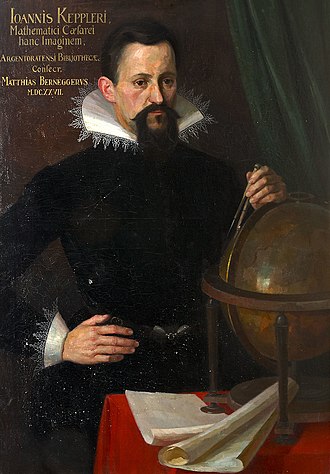
The earliest use of the term camera obscura is found in the 1604 book Ad Vitellionem Paralipomena by German mathematician, astronomer, and astrologer Johannes Kepler. Kepler discovered the working of the camera obscura by recreating its principle with a book replacing a shining body and sending threads from its edges through a many-cornered aperture in a table onto the floor where the threads recreated the shape of the book.
In 1611, Frisian/German astronomers David and Johannes Fabricius (father and son) studied sunspots with a camera obscura, after realizing looking at the Sun directly with the telescope could damage their eyes.
In 1612, Italian mathematician Benedetto Castelli wrote to his mentor, the Italian astronomer, physicist, engineer, philosopher, and mathematician Galileo Galilei about projecting images of the Sun through a telescope (invented in 1608) to study the recently discovered sunspots. Galilei wrote about Castelli's technique to the German Jesuit priest, physicist, and astronomer Christoph Scheiner.
From 1612 to at least 1630, Christoph Scheiner would keep on studying sunspots and constructing new telescopic solar-projection systems.
By 1620 Kepler used a portable camera obscura tent with a modified telescope to draw landscapes.
Dutch inventor Cornelis Drebbel is thought to have constructed a box-type camera obscura which corrected the inversion of the projected image. In 1622, he sold one to the Dutch poet, composer, and diplomat Constantijn Huygens who used it to paint and recommended it to his artist friends. Huygens wrote to his parents:
German Orientalist, mathematician, inventor, poet, and librarian Daniel Schwenter wrote in his 1636 book Deliciae Physico-Mathematicae about an instrument that a man from Pappenheim had shown him, which enabled movement of a lens to project more from a scene through a camera obscura.
In his 1637 book Dioptrique French philosopher, mathematician and scientist René Descartes suggested placing an eye of a recently dead man (or if a dead man was unavailable, the eye of an ox) into an opening in a darkened room and scraping away the flesh at the back until one could see the inverted image formed on the retina.
Italian Jesuit philosopher, mathematician, and astronomer Mario Bettini wrote about making a camera obscura with twelve holes in his Apiaria universae philosophiae mathematicae (1642).
French mathematician, Minim friar, and painter of anamorphic art Jean-François Nicéron (1613–1646) wrote about the camera obscura with convex lenses.
1650 to 1800: Introduction of the magic lantern, popular portable box-type drawing aid, painting aid
The use of the camera obscura to project special shows to entertain an audience seems to have remained very rare.
German Jesuit scientist Gaspar Schott heard from a traveler about a small camera obscura device he had seen in Spain, which one could carry under one arm and could be hidden under a coat. He then constructed his own sliding box camera obscura, which could focus by sliding a wooden box part fitted inside another wooden box part.
By 1659 the magic lantern was introduced and partly replaced the camera obscura as a projection device, while the camera obscura mostly remained popular as a drawing aid.
The 17th century Dutch Masters, such as Johannes Vermeer, were known for their magnificent attention to detail. It has been widely speculated that they made use of the camera obscura.
German philosopher Johann Sturm published an illustrated article about the construction of a portable camera obscura box with a 45° mirror and an oiled paper screen.
Johann Zahn's Oculus Artificialis Teledioptricus Sive Telescopium, published in 1685, contains many descriptions, diagrams, illustrations and sketches of both the camera obscura and the magic lantern.
The scientist Robert Hooke presented a paper in 1694 to the Royal Society, in which he described a portable camera obscura.
From the beginning of the 18th century, craftsmen and opticians would make camera obscura devices in the shape of books, which were much appreciated by lovers of optical devices.
One chapter in the Conte Algarotti's Saggio sopra Pittura (1764) is dedicated to the use of a camera obscura ("optic chamber") in painting.
By the 18th century, following developments by Robert Boyle and Robert Hooke, more easily portable models in boxes became available. These were extensively used by amateur artists while on their travels, but they were also employed by professionals, including Paul Sandby and Joshua Reynolds, whose camera (disguised as a book) is now in the Science Museum in London.
Role in the modern age
The camera obscura has been known for a long time. It helped artists and scientists when Europe was discovering new ways to see the world. Famous thinkers like Leonardo da Vinci and René Descartes used it to learn about how we see and think.
Today, you can make a simple camera obscura using everyday items like a box, paper, tape, and a blanket to block out light. Many schools use this as a fun science or art project. Some artists still use the camera obscura instead of modern cameras to create special kinds of pictures.
Images
Related articles




This article is a child-friendly adaptation of the Wikipedia article on Camera obscura, available under CC BY-SA 4.0.
Images from Wikimedia Commons. Tap any image to view credits and license.