
Catholic theology
Catholic theology is the study of the teachings and beliefs of the Catholic Church. It is based on sacred writings and traditions, and is explained by Church leaders. This theology helps explain important ideas about God, Jesus, and how people can live good lives.
The Church has created summaries of its teachings called creeds and catechisms. One important book is the Catechism of the Catholic Church, published in 1992. These guides help people understand what the Church believes.
Catholic theology has grown over many years, with ideas from early leaders, scholars, and saints. It covers many topics, including the nature of God, the role of Jesus, and the importance of good actions. These teachings help Catholics in their faith and everyday lives.
For broader coverage of this topic, see Christian theology.
Major teachings of the Catholic Church discussed in the early councils of the church are summarized in various creeds, especially the Nicene (Nicene-Constantinopolitan) Creed and the Apostles' Creed. Since the 16th century the church has produced catechisms which summarize its teachings; in 1992, the Catholic Church published the official Catechism of the Catholic Church.
The Catholic Church understands the living tradition of the church to contain its doctrine on faith and morals and to be protected from error, at times through infallibly defined teaching. The church believes in revelation guided by the Holy Spirit through sacred scripture, developed in sacred tradition and entirely rooted in the original deposit of faith. This developed deposit of faith is protected by the "magisterium" or College of Bishops at ecumenical councils overseen by the pope, beginning with the Council of Jerusalem (c. AD 50).
Catholic theology contains a highly developed set of doctrines that have matured over two millennia, from the foundational contributions of the Apostles to the Church Fathers to the Medieval Scholastics to the Modern era. Fundamental areas of Catholic theology include the nature of God, Jesus Christ, humanity, the saints, and the Virgin Mary; divine grace and its role in justification and salvation; and other topics such as Biblical theology, moral theology, spiritual theology, sacramental theology, ecclesiology, and eschatology.
Profession of Faith
Human capacity for God
The Catholic Church teaches that everyone wants God because God made us. Even if people turn away, God still calls us back. Because we are made in God’s image, we can know God exists by thinking and reasoning. To know God personally, He chose to show Himself to us and gave us special help called grace to believe this truth.
In short, the Church teaches that humans are by nature meant to live close to God. Our lives are best when we choose to stay connected to Him.
God comes to meet humanity
The Church teaches that God showed Himself over time, starting in the Old Testament. This began with Adam and Eve and continued after their original sin, as God promised to send a savior. God also showed Himself through special promises called covenants with people like Noah and Abraham. He gave laws to Moses on Mount Sinai and spoke through prophets. The fullest showing of God came through Jesus Christ, God’s Son, who came to Earth as a man.
Creeds
Main article: Creed
Creeds are short statements that explain important beliefs. They started as simple promises made during baptism and grew over time, especially during debates in the 4th and 5th centuries.
The Apostles Creed was created between the 2nd and 9th centuries. It focuses on beliefs about the Trinity and God as Creator. It was used to teach people the basics of Christian belief before they were baptized.
The Nicene Creed was made at meetings called the Councils of Nicaea and Constantinople in the years 325 and 381. It became the main belief statement for Catholic Christians and is said at many Sunday services.
The Chalcedonian Creed was created at the Council of Chalcedon in 451. It teaches that Jesus has two natures — divine and human — that are perfectly united as one person.
The Athanasian Creed states: "We worship one God in Trinity, and Trinity in Unity."
Scriptures
Christianity sees the Bible, with parts called the Old Testament and the New Testament, as very important. Christians believe people wrote the Bible with help from the Holy Spirit.
Catholics think the Bible is special but not the only source for understanding important truths. The Catholic Bible includes books from the Jewish scriptures, called the Tanakh, plus some extra books. These books are split into the Old Testament and the 27 books of the New Testament, mostly written in Greek.
Catholic teaching says there are different ways to understand the Bible. The main way is the literal meaning — what the words directly say. There is also a spiritual way, which has three parts: learning lessons, thinking about good behavior, and thinking about big ideas about life and the future.
Celebration of the Christian mystery
Sacraments
Main article: Sacraments of the Catholic Church
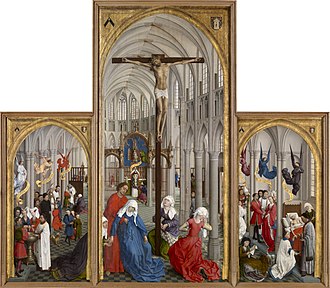
There are seven important actions, called sacraments, in the Catholic Church. The most important one is the Eucharist. These sacraments were created by Jesus and given to the Church. They help people feel God's love. Before receiving some sacraments, people may need to prepare themselves. Through these sacraments, Catholics receive God's love and forgiveness for their mistakes. The seven sacraments are: Baptism, Confirmation, the Eucharist, Penance and Reconciliation, the Anointing of the Sick, Holy Orders, and Matrimony.
In Eastern Catholic Churches, these are often called holy mysteries instead of sacraments.
Liturgy
Main articles: Eucharist in the Catholic Church, Catholic liturgy, and Sacraments of the Catholic Church
Catholics are encouraged to attend Mass every Sunday. During Mass, they remember Jesus' command at the Last Supper to "do this in remembrance of me." In the past, Mass was celebrated using a special book created by Pope Pius V, and the prayers were said in Latin. Now, Mass can also be celebrated in everyday languages.
The Mass has two main parts. The first part, called the Liturgy of the Word, includes readings from the Old and New Testaments, followed by a talk from the priest. The second part, called the Liturgy of the Eucharist, is very important to Catholics as they believe it connects them to Jesus.
Eastern Catholic
See also: Divine Liturgy
In Eastern Catholic Churches, the service is called the Divine Liturgy, and they use different traditions from very early Christian times. The liturgy is seen as connecting people to heaven. It has two parts: the first with scripture readings and sometimes a talk, and the second remembering the Last Supper. By sharing the special bread and wine, Catholics believe they become part of Christ's body on earth, the Church.
Liturgical calendar
Main articles: Liturgical calendar and General Roman Calendar
The Church's year starts with Advent, a time of waiting for the celebration of Jesus' birth. This is followed by a time called Ordinary Time. In Spring, Easter is celebrated after 40 days of preparation called Lent. The Easter celebration includes special days remembering Jesus' Last Supper, his death on the cross, and his coming back to life. The time after Easter leads up to Pentecost, when Catholics remember the Holy Spirit coming to Jesus' followers.
Holy Trinity
Main article: Trinity
The Trinity is a belief that there is one God who exists as three distinct persons. These are called the Father, the Son (Jesus), and the Holy Spirit. The Father is the creator of all things. The Son, Jesus, is both fully human and fully divine. The Holy Spirit connects the Father and the Son and is present in the hearts of people. All three persons are fully God and eternal.
Main article: God the Father § Christianity
Catholics believe in one God, the Father, who created everything. This belief is expressed in the Nicene Creed. God is seen as loving and caring, and desires for people to love one another.
Main articles: God the Son, Son of God § Christianity, Divine filiation, Jesus in Christianity, and Jesus
Catholics believe that Jesus is both fully human and fully divine. After his death, Jesus rose to life again. According to the New Testament, Jesus was conceived by the Holy Spirit and born to the Virgin Mary. His life includes his baptism, healings, teaching, and helping others.
Main article: Holy Spirit (Christianity)
Jesus told his followers that after his death, he would send the Holy Spirit to guide them. The Nicene Creed states that the Holy Spirit is one with God the Father and God the Son. Catholics receive the Holy Spirit through a special ceremony called confirmation. This sacrament is seen as a time of spiritual growth and maturity.
Soteriology
Main articles: Soteriology and Salvation (Christianity)
Sin and salvation
Soteriology is part of Catholic teaching about how people can be saved through Jesus. Eternal life is a gift from God that we cannot earn; it is freely given. The crucifixion of Jesus is seen as a big act that takes away the sins of everyone. Being saved means being made right with God.
Fall of Man
Main article: Fall of Man
The Catholic Church teaches that angels who chose to go against God, led by one called Lucifer, Satan, and the devil, were punished. These angels tempted the first humans, Adam and Eve, who then sinned. This brought suffering and death into the world.
Sin
Main article: Sin
Catholics believe some actions are wrong and break God's rules. There are two kinds of wrong actions. One kind, called mortal sin, is very serious and can stop a person from being with God forever. The other kind, called venial sin, is less serious and does not completely break the relationship with God.
Jesus Christ as savior
Main articles: Christian views of Jesus, Christ, and Redeemer (Christianity)
The church believes Jesus was the savior God promised to send. Catholics think Jesus was God's son who came to Earth to help people. They believe he was born from a virgin named Mary and lived a perfect life. Jesus' death and coming back to life are very important because they show his power over death and offer people a chance at eternal life in heaven.
Penance and conversion
Grace and free will
Further information: Infused righteousness
Catholics believe that God's help, called grace, is needed to do what is right, and people must choose to work with this help. This is different from some other Christian teachings.
Forgiveness of sins
Further information: Baptism § Catholicism, and Penance (Catholic Church)
Catholics believe people can be forgiven for their wrong actions during their life through special church services like Baptism and Reconciliation. If not forgiven in life, some wrong actions can be forgiven after death.
Baptism and second conversion
Main article: Baptism
Baptism is a special ceremony that makes a person a part of the church. It is very important, and babies are usually baptized when they are very young.
Penance and Reconciliation
Main article: Penance (Catholic Church)
After Baptism, if a person does something wrong again, they can go to a priest for help through the sacrament of Penance or Reconciliation. The priest can forgive them and give them guidance.
Afterlife
Eschaton
Main article: Christian eschatology
Catholics believe that after people die, they will face a judgment by Jesus. There are three possible outcomes: being with God forever in heaven, being purified for a time in purgatory, or being separated from God forever in hell. The church teaches that no one is forced to go to hell; it is a choice to reject God's love.
At the end of time, Jesus will come back, and everyone who has died will be brought back to life for a final judgment. This will start a new world where God rules forever.
Prayer for the dead and indulgences
Main articles: Prayer for the dead, Indulgences, and Protestant Reformation
The Catholic Church teaches that people can help those who have died by praying for them. There is also a practice called indulgences, which are special ways to show devotion that can help reduce the time someone might spend in purgatory.
Salvation outside the Catholic Church
Main article: Extra Ecclesiam nulla salus
See also: Baptism of blood and Baptism of desire
The Catholic Church teaches that it is the true church started by Jesus. It believes that people who honestly seek God and try to follow his will can also be saved, even if they are not part of the Catholic Church. The church feels it is important to share its beliefs with everyone.
Ecclesiology
Main article: Catholic ecclesiology
See also: Philosophy, theology, and fundamental theory of Catholic canon law
Catholics believe the Catholic Church is like Jesus being with us today. Jesus told his followers to stay close to him, comparing himself to a vine and them to branches. When Catholics talk about "the Church," they mean more than just a building or leaders — it’s about all the people who believe and follow Jesus together around the world.
Catholics also believe the Church exists in different places — here on earth, in a place of waiting after this life, and in Heaven with God. This connects everyone, living and in Heaven, as one big family. Special prayers are offered to Mary, the mother of Jesus, and other holy people, but this is different from worship, which is only for God. These prayers are a way to ask for their help and guidance.
Ordained ministry: bishops, priests, and deacons
Main articles: Catholic Church hierarchy, College of Bishops, Priesthood (Catholic Church), and Deacon
Men become bishops, priests, or deacons through a special ceremony called Holy Orders. To become a priest, a man needs a college degree and four more years of studying religion. Only men can be priests, bishops, or deacons in the Catholic Church. Bishops are the main leaders, and priests and deacons help them.
Bishops lead areas called dioceses, which are split into smaller groups called parishes. Each parish usually has a priest who helps with many tasks, like teaching and leading services. Deacons can preach, teach, and help with many church activities. They go through special training before they can join the Church.
Apostolic succession
Main article: Apostolic succession
The Catholic Church believes that the pope and bishops are direct successors of the original twelve followers of Jesus. The pope is the main leader of the Catholic Church and is chosen by a group called the College of Cardinals. The Church teaches that it has always stayed true to Jesus' teachings.
Clerical celibacy
Main article: Clerical celibacy (Catholic Church)
In the Latin Church, most priests are chosen from men who are not married and plan to stay that way. This is called celibacy. In some other parts of the Catholic Church, married men can become priests. The Church believes celibacy helps priests focus on their work.
Relationship between bishops and theologians
Bishops and theologians work together. Theologians help explain the Church's teachings and support bishops in guiding the faithful. They work in teams and help each other learn more about their faith.
Contemporary issues
Main article: Catholic social teaching
Main article: Evolution and the Catholic Church
Catholic social teaching is based on the lessons of Jesus. It teaches Catholics to help others, like feeding hungry people, caring for the sick, and welcoming newcomers. Catholics are also encouraged to be kind, patient, and forgiving.
The Catholic Church believes that faith and science can work together. The Church teaches that while our bodies may have developed over time, God gave humans a special spirit that makes us unique. This idea is part of what some call theistic evolution, though people have different opinions about how creation and evolution fit together.
Comparison of traditions
Latin and Eastern Catholicism
Main articles: Latin Church, Eastern Catholic Churches, Palamism, and Essence–energies distinction
The Eastern Catholic Churches follow the traditions of Eastern Christianity. This means they have different ways of thinking and celebrating compared to the Latin Church.
Even though Eastern Catholic Churches respect the leader of the Catholic Church and mostly share the same beliefs, there are small differences. One of these is how they describe Mary going to heaven. They call this the Dormition of the Theotokos.
Eastern Orthodox and Protestant
Further information: Theological differences between the Catholic Church and the Eastern Orthodox Church
Other Christian groups, like the Eastern Orthodox and Protestant churches, have beliefs that are sometimes different from the Catholic Church. The Eastern Orthodox mostly agree with Catholics but have different ideas about the leader of the Church. Protestant churches also have different views.
Pictures
Keep exploring



This article is a child-friendly adaptation of the Wikipedia article on Catholic theology, available under CC BY-SA 4.0.
Images from Wikimedia Commons. Tap any image to view credits and license.