 Safekipedia
Chalk
Adapted from Wikipedia · Adventurer experience
Chalk is a soft, white porous sedimentary carbonate rock. It is a type of limestone made from a mineral called calcite. It formed long ago under the sea when tiny plankton settled on the sea floor.
You can find chalk in many places in Western Europe, especially in areas like France. Some famous chalk cliffs are the Dover cliffs along the Kent coast of the English Channel.
People mine chalk for many uses. It helps make things like quicklime, bricks, and builder's putty. Farmers also use it in agriculture to help balance the pH in soils that are too acidic. Chalk is also used to make blackboard chalk for writing and drawing, even though sometimes other minerals like gypsum are used instead.
Description
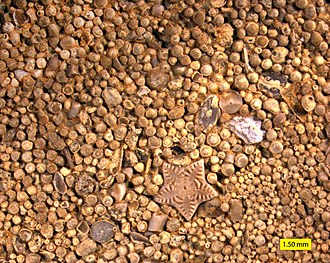
Chalk is a soft, white type of limestone. It is made mostly from tiny pieces of calcite shells of small sea creatures called plankton, such as foraminifera or coccolithophores. These pieces are very small, usually between 0.5 to 4 microns. Some larger pieces come from bigger sea animals like molluscs, echinoderms, or bryozoans.
Chalk is almost pure calcite, CaCO3. It has only a small amount of other minerals like quartz and clay minerals. It is very porous, meaning it has lots of tiny holes. It fizzles when you put acid on it.
Formation
Chalk formed in Western Europe during the Late Cretaceous Epoch and early Palaeocene Epoch, between 100 and 61 million years ago. It was created on wide underwater areas called continental shelves, at depths of 100 to 600 metres. At that time, the climate was dry, which helped the chalk stay pure.
Small sea creatures like coccolithophores and foraminifera built their skeletons from a special kind of mineral, which later became chalk. Unlike other kinds of limestone, chalk did not change much after it formed, which makes it very porous. Flint, a type of chert, is often found in chalk as narrow bands or small lumps, and it likely came from tiny glass-like parts of sea sponges or other siliceous organisms.
Geology and geographic distribution
Chalk is a soft, white rock made from tiny sea creatures. You can see it in the famous White Cliffs of Dover in England. It is also found in the Champagne region and in parts of Germany and Denmark.
Chalk exists on many continents, including North America and Australia. These chalk layers help scientists learn about Earth from millions of years ago.
Mining
Chalk is taken from places above ground and under the ground. In the Industrial Revolution, people needed things like cement, quicklime, and bricks to build, so chalk mining became very important.
Uses
Many people first see chalk in school, where it is used for writing on blackboards. Originally, chalk was made from a mineral called chalk. This type of chalk crumbles easily and leaves particles that stick, letting writing be erased. Today, blackboard chalk may still be made from mineral chalk, but it can also come from other materials like calcium carbonate or gypsum. Gypsum-based chalk is cheaper and very common, while chalk made from calcium carbonate makes less dust and is called “dustless.”
Coloured chalks and sidewalk chalk are often used for drawing on sidewalks, streets, and driveways. These are usually made from gypsum. Magnesium carbonate chalk is used by gymnasts and rock climbers to help them hold onto things better. Chalk is also used in agriculture to help change the pH of some soils, and it is an ingredient in toothpaste as a gentle abrasive. In the past, chalk was used to mark lines in sports like tennis and in building, but these uses have mostly changed now.
Images
Related articles


This article is a child-friendly adaptation of the Wikipedia article on Chalk, available under CC BY-SA 4.0.
Images from Wikimedia Commons. Tap any image to view credits and license.