
Chinese Civil War
The Chinese Civil War was a big fight between two groups in China: the Kuomintang-led government of the Republic of China and the Chinese Communist Party (CCP). This war started on 1 August 1927 and lasted until the Communists won and took control of most of mainland China on 10 December 1949.
The war had two main parts with a break in the middle. At first, from 1926 to 1927, the two groups worked together in the First United Front and fought against local leaders in central China during the Northern Expedition. But then they started fighting each other. This part lasted until 1937.
From 1937 to 1945, they mostly stopped fighting each other to work together against the Japanese invasion of China, with help from the Allies of World War II. But small fights between them still happened.
After Japan was defeated, the war started again, and this time the Communists did very well. From 1945 to 1949, they took control of mainland China and proclaimed the People's Republic of China in 1949. The leaders of the Republic of China had to go to the island of Taiwan. Since then, there has been a stand-off between the two sides, with both saying they are the real government of all China.
Background
After the old Qing dynasty ended and the 1911 Revolution created a new government, China had many leaders fighting for power. Sun Yat-sen tried to bring the country together, but after he died, groups began arguing over how to lead.
Two big groups formed: the Kuomintang, led by Sun Yat-sen, and the Chinese Communist Party (CCP). They worked together for a time with help from the Soviet Union, but soon they disagreed. In 1927, fights broke out between them. Many people were arrested, and the two groups became enemies, starting a long struggle for control of China.
Communist insurgency (1927–1937)
See also: Encirclement Campaigns
In 1927, a group called the CCP began fighting against the government led by the Kuomintang. This started with an uprising in Nanchang on August 1, creating what became known as the Red Army. The fighting happened in places like Changsha, Shantou, and Guangzhou. The Red Army controlled some areas in southern China, but the government kept trying to stop them.
Later, the government tried to surround the Communist areas. In 1934, the CCP broke out and began a long journey called the Long March to escape. This journey covered thousands of kilometers and ended in Shaanxi. During this time, many people joined the CCP, and Mao Zedong became its main leader.
In 1931, the Empire of Japan invaded part of China called Manchuria. Even though the two sides were fighting each other, they later stopped to work together against Japan after an important event known as the Xi'an Incident.
The Long March
Main article: Long March
The Long March was a big journey taken by the CCP to escape from the government's army. It lasted a year and covered a very long distance. The CCP moved through hard terrain to reach Shaanxi. By the end of the march, Mao Zedong became the main leader of the CCP.
Second Sino-Japanese War (1937–1945)
Main article: Second Sino-Japanese War
In 1937, Japan invaded parts of China, taking over areas in the north and along the coast. After Japan attacked Pearl Harbor in 1941, this conflict became part of the World War II.
During this time, two main Chinese groups, the CCP and KMT, were supposed to work together against Japan, but they did not cooperate well. The CCP used surprise attacks, while the KMT fought in big battles. Even though they were both fighting Japan, these groups were still trying to control areas not taken by Japan. This caused tension between them.
As the war went on, Japan attacked the KMT forces hard. Meanwhile, the CCP grew stronger by gaining support from people in the areas they controlled. By 1945, the CCP had more troops and controlled places where many people lived.
Immediate post-war clashes (1945–1946)
After World War II ended, the Communist and Nationalist leaders in China both wanted to control areas that Japan had taken. Some Japanese soldiers surrendered to Nationalist troops, but in other places, Communist forces accepted them instead. This caused fighting between the two sides.
Leaders from both groups tried to talk about peace, but battles kept happening. By late 1945, the Soviet Union gave weapons to the Communists. The fighting grew until full war began again in June 1946, starting a long civil war in China.
Nationwide civil war (1946–1949)
By the end of the war with Japan, the Chinese Communist Party had grown stronger. They had many soldiers and support from local groups. They controlled many important areas and cities.
Fighting between the two sides started again in 1946. The Communists used clever plans and got support from farmers by promising land changes. Big battles happened in the northeast, east China, and near Beijing and Tianjin. These battles helped the Communists take control.
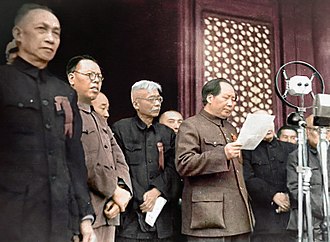
In 1949, the Communists captured many key cities. The leaders of the other side went to the island of Taiwan. On October 1, 1949, Mao Zedong announced the start of the People's Republic of China.
Nationalist reorganization and continued resistance (1949–1965)
After moving to Taiwan in 1949, the Nationalist government led by Chiang Kai-shek worked to rebuild its military and political systems. With help from the United States and a secret group of former Japanese military officers, they reorganised their forces and improved training. They also changed land rules to give more land to farmers, which helped improve support for their government.
Many people who moved to Taiwan still hoped to return to their homes on the mainland. They missed their families and believed in the goal of freeing mainland China from Communist control. Though they couldn’t send letters or receive news, this hope kept many determined for years. The Nationalists also tried several plans to send forces back to the mainland, but these efforts ended in the early 1970s. Some Nationalist soldiers also stayed in areas near China’s southwest border, continuing small operations for many years before finally joining others in Taiwan.
Aftermath
Main articles: Cross-strait relations and Retreat of the government of the Republic of China to Taiwan
See also: Political status of Taiwan, Two Chinas, and Domino theory
After the Chinese Civil War ended, some people thought the government might lose when the other side tried to take over Taiwan. At first, the United States did not want to help much, but this changed when a big conflict started in Korea in 1950. This made the United States send its navy to protect Taiwan.
When the war ended, some soldiers who could not get to Taiwan kept fighting, but they were defeated. The new government took control of all of mainland China by 1951, except for a few small islands.
After winning, the new government helped another group fighting in Vietnam. This support helped that group win battles against French forces.
Taiwan Strait tensions
Though some thought it wasn’t useful, Taiwan’s government kept a few islands nearby as important for any plan to take back mainland China. In 1954, the other side started attacking one of these islands, which led to more fighting. The United States helped Taiwan during these battles.
More fights happened later, like in 1958 and again in 1995–96 and 2022, when a visit by a U.S. leader caused big military exercises around Taiwan.
Political fallout
Main articles: China and the United Nations and United Nations General Assembly Resolution 2758
In 1971, most countries started recognizing the new government as China’s representative in the United Nations. Over time, relations between Taiwan and mainland China improved, especially after 2008 when a new leader in Taiwan worked to improve ties. Even so, some people still worry about possible conflict between the two sides.
Analysis
The Communist victory over the Nationalists was a big surprise in the twentieth century. Many experts say this happened because the Communists won the support of many ordinary people, while the Nationalist government had problems.
The Nationalists faced big challenges, especially with money and supplies. Their soldiers often lacked good food and equipment, and many chose to leave the army. People lost trust in the Nationalist government because they thought it was unfair.
The Communists were successful because they changed laws about land, which helped farmers. Their leaders worked together well, and their main leader, Mao Zedong, was very good at keeping everyone united.
In the end, the Communists were able to win because they had more support from the people and better planning.
Atrocities
During the Chinese Civil War, both the Nationalists and the Communists did terrible things to many people who were not fighting. Lots of ordinary people were hurt or killed.
The Nationalists, led by the Kuomintang, did many bad things after 1927. They hurt many people, mostly farmers, during their fights against the Communists.
The Communists also did harmful actions. They hurt soldiers who disagreed with their leaders. In some places, they took land from people and made others work without pay. In one city, they stopped food from coming in, and many people went hungry. Both sides did very hard things to each other and to ordinary people during the war.
Pictures
Keep exploring



This article is a child-friendly adaptation of the Wikipedia article on Chinese Civil War, available under CC BY-SA 4.0.
Images from Wikimedia Commons. Tap any image to view credits and license.