 Safekipedia
Chromatic scale
Adapted from Wikipedia · Adventurer experience
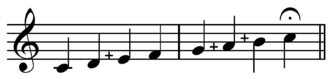
A chromatic scale is a special set of twelve notes used in Western music. These notes are played within one octave. Each note is a tiny step, called a semitone, away from the next note. This means there is only a very small change in pitch between any two notes in the chromatic scale.
When instruments are tuned using a method called 12-tone equal temperament, the chromatic scale becomes very useful. It helps musicians play in any key and matches the natural sounds we hear. The chromatic scale includes all the notes found in simpler scales, like the major and minor scales.
Instruments such as the piano are built to easily play the chromatic scale. Other instruments, like the trombone and violin, can also play notes between the ones on a piano, called microtones. This makes the chromatic scale an important tool for musicians to create many different kinds of music.
Definition
The chromatic scale is a special set of twelve notes in music. Each note is a very small step, called a semitone, above or below the next note. This scale includes every note you can play on a piano in one octave. It includes both the white keys and the black keys.
Because the notes are evenly spaced, the chromatic scale can be used in many kinds of music. It adds color and movement to music. Instruments like the piano are made so they can easily play the chromatic scale.
Notation
The chromatic scale can be written in different ways depending on whether the music is played going up or down. When playing up, we usually use sharps, and when playing down, we use flats. This helps musicians know which notes to play.
Some notes in the chromatic scale can also have more than one name. For example, when going up, the notes might be called Do, Di, Re, and so on. When going down, they might be called Ti, Te, La, and others. Using numbers from 0 to 11 can also help tell these notes apart.
Pitch-rational tunings
Pythagorean
Main article: Pythagorean tuning
Long ago, before the 13th century, people often used a special kind of chromatic scale called the Pythagorean chromatic scale. This scale uses a unique tuning way that makes the twelve notes not exactly the same size. Because of this, the scale does not look perfectly even. Over time, many new tuning ways were made that also have this uneven quality.
Just intonation
Main article: Just intonation § Twelve-tone scale
There is another tuning way called 5-limit just intonation. In this way, there is a special chromatic scale named Ptolemy’s intense chromatic scale. This scale adds extra notes between some notes, making it more detailed. Many pairs of notes can be used in different ways because small tuning differences are smoothed out.
| C | D♭ | C♯ | D | E♭ | D♯ | E | F | G♭ | F♯ | G | A♭ | G♯ | A | B♭ | A♯ | B | C | |
|---|---|---|---|---|---|---|---|---|---|---|---|---|---|---|---|---|---|---|
| Pitch ratio | 1 | 256⁄243 | 2187⁄2048 | 9⁄8 | 32⁄27 | 19683⁄16384 | 81⁄64 | 4⁄3 | 1024⁄729 | 729⁄512 | 3⁄2 | 128⁄81 | 6561⁄4096 | 27⁄16 | 16⁄9 | 59049⁄32768 | 243⁄128 | 2 |
| Cents | 0 | 90.2 | 113.7 | 203.9 | 294.1 | 317.6 | 407.8 | 498 | 588.3 | 611.7 | 702 | 792.2 | 815.6 | 905.9 | 996.1 | 1019.6 | 1109.8 | 1200 |
| C | C♯ | D♭ | D | D♯ | E♭ | E | E♯/F♭ | F | F♯ | G♭ | G | G♯ | A♭ | A | A♯ | B♭ | B | B♯/C♭ | C | |
|---|---|---|---|---|---|---|---|---|---|---|---|---|---|---|---|---|---|---|---|---|
| Pitch ratio | 1 | 25⁄24 | 16⁄15 | 9⁄8 | 75⁄64 | 6⁄5 | 5⁄4 | 32⁄25 | 4⁄3 | 25⁄18 | 36⁄25 | 3⁄2 | 25⁄16 | 8⁄5 | 5⁄3 | 125⁄72 | 9⁄5 | 15⁄8 | 48⁄25 | 2 |
| Cents | 0 | 70.7 | 111.7 | 203.9 | 274.6 | 315.6 | 386.3 | 427.4 | 498 | 568.7 | 631.3 | 702 | 772.6 | 813.7 | 884.4 | 955 | 1017.6 | 1088.3 | 1129.3 | 1200 |
Non-Western cultures
The ancient Chinese chromatic scale is called Shí-èr-lǜ. These twelve notes, called the twelve lü, were used as basic notes to build different scales. In Western music, the chromatic scale is also a set of basic notes used to make other scales.
Images
Related articles


This article is a child-friendly adaptation of the Wikipedia article on Chromatic scale, available under CC BY-SA 4.0.
Images from Wikimedia Commons. Tap any image to view credits and license.