 Safekipedia
Cultural Revolution
Adapted from Wikipedia · Adventurer experience
Cultural Revolution
The Cultural Revolution, also called the Great Proletarian Cultural Revolution, was a big movement in the People's Republic of China. It started in 1966 by CCP chairman Mao Zedong and lasted until he died in 1976. The goal was to keep Chinese communism strong by getting rid of any ideas that seemed like capitalist or traditional influences.
Mao thought some people in government and society wanted to bring back capitalism. He told young people it was okay to question leaders. Many students became Red Guards and worked to change things. They sometimes took down old buildings and items. This time was very confusing and hard for many people in China.
After Mao died, new leaders changed the country and moved away from the ideas of the Cultural Revolution. In 1981, the Communist Party said this time caused big problems. Today, people in China remember this time in different ways, often calling it the “ten years of chaos” because of how it changed everyone.
Etymology
People talked about the idea of a "cultural revolution" even before China became the People's Republic of China. At that time, the term meant helping more people learn to read so they could join in community decisions. People sometimes compared this idea to events like the May Fourth Movement and the Soviet cultural revolution from 1928 to 1931.
Background
Creation of the People's Republic
Main article: Proclamation of the People's Republic of China
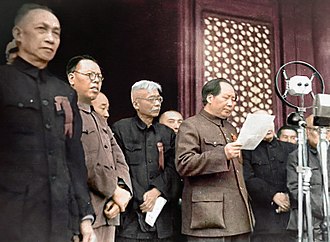
On 1 October 1949, Mao Zedong announced the start of the People’s Republic of China, ending a long and difficult war. Some former soldiers and leaders who did not support the new government fled to Taiwan. Mao began efforts to remove anyone he thought might threaten his new leadership.
Great Leap Forward
Main articles: Great Leap Forward and Great Chinese Famine
See also: Seven Thousand Cadres Conference
In 1962, a big meeting happened in Beijing with thousands of important people. Leaders talked about mistakes made during a past plan called the Great Leap Forward. Mao admitted some blame but stepped back from economic decisions. Later, Mao grew unhappy with changes happening in China’s farms and fields.
Impact of international tensions and anti-revisionism
Main article: Sino-Soviet split
In the 1950s, China and the Soviet Union were both communist countries, but they began to disagree. The Soviet leader changed some important ideas, which upset Mao. This caused problems between the two countries. Mao worried that these disagreements might affect China’s safety and its goals.
Socialist Education Movement and Hai Rui Dismissed from Office
See also: Socialist Education Movement and Hai Rui Dismissed from Office
In 1963, Mao started a movement to strengthen communist ideas in China. He focused on removing anyone he thought was not fully loyal. A play written by a Beijing official caught Mao’s attention. Mao believed the play was a hidden criticism of him, leading to more conflict within the government.
1966: Outbreak
The Cultural Revolution was a big movement in China that started in 1966 and lasted until 1976. It began in the spring of 1966 and had two main parts. The first part lasted from spring 1966 to summer 1968. The second part lasted until fall 1976.
In May 1966, a meeting was held in Beijing where leaders talked about important ideas. Students started groups called Red Guards. Classes were cancelled, and many students gathered in Beijing to show their support.
In July 1966, Mao Zedong wrote a message called "Bombard the Headquarters," asking people to challenge leaders. Red Guards met in August 1966, and Mao encouraged them to make changes. Many places and traditions were changed during this time.
1967: Seizure of power
Main article: Seizure of power (Cultural Revolution)
See also: Violent struggle, Rebel Faction (Cultural Revolution), Conservative Faction (Cultural Revolution), and Smashing gong-jian-fa
During this time, people formed different groups. Some groups supported leader Mao Zedong, while others supported more moderate leaders. In January 1967, a policy was made to help these groups take control of local governments.
In March 1967, a plan was made to send military troops to schools and workplaces to help calm things down. However, not all military leaders agreed with these changes, which caused more problems. In Shanghai, a young worker helped organize a group that took over the city's government in January 1967. Soon, many other local governments lost their power to new groups called "revolutionary committees."
Fighting and disagreements grew between these groups and the military. In some places, like Wuhan, leaders tried to stop the changes, but this led to more conflict. By the end of 1967, the military had become an important force in controlling the country. Despite the trouble, efforts were made to improve healthcare in rural areas, with new medical stations helping people stay healthy.
1968: Purges
See also: Cleansing the Class Ranks
In 1968, a big political cleanup began. Many people were sent to work in the countryside.
In July, leaders of a student group called the Red Guards met with Mao. They talked about ending fights among students. Mao said he had sent workers to help stop the violence.
That same year, Mao started a movement called "Down to the Countryside." Young people from cities were sent to live and work in rural areas. This helped move students away from cities.
1969–1971: Lin Biao
The 9th National Congress happened in April 1969. It was meant to bring new ideas and leaders into the party after some older members had been removed. The way leaders were chosen changed, with military leaders having more say. Lin Biao, a top military leader, became very important and was named as Mao Zedong's main successor.
Lin was given a special role in the party, and his name was written into the party constitution as Mao's closest helper. He made a big speech at the Congress, talking about some past leaders and stressing Mao's ideas. The Congress also restarted some important party groups that had stopped working earlier in the Cultural Revolution.
In early 1970, a new effort started to strengthen the party's control. Sadly, many people were treated badly during this time.
Mao tried to reorganize the party, but there were still disagreements, especially between Lin and other leaders. Tensions grew, especially after border clashes with the USSR in 1969. In October 1969, Lin ordered preparations for war without Mao's approval, which upset Mao.
Attempts were made to give Lin an official government role, but Mao did not agree. Arguments between leaders increased, and Mao removed some of Lin's supporters from key positions.
In 1971, there were worries about Lin's actions. Lin and some of his close allies tried to leave China, but their plane crashed, and everyone on board died. The exact reasons for the crash are still not known. This event surprised many people and created confusion within the party about what had happened.
1972–1976: The Gang of Four
Main article: Gang of Four
After some hard times, Mao Zedong asked old friends for help. He brought a young worker named Wang Hongwen from Shanghai to Beijing to help lead the country. Wang seemed like a good person to help guide China.
Jiang Qing, Mao’s wife, became more powerful. She joined Wang and two others, Zhang Chunqiao and Yao Wenyuan, to form a group called the Gang of Four. They wanted to control what people thought and said.
China’s economy was having problems, and many important workers had lost their jobs. Zhou Enlai, a leader who wanted calm change, tried to fix the economy, but the Gang of Four did not like him. They started a campaign against old ideas to weaken Zhou’s influence.
Deng Xiaoping's rehabilitation (1975)
Deng Xiaoping returned to help lead China in 1973. After Zhou Enlai stepped back from politics in 1975, Deng took on many important jobs. He worked to improve China’s economy and bring calm. But some leaders, including the Gang of Four, did not agree with Deng’s ideas. They worried his changes might undo the work of the Cultural Revolution.
Death of Zhou Enlai
On 8 January 1976, Zhou Enlai passed away from illness. Many people in China respected Zhou and wanted to honor him. But the Gang of Four tried to stop public mourning, which made many people unhappy.
Tiananmen incident
Main article: 1976 Tiananmen incident
On 4 April 1976, many people gathered in Tiananmen Square to remember Zhou Enlai. They left flowers, banners, and poems to show their respect. Some people also showed they were unhappy with the Gang of Four and the changes made during the Cultural Revolution. The government tried to stop these memorials, which caused some trouble.
Death of Mao Zedong and the Gang of Four's downfall
See also: Death and state funeral of Mao Zedong and Smashing the Gang of Four
Mao Zedong passed away on 9 September 1976. After his death, Hua Guofeng, whom Mao had trusted, became the new leader. With help from the army and other important leaders, Hua and his allies arrested the Gang of Four, ending their power over China.
Aftermath
After the Cultural Revolution ended, China began to change and heal. Leaders worked to fix problems from those years. Deng Xiaoping, a new leader, wanted to bring fresh ideas and changes to help China grow.
Many people who were treated unfairly during the Cultural Revolution were cleared of false accusations and honored again. The government said the Cultural Revolution caused big problems for the country and its people. Leaders tried to learn from past mistakes and make new plans for the future.
Atrocities
Many people died during the Cultural Revolution. Some of these deaths happened after big public events had ended, as people tried to bring back order to their communities and jobs.
Accidents also caused deaths, such as the collapse of the Banqiao Dam in 1975.
Fighting happened in many parts of China, and sometimes people were hurt or killed. These fights were sometimes led by local leaders or groups. Many people were treated very badly, accused of being spies or troublemakers. Some were put in prison or had their things taken away.
The Cultural Revolution also caused trouble for some minority groups. Their languages, customs, and religious practices were targeted, and many suffered. In Inner Mongolia, many people were harmed. In Tibet, many monasteries were destroyed, and monks and nuns were harmed. Even with these problems, some traditions survived in faraway places.
Cultural impact and influence
The Cultural Revolution aimed to remove old traditions and ideas from Chinese society. This led to many changes, including closing schools and changing how art and music were made. Some important places were also damaged.
During this time, students called Red Guards formed groups to support their leaders. They sometimes treated teachers and parents harshly, which caused sadness for many families. Many important people, including scientists and writers, faced difficult times and were sent to work in rural areas.
Schools and universities were closed for several years, which affected many students' education. New ways of teaching were tried, but these changes were hard for everyone. Even today, some parts of China still feel the effects of these changes.
Foreign relations
In the early years of a big movement in China called the Cultural Revolution, China's embassies around the world were not working well. In 1969, Mao Zedong talked about how China felt alone and needed to improve its relationships with other countries.
There was a big tension between China and the Soviet Union in 1969. The Soviet Union planned a big attack but this was stopped with help from the United States. China also supported groups in several countries in Southeast Asia, like Indonesia, Malaysia, Vietnam, Laos, Myanmar, and Cambodia, by sending money and ideas. This included help to a group in Cambodia called the Khmer Rouge. By the 1970s, China had trouble helping North Vietnam in its war against South Vietnam because of its own economic problems.
Evaluations
Main article: Evaluation of the Cultural Revolution
In 1981, leaders of the Chinese Communist Party said the Cultural Revolution caused big problems for the country and its people. After this, many people in China began to question the ideas from the Cultural Revolution and wanted to learn more about the world.
Today, talking about the Cultural Revolution is still controlled in China. Books and online discussions about it are watched closely by the government, and many old documents are still kept secret. People have different opinions about the leader Mao Zedong, with some seeing him as a hero and others thinking he made poor decisions.
Images
Related articles


This article is a child-friendly adaptation of the Wikipedia article on Cultural Revolution, available under CC BY-SA 4.0.
Images from Wikimedia Commons. Tap any image to view credits and license.