 Safekipedia
Cvetković–Maček Agreement
Adapted from Wikipedia · Adventurer experience
The Cvetković–Maček Agreement (Serbo-Croatian: Sporazum Cvetković-Maček, Споразум Цветковић-Мачек), also known simply as the Sporazum in English-language histories, was a political compromise about internal divisions in the Kingdom of Yugoslavia. It was settled on August 26, 1939, by Yugoslav prime minister Dragiša Cvetković (an ethnic Serb) and by Vladko Maček (a Croat politician).
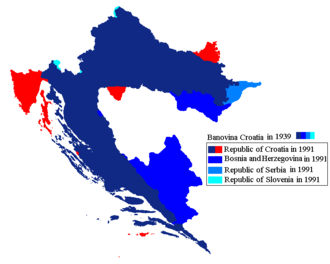
The agreement established the Banovina of Croatia, with boundaries drawn to include as many ethnic Croats as possible. This created within unitary Yugoslavia an autonomous Croatian sub-state, which was a long-standing demand of Croat politicians since the 1918 founding of the Kingdom of Serbs, Croats and Slovenes (Yugoslavia).
The Banovina later provided a model for eventual post-war constitutional arrangements in Federal Yugoslavia (1943–1945).
Background
Administration in the 1920s & the Croatian Question
Yugoslavia had two main ways of setting up its areas in the 1920s. In 1921, a plan called the Vidovdan Constitution made 33 areas, mostly designed to give more power to ethnic Serbs. This upset many Croats.
The constitution caused anger, especially when its leader, Stjepan Radić, was shot in parliament in 1928. After this, many Croats lost faith in the constitution.
From the start, the Croats were worried about how they would fit into Yugoslavia. Some wanted full independence or a loose union of separate nations. Others wanted Croatia to be separate from Serbian control.
The Royal Dictatorship of the 1930s
In 1929, King Alexander took control and changed the government system. Instead of 33 areas, he made nine banovinas, named after rivers. Though they seemed neutral, they still favored Serbs.
Many prime ministers came and went during this time, but Milan Stojadinović was in charge the longest, from 1935 to 1939. He strongly supported a central government and did not want to give in to Croatian demands. He lost his position in February 1939 and was replaced by Dragiša Cvetković. Cvetković tried to make a deal with Vladko Maček, the leader of the Croatian regionalist movement.
The Role of the Croats in Government, 1918–1939
Stjepan Radić, leader of the Croatian Peasant Party, first refused to work with the Yugoslav government. But later, he changed his mind and decided to work within the system.
After Radić died in 1928, Vladko Maček took over. He tried to work with other groups, forming alliances to challenge the government. In 1938, these alliances won a lot of votes, showing that many people were unhappy with the current government. This led to Stojadinović leaving and Cvetković taking over in 1939.
Agreement
Negotiations
Prime Minister Dragiša Cvetković met with Croat politician Vladko Maček in Zagreb to talk about helping Croatia. Cvetković wanted support from the Croat people, and Maček wanted more control for Croatia. They talked from April to August 1939 and made an agreement on August 26, 1939.
Terms
The agreement created the Banovina of Croatia. This area included many places where most people were Croatian. Serbs, Croats, and Slovenes were to be treated equally. Croatia would handle its own local matters like education and roads, while the national government kept control of important issues like defense and safety.
Outcome
The Banovina of Croatia was about a third of Yugoslavia’s land. It had its own parliament in Zagreb. However, the agreement was not fully carried out because World War II began very soon after it was made.
Reaction
Croatia
Most Croats were happy at first to have their own government. But some groups were not satisfied because Croatia was not fully independent. As problems grew with the start of World War II, many Croats became unhappy with the agreement.
Serbia
Many Serbs were angry because large numbers of Serbs now lived under Croatian rule. They felt it was unfair and asked for similar autonomy for Serbia. This caused tension between Serbs and Croats.
Rest of Yugoslavia
Bosniaks felt left out because they had no special national area and were split among different regions. Slovenes also felt left out because they did not receive the same special rights as Croats.
Related articles


This article is a child-friendly adaptation of the Wikipedia article on Cvetković–Maček Agreement, available under CC BY-SA 4.0.
Images from Wikimedia Commons. Tap any image to view credits and license.