 Safekipedia
Dance
Adapted from Wikipedia · Adventurer experience
Dance is an art form where people move their bodies in pretty patterns. These movements can be made up as you go or planned ahead. Dance is often done with music, and sometimes dancers also play instruments.
There are two main kinds of group dances: theatrical dances, which are performed on a stage, and participatory dances, where everyone joins in. Dances can bring people together for fun, celebrate special events, or be part of religious ceremonies. People also dance to stay healthy or to train for sports.
You can dance by yourself to exercise or show how you feel. Dancing is enjoyed by people all over the world, and it doesn’t need a planned routine to be special.
Theatrical and participatory dance
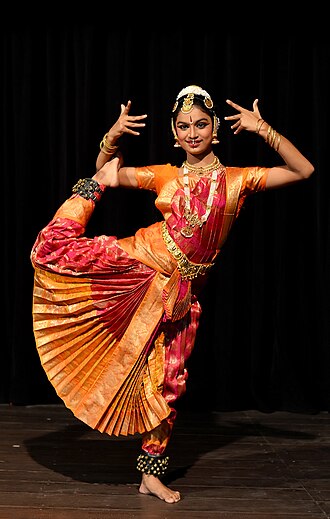
Theatrical dance, also called performance or concert dance, is meant to be watched by an audience. It is usually done on a stage by skilled dancers. This type of dance often tells a story using movements. It may also use mime, costume, and scenery to help tell the story. Examples include Western ballet and modern dance, Classical Indian dance like Bharatanatyam, and Chinese and Japanese dances such as the dragon dance. These dances are often seen in opera and musical theatre too.
Participatory dance is done with others, for fun, to meet people, or to stay healthy. It might be a folk dance, a social dance, or a dance done in lines, circles, or squares. Some dances are done with a partner, like in Western ballroom dancing. These dances usually don’t tell a story. Sometimes everyone does the same steps, but in some places, people dance freely together.
History
Main article: History of dance
Dance has a very long history. Ancient paintings found in Madhya Pradesh, India at the Rock Shelters of Bhimbetka show people dancing. These paintings are about 10,000 years old. In ancient Egypt, tomb paintings from around 3300 BC also show dancers. Before people could write, dance may have been a way to tell stories and share them.
Early writers like Plato, Aristotle, Plutarch, and Lucian wrote about dance in Greece. The Bible and Talmud also mention dance. In very old China, pottery shows groups of people dancing together. Dance was part of special rituals in ancient China. In India, important old books talk about dance. One of these books is the Natya Shastra, written by Bharata Muni. Dance remains important in India today, in culture, rituals, and movies from the Bollywood industry. Many dance styles we see now come from old traditions and ceremonies.
Music
Dance is often done with music, but not always. Dancers might move to music, or they might make their own sounds, like in tap dance or gumboot dance. Many old dances and music were made for each other, such as the jig, waltz, tango, disco, and salsa. Sometimes a type of music and a dance share the same name but grew in different ways, like classical music and classical ballet. The dance moves and the music work together to tell a story.
Rhythm
Rhythm and dance are closely linked. Dance steps often follow a steady beat, like matching the music. Different dances have their own timing and patterns. For example, the tango is usually danced in 24 time, with steps that match the beat.
Dancers use strong and weak movements, like stepping left and right or forward and backward. This helps make patterns in the dance. Some dances use more complex rhythms, like folk dances from the Balkans. Music and dance have influenced each other for a long time.
Approaches
Dance can be done in many ways. Sometimes it tells a story, like in a ballet or opera. The moves show how the characters feel and what they are doing. This type of dance has longer, more expressive steps. For example, in Swan Lake, dancers use special steps to act out the story.
Social dances, like the waltz or polka, are for people to dance together. These dances match the music's beat closely. In some dances, like tap dance, the dancers' feet can make part of the music. Dancers in different cultures, such as African dance, follow basic steps but can also add their own creative rhythms.
Cultural traditions
Africa
Main article: African dance
Dance in Africa is part of community life and big events like births, weddings, and funerals. Dances help share cultural values, tell stories, and bring people together. There are thousands of different dances across the continent, with styles ranging from traditional to modern. Over time, outside influences have shaped African dance, but it still plays important roles today, such as celebrating new community buildings or bringing people together in cities.
Asia
See also: History of dance § Asia
Indian classical dances share common features like hand positions and body movements, often performed with music. There are many regional styles across India. In the Punjab area, the Bhangra dance comes from harvest celebrations and festivals. In Indonesia, dances reflect the country’s many cultures and often have special meanings. The dances of the Middle East, such as dabke, usually involve participants holding hands and moving in a circle.
Europe and North America
Main article: Concert dance
See also: History of dance § Europe
Folk dances in Europe often include group participation and fixed music patterns. Some, like the maypole dance, are shared across many countries. Ballet began in Italy and France, evolving from court performances into a professional art form. The 20th century brought new styles like modern dance. African American dances like tap, jazz, and hip hop have influenced dance worldwide. Fusions of ballet with these styles have also emerged.
Latin America
Main article: Latin American dance
Dance is a key part of life in Latin America. Dances such as Brazilian Samba, Argentinian tango, and Cuban salsa are popular around the world, while other dances like merengue and cueca are important to their own cultures. These dances bring together different groups of people and have helped shape a shared identity across the region. Traditional festivals, like Carnival, feature many of these dances in big celebrations.
Dance styles
See also: List of dance styles
Dance has many different styles, each with its own special moves and feelings. Some dances, like ballet, began a long time ago during the Italian Renaissance. Ballet is known for its beautiful, exact steps and stories told through choreography. At parties like weddings, people might dance ballroom dance, such as the waltz or tango, usually with a partner.
Other dances come from specific cultures, like jazz dance from African-American folk dance or Bollywood dance, which mixes old Indian dances with new styles. New styles appeared in the 1970s, such as aerial dance, hip-hop dance, modern dance, and street dance. Dances often start in one place but then spread to be enjoyed all over the world.
Education
Dance is taught in many colleges and universities. It is part of arts and humanities programs. Some schools give out Bachelor of Arts and other degrees in Dance. Students learn how to perform dances, create new ones, study different dance cultures, understand how the body moves, write about dances, and see how dance can make people feel good.
Dance classes are for people of all ages, even as young as two years old. You can find dance lessons in studios around the world. Some public schools also have beginner dance classes and dance teams that perform at school events.
Occupations
Main article: List of dance occupations
Professional dancers often work for special shows or events. They sometimes face tough competition and may not earn a lot of money, so many have other jobs too. In the U.S., many dancers join groups such as the American Guild of Musical Artists, Screen Actors Guild, and Actors' Equity Association to help make sure they are treated well and paid fairly. Dancers need lots of energy and can do many different dance styles to do well.
Dance teachers help others learn and do dance. They sometimes get their students ready for contests too. Teachers usually have done dance before and know many dance styles to make good routines. They may work at dance schools, universities, or private studios.
Choreographers make up the moves in dances, often working on special projects or joining a dance group.
Dance studios are private places that offer many kinds of classes, such as hip hop, jazz, contemporary, and ballet. These studios have become more popular and are fun places for people to learn and enjoy dancing.
Competition judges are experienced dancers who have worked in places like Broadway or ballet companies. They use their skills to give scores and advice to help dancers get better.
Competitions
A dance competition is an event where dancers show off their moves in front of judges. They perform to win awards or prizes. There are many kinds of dance competitions. Each focuses on different dance styles. These events usually last two or three days. They happen in regions or across the whole country. Dancers do routines they planned before, often about two minutes long. Styles can be contemporary, lyrical, jazz, tap, hip hop, and ballet. Judges look at how well the dancers planned their moves, how they felt while dancing, their skills, and the overall look, like costumes and music. Competitions help dancers learn and perform for others, sometimes in professional places or school theatres. Groups are often based on the dance style, age, experience, and number of dancers.
One special type is ballroom dance. It became a competitive sport when the World Dance Council made rules for standard dances. These include the Waltz, Tango, Foxtrot, and others. Dancers practice for years to master these styles. They start at the lowest level and aim for the highest international level. They compete in pairs, often staying together for many years. To move up levels, they must be in the top three. They begin at local competitions and later compete nationally or internationally, sometimes traveling to other countries. Judges use a scoring system to decide who moves to the next rounds.
Other types of dance competitions include single-style events, like highland dance and Irish dance. These only allow one dance style. There are also open competitions, which allow many different styles. Dance has tried to become an Olympic sport since the 1930s. Breakdancing was included in the 2021 summer Olympics.
Main Article: Ballroom dance
Dance diplomacy
During the 1950s and 1960s, dance helped countries build friendship. The People's Republic of China used dance to show respect for traditions in new countries like Indonesia, India, and Burma. This helped make good relationships with nations that were once ruled by European powers.
Health
Dance is good for your health in many ways. It helps your heart, reduces stress, and makes you more flexible. It also strengthens your muscles and bones. Dancing improves your balance and coordination. It can even help your brain by improving memory.
Dancers sometimes worry about their body shape. It’s important for dancers to take care of their bodies and eat well to stay healthy.
Dance in pop culture
Dance is very popular on social media, especially on TikTok. In 2020, many people used TikTok dances to stay connected while staying at home. Professional dancers use the app to share their art and earn money, even though they usually work in big studios.
Television shows like Dancing with the Stars, So You Think You Can Dance, and Dance Moms have helped more people enjoy dance. These shows display the skill and practice needed for dance routines, inspiring children to try dancing. Commercial dance is used to advertise products or ideas in music videos, TV shows, commercials, movies, advertisements, concerts, Broadway, and Las Vegas shows.
Images
Related articles



This article is a child-friendly adaptation of the Wikipedia article on Dance, available under CC BY-SA 4.0.
Images from Wikimedia Commons. Tap any image to view credits and license.