 Safekipedia
Docking and berthing of spacecraft
Adapted from Wikipedia · Adventurer experience
Docking and berthing of spacecraft
Docking and berthing are ways that two spacecraft connect in space. When two spacecraft dock, they join together while both are moving through space. This is like two cars meeting and linking up while driving.
Berthing is different. In berthing, a robot arm moves a spacecraft or module and places it into another spacecraft, such as a space station. This is like a crane lifting a box and putting it exactly where it should go.
These connections can be temporary or last longer, such as when adding new parts to a space station. Docking is quicker and better for emergencies, while berthing takes more time and work. Both methods help astronauts live and work together in space, like on the International Space Station.
History
Docking
When two space vehicles connect, it is called docking. This joining can be temporary or last longer, like when parts of a space station are added.
The United States first worked on docking during Project Gemini. In 1965, they tried to connect two spacecraft but had some trouble. Later, in 1966, they docked for the first time. The Apollo program needed docking to land people on the Moon. The Soviet Union used automated systems for docking starting in 1967. They docked two uncrewed spacecraft and later achieved the first crewed docking in 1969.
Berthing
Berthing is when spacecraft or payloads are placed inside another vehicle. This was done with the Space Shuttle, which could capture free-flying spacecraft or hold payloads in its bay using different tools.
Hardware
Docking and berthing systems can be androgynous (ungendered) or non-androgynous (gendered). In non-androgynous systems, each spacecraft has a unique design, like male and female parts, and can only connect in one way. Two spacecraft with the same design cannot connect.
Androgynous systems have the same design on both spacecraft. This means any two spacecraft can connect, helping with rescue missions and making planning easier.
Adapters help different types of docking or berthing systems connect. Examples include:
-
ASTP Docking Module: Changed U.S. systems for the Apollo–Soyuz Test Project mission.
-
Pressurized Mating Adapter (PMA): Connects different parts of the ISS.
-
International Docking Adapter (IDA): Allows spacecraft to use a common docking standard.
-
SSPA-GM: Changes docking rings for certain ports on the ISS.
ASTP Docking Module
Pressurized Mating Adapter
International Docking Adapter
APAS to SSVP (SSVPA-GM) Docking Ring
| Image | Name | Method | Internal crew transfer | Type |
|---|---|---|---|---|
| Gemini Docking Mechanism | Docking | No | Non-Androgynous | |
| Apollo Docking Mechanism | Docking | Yes | Non-Androgynous | |
| Original Russian probe and drogue docking system | Docking | No | Non-Androgynous | |
| Kontakt docking system | Docking | No | Non-Androgynous | |
  | SSVP-G4000 | Docking | Yes | Non-Androgynous |
 | APAS-75 | Docking | Yes | Androgynous |
  | APAS-89 | Docking | Yes | Androgynous |
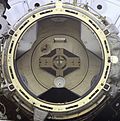  | APAS-95 | Docking | Yes | Androgynous (Shuttle and PMA-1), Non-Androgynous (Zarya, PMA-2 and PMA-3) |
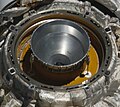 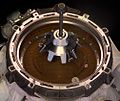 | SSVP-M8000 (Hybrid Docking System) | Docking | Yes | Non-Androgynous |
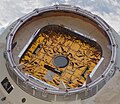  | Common Berthing Mechanism | Berthing | Yes | Non-Androgynous |
| Chinese Docking Mechanism | Docking | Yes | Androgynous (Shenzhou) Non-Androgynous (Tiangong-1) | |
| Chinese Docking Mechanism | Grappling-type | No | Non-Androgynous | |
| International Docking System Standard (IDSS) | Docking or Berthing | Yes | Active, Passive, or Androgynous (i.e., both). Active (Commercial Crew Vehicle, Orion); Passive (IDA) | |
 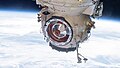 | ASA-G/ASP-G | Berthing | Yes | Non-Androgynous |
| SSPA-GB 1/2 (Hybrid Docking System) | Docking | Yes | Non-Androgynous | |
| Bhartiya Docking System (BDS) | Docking or Berthing | Yes | Androgynous (i.e., both). Used on SpaDeX, Gaganyaan and Bharatiya Antariksh Station. |
Docking of uncrewed spacecraft
For many years, most space missions that joined two spacecraft were done to move people, build or bring supplies to a space station, or to test these kinds of missions. Usually, at least one of the spacecraft had people on board and could be entered safely, like a space station or a moon lander.
In 2015, plans were made for commercial missions where uncrewed spacecraft would join together without any people. Some companies wanted to send spacecraft to service other satellites.
One example is the Hubble Space Telescope. In 2009, a space shuttle added a special part to help an uncrewed spacecraft connect to it later. This would help guide Hubble safely out of space when its time comes.
Non-cooperative docking
Sometimes, we need to connect to a spacecraft that cannot move or control itself. This could be to help fix it or bring it down safely. Usually, both spacecraft can move and control themselves when they connect. But there have been ideas about how to connect to spacecraft that cannot move on their own.
The only time this happened was in 1985, when the Soyuz T-13 spacecraft helped fix the Salyut 7 space station. The station had stopped working and was spinning, but the Soyuz crew connected and fixed it. They wore warm clothes because the station was very cold. They fixed enough things so that other ships could bring supplies.
There have also been ideas about robot spacecraft connecting to others that cannot control themselves. This would need new technology to help the spacecraft find and connect safely. NASA is interested in this for future missions, like refilling fuel in space or building things far from Earth.
Docking states
When two space vehicles connect, it can be a "soft" or "hard" docking. First, they make a soft dock by touching and latching their docking parts together. If both spacecraft have air inside, they can then move to a hard dock. This creates a tight seal so that doors can be opened safely, allowing people and supplies to move between the two spacecraft.
Berthing spacecraft and modules
Docking and undocking happen when spacecraft connect using a special port. Berthing is used when a spacecraft or module cannot connect on its own. It needs help from another spacecraft.
For example, the Space Shuttle used its robotic arm to move International Space Station (ISS) modules into place. The Poisk module was moved by a modified Progress spacecraft, which was then removed. The Cygnus resupply spacecraft does not use a docking port. The station's robotic arm pulls it into place, and the station finishes the connection.
This berthing method is only used on the US segment of the ISS. The Russian segment of the ISS uses docking ports for permanent connections.
Mars surface docking
NASA has talked about docking for a Crewed Mars rover. This could involve connecting to a Mars habitat or an ascent stage. The Martian surface vehicle and surface habitats would have a big rectangular docking hatch, about 2 by 1 meter in size.
Images
Related articles


This article is a child-friendly adaptation of the Wikipedia article on Docking and berthing of spacecraft, available under CC BY-SA 4.0.
Images from Wikimedia Commons. Tap any image to view credits and license.