 Safekipedia
Early Slavs
Adapted from Wikipedia · Adventurer experience
The early Slavs were Indo-European peoples. They lived during the Migration Period and the Early Middle Ages from about the 5th to the 10th centuries AD. They were in Central, Eastern, and Southeast Europe. They helped create the Slavic nations.
Ancient Roman writers called the ancestors of Slavs Venedi. The first time the name "Slavs" was written down was in the 6th century. At that time, Slavic tribes lived in much of Central and Eastern Europe. Over the next two centuries, the Slavs moved west, south, and east.
Starting in the 7th century, the Slavs slowly became Christianized. By the 12th century, they were the main people in several medieval Christian states. These included Kievan Rus', the Bulgarian Empire, the Principality of Serbia, the Duchy of Croatia, and the Kingdom of Poland. The oldest known Slavic principality was Carantania. It was set up in the 7th century by the Eastern Alpine Slavs. They were the ancestors of today’s Slovenes.
Origins
Main articles: Slavs (ethnonym), Vistula Veneti, Spori, Antes (people), Sclaveni, and Wends
The early Slavs were known to ancient Roman writers as Veneti. They lived east of the Vistula river and near Gdańsk Bay. Later, during a time of big movements of people, they split into three groups called Veneti, Antes, and Sclaveni. A writer named Jordanes wrote about these three names in the year 551.
Other writers like Procopius said that Sclaveni and Antes were once called Sporo. The oldest hints of Slavs appear in old maps from the 2nd century. By the 8th century, some early Slavs near the Carolingian Empire were called Wends.
People are not sure exactly where the Slavs came from, but many think it was in a place called Polesia in Central and Eastern Europe. The Slavs never lived as far east as the Volga River, or as far southwest as the Dinaric Alps, or past Bohemia to the west. Old writings from around the year 900 talk about a place called Zeriuani, which might be connected to where the Slavs began.
Linguistics
Main articles: History of Proto-Slavic and Proto-Balto-Slavic language
Proto-Slavic came from Proto-Indo-European, an ancient language that many languages in Eurasia came from. Slavic languages share some features with the Baltic languages.
Proto-Slavic became its own language around the first half of the second millennium BC. It had words for family and daily life but fewer words for sea or mountain things. River names from that time show links to other languages, like Iranian and Germanic. Some Slavic words like "god" and "house" might have come from Iranian. Words like "buy" and "helmet" came from Germanic languages.
Historiography
Further information: Migration Period, Slavic migrations to the Balkans, Maurice's Balkan campaigns, Slavic settlement of the Eastern Alps, Limes Saxoniae, and Baltic Slavic piracy
Jordanes, Procopius, and other Late Roman writers wrote about the southern Slavs in the middle of the 6th century AD. Jordanes finished his book, Gothic History, in Constantinople around the year 550. He wrote about a group of people called the Venethi. He said they were many in number and lived near the Vistula and Aeningia rivers.
Procopius wrote about the Slavs when Emperor Justinian I ruled. He described how they lived and where they lived near the Eastern Roman Empire. These old writings help historians understand where the Slavs lived and how they lived long ago.
Archaeology
Scientists learn about early Slavic people by studying old ways of living from different places and times. One important way of living is called the Kiev culture. It existed from the 2nd to the 5th century near the middle and upper Dnieper basin. This culture is thought to be the start of later Slavic groups.
Another way of living is the Chernyakhov culture. It existed from the 2nd to the 5th century in places like modern Ukraine, Moldova, and Wallachia. It had special pots, decorations, and tools. Some believe it shows early Slavic people, but others think it was a mix of different groups.
The Przeworsk culture was located northwest of the Chernyakhov area. It stretched from the Dniester to the Tisza valley and up to the Vistula and Oder rivers. It was a mix of local traditions with influences from other cultures.
East of Przeworsk, the Zarubintsy culture existed from the 2nd century BC to the 2nd century AD in the Dnieper forest zone. Some think it may be connected to early Slavic people.
Ethnogenesis
Culture-historical viewpoint
The Slavic homeland was in forests and wetlands. This helped them keep their identity, language, and farming customs. Early Slavs were part of groups called the Zarubintsy and Chernyakov cultures. They lived between the Vistula and Dnieper rivers, especially around the Pripet Marshes. These cultures may explain how early Slavs later split into different groups.
Paul Barford thought Slavic groups lived across central-eastern Europe before the sixth to ninth centuries. They served in armies and may have reached the Balkans before the sixth century. After the Hunnic Empire fell and the Avars arrived, the Slavs spread across central and south-eastern Europe.
Marija Gimbutas said that after the Avars left, the Slavs moved into empty lands. As farmers, they looked for new places to live when their old ones got too full.
Walter Pohl said the Slavs succeeded because their simple farming let them settle in new areas between the Baltic and the Aegean. Their numbers grew, and the area became empty partly because of people leaving and diseases. This helped the Slavs spread to the west and south of the Carpathian Mountains.
Processual viewpoint
Another idea says Slavic languages spread for different reasons. Central Europe became Slavic because many people moved there, and because people there started speaking Slavic. The East Slavic languages spread by people moving and by others starting to speak them. East Slavic became important because people learned to read and write in it. South Slavic languages spread in the Balkans as more people started speaking them.
Horace Lunt thought Slavic became a common language in the Avar khanate, helping it spread. But this doesn’t explain why Slavic spread far from the Avars. Alan Timberlake said people moving was important, along with other groups adopting Slavic ways.
Genetics
Studies of DNA from modern Slavic people try to find where they came from. The Y-DNA haplogroups R1a and I2 match the time when Slavs moved and spread their language from Eastern Europe. A study said Slavic culture spread mostly because real people moved. Later studies found that South Slavs share common ancestors with Poles.
Socio-political organisation
Early Slavic groups were not ruled by one leader. They lived under a system where decisions were made together. Over time, some groups started to have leaders and warriors. By the mid-9th century, these leaders lived richly and had soldiers with them. They often fought each other.
Arab travelers from the 10th century wrote about a group called the Walītābā, who were once the leading group among the Slavs. Other Slavic groups chose their rulers from this group.
Tribal and territorial organisation
Main article: List of ancient Slavic peoples and tribes
Before AD 560, there is no sign of Slavic leaders. The Sclaveni and the Antes lived without leaders, making decisions together. But some writers mention leaders who led groups of Slavs, like Daurentius, Chatzon, Samo, Dervan, and Perbundos. They had meetings called věče to make decisions.
Settlements were often in groups, linked by family ties. These groups formed the basis of areas called župa in South Slavic and opole in Polish. Several of these areas made up tribes. The names of many tribes come from the lands they lived in, like the Milczanie (in loess areas), Moravians (along the Morava river), and Diokletians (near Doclea). Other names describe their land, like Polanes (fields) and Drevlyans (trees). Some names might come from non-Slavic languages. Some tribes shared names even if they lived far apart, like the Dregoviti, Croats, Sorbs/Serbs, and Obodrites. The word "Slav" is still in the names of Slovenes, Slovaks, and Slavonians.
Culture
Settlements
Early Slavic settlements were small, usually between 0.5 to 2 hectares. They were often temporary and near rivers. These settlements had special buildings called Grubenhäuser or poluzemlianki. These buildings were made over pits and could hold a family. Each house had a stone or clay oven, which was important in Eastern Europe. Settlements had a central open area for community events and were divided into zones for living and working.
The Slavs also built underground shelters covered with wood to stay warm in winter.
Log cabin saunas were used. They were made with gaps filled with moss to keep heat in. Inside, a stone stove was placed, and water was poured on it to create steam. People used grass to move the air and open their pores.
Fortified strongholds, called gords, became common in the 9th century. They were often at the center of groups of settlements. Some strongholds appeared as early as the 5th and 6th centuries near the Dnieper river. They were also found on the Dniester river and in regions like Western Ukraine, Belarus, and Eastern Poland.
The Slavs liked to live in hard-to-reach places like dense forests, rivers, lakes, and marshes to protect themselves from attacks. Their settlements had exits that branched in many directions for safety.
Food and agriculture
The Slavs hunted, farmed, herded animals, and kept bees. They lived in valleys with rich soil and access to rivers for their livestock. They practiced crop rotation and used an efficient plow called the moldboard plow. They used tools like iron hoes, sickles, and wooden spades. They also bred animals selectively.
Hunting included animals like boar, deer, hare, elk, and sometimes bear. Beavers and marten were trapped for their fur.
When crops were ready, they were cut with sickles and threshed with a wooden flail. The grain was ground using stone querns. Common crops included wheat, millet, and barley. Vegetables like onions, carrots, radishes, turnips, parsnips, cucumbers, cabbage, peas, and beans were grown in gardens. Herbs such as garlic and parsnip were used, and hops were grown for beer. Fruit trees like cherry, apple, pear, plum, and peach were cultivated, along with walnuts.
Animals were raised for meat, leather, milk, and to fertilize the soil. Cattle were bred in large herds for plowing and meat, and their females provided milk. Pigs were valued for their meat. Goats and sheep were less common but still bred. Horses were rarely eaten and were mainly used for work or riding. Fowl like ducks and geese were also kept.
The Slavs had many cattle and grew millet and buckwheat. They cultivated crops and livestock that could be easily moved.
They planted crops in both summer and spring and harvested twice a year. Millet was their main crop. They avoided eating chicken, believing it caused illness, but ate beef and goose. Their drinks and wine were made from honey.
Ibn Rusta described their beehives as wooden boxes with holes where bees lived. They collected about ten jars of honey from each box. They herded pigs like sheep and drank mead.
Medicine
The ancient Slavs understood human anatomy well. Their medicines came from animals, plants, minerals, sulfur, and salt. They cleaned themselves in log cabin saunas and bathed in rivers.
Craftsmanship
The Early Slavs were skilled in working with wood, leather, metal, and clay. Pottery was made by craftsmen or women, often in home workshops. Clay was mixed with materials like sand to improve it and was shaped by hand or with a pottery wheel. After drying, the pottery was baked at low temperatures in kilns. Other crafts like metalworking were done by specialists.
Metalworking was crucial for making tools and weapons. Iron was obtained from local ore by smiths and made into bars. Smiths created products like knives, tools, decorative items, and weapons. Broken tools were reforged because iron was valuable.
Houses and everyday items were made from wood. Leather and textiles from linen and wool were used to make carpets, blankets, overcoats, and clothing. Spindlewhorls were used to make thread at home. Glass beads were crafted and often used in trade.
Clothing
Our main knowledge of Early Slavic clothing comes from images and graves. Clothing varied by region, season, and social status, but a general picture can be described.
Men wore long-sleeved tunics made of linen or wool, reaching to the knee, with breeches underneath. Wool cloaks were sometimes worn over the tunic. Hats and mittens were worn in winter. Both men and women wore leather boots and shoes, along with belts carrying knives and whetstones for sharpening.
Some women wore long patterned dresses made of linen, sometimes with an apron over the dress. Dresses or tunics could be made from a single piece of fabric. Unmarried women often wore their hair braided or loose, but covered it after marriage. Ornaments and jewelry like beads, earrings, and twisted wire bracelets were worn, especially by wealthier women.
Musical instruments
The Slavs had many musical instruments, as recorded in historical writings.
Ibn Rusta noted they had various lutes, pan pipes, and flutes. They played instruments during ceremonies for the dead, believing their joy showed respect.
Ibrahim Ibn Ya'qub mentioned they had different wind and string instruments.
Theophylact Simocatta wrote that Slavs carried lyres with them.
Marriage
Capturing wives and marriage outside their group were traditions among Slavic tribes until the early medieval period. In some places like Bohemia and Ukraine, women sometimes chose their husbands. The 12th-century Primary Chronicle recorded that groups like the Vyatichi, Radimichs, and Severians practiced polygamy instead of monogamous marriages.
Law
Main article: Old Rus' Law
See also: Medieval Serbian law
Slavic law was based on customs rather than written rules. The East Slavs didn’t have written laws until the time of Yaroslav the Wise. One important custom was the law of hospitality. If a tribe treated a guest poorly, neighboring tribes would attack them for dishonoring the guest.
Ibn Rusta described Slavic law around 903–918. Leaders collected taxes yearly. Men had to provide clothing for their daughters, sons, or wives. Thieves were either strangled or sent far away.
Warfare
Our knowledge of Early Slavic warfare comes from old writings and archaeological finds. Early warrior groups were small, usually under 200 men, and aimed for quick attacks and retreats. The Slavs preferred ambushes and fighting in forests, gorges, or marshes but also fought in open battles, sieges, and close combat. They used siege tools like towers and ladders. Weapons included spears, javelins, and bows and arrows. Swords and armor were rare and used only by leaders and their closest warriors. Shields were round with a central grip. Axes and slings were also used.
Procopius and Pseudo-Maurice wrote that South Slavs had few weapons and no armor, using spears, small shields, and bows. Ibn Rusta noted that Central-Eastern Slavs had few horses. Their weapons included javelins, shields, and lances. They followed a leader called the Župan and had a higher leader called the "chief of chiefs." The Župan was the lieutenant of this leader.
Although Slavs often fought on foot, they were also skilled cavalrymen. Procopius mentioned that in 536, 1,600 Slavic, Hun, and Antes horsemen served as Byzantine reinforcements in Italy. In 595, Slavic or Antes horsemen captured Byzantine scouts. Interactions with groups like the Sarmatians, Huns, Bulgars, and Avars may have made them skilled light horsemen. Archaeological finds show influence from Asian steppe nomads on Slavic cavalry.
By the mid-6th century, Slavs knew about naval warfare, building rafts and monoxyles. These small boats were used for travel and could be carried over land, allowing movement on both land and sea.
Byzantine writers mentioned Slavic mercenaries who were brave soldiers. Some became Byzantine officials and military leaders between the 8th and 10th centuries.
Menander Protector mentioned a Slavic leader named Daurentius around 577–579.
Military organization
Procopius wrote that Slavs attacked without formations, but this may be biased. By the late 6th and early 7th centuries, Slavic warriors began using heavier defensive armor, especially in Southeastern Europe.
Historical records show that alongside ordinary soldiers, there were military leaders and professional warriors, some of whom were hired as mercenaries, even before the mid-6th century. Society was changing from egalitarian to a military-social hierarchy. Archaeological finds of professional warriors and leaders were found mainly in Southeastern and Eastern Europe.
In 550, a small Slavic group of about 3,000 men invaded Thrace, winning several battles against the Byzantines and capturing fortresses. Mentions of larger Slavic forces and Byzantine losses suggest a well-organized and numerous Slavic population.
Writing
Main article: Pre-Christian Slavic writing
The existence of writing among the Early Slavs is debated. They passed down stories and legends orally like most tribal peoples in Europe. However, they may have used a runic script.
The 9th-century Bulgarian writer Chernorizets Hrabar mentioned that before becoming Christian, Slavs used a system of strokes and incisions, or tallies and sketches. After converting to Christianity, they used Roman and Greek letters unsystematically. He questioned how well Slavic could be written with Greek letters and noted this continued for many years.
Symbols
Early Slavs had many symbols representing concepts, beliefs, and gods. These symbols were found in large numbers and variety, possibly due to influences from steppe and Roman cultures. They included types of swastikas and similar shapes, such as the kolovrat, meaning "spinning wheel." The swastika, both right-facing and left-facing, appeared in Zarubintsy, Kyiv, and Proto-Slavic cultures. The kolovrat stood for the sun and the ongoing cycle of life, death, and birth. It was often carved on markers near graves to represent eternal life.
Gromovitit Znaci were symbols linked to Perun, the Slavic god of thunder and sky. Early Slavic homes often had these symbols carved into beams to protect against lightning. The circular shape represented ball lightning. These symbols were also found on Slavic pottery from the 4th century. Another symbol connected to Perun is the Perunika, resembling a six-petalled rose. Today, it is the name for a flower in some Slavic languages.
The hands of God were another ancient symbol, associated with the god Svarog.
Ancient symbols like these are still sometimes seen on clothing, especially in Russia. Many examples are described in women's folk costumes from the Meshchera Lowlands.
Burial practices
The Slavs burned their dead. While the Slavic funeral pyre was seen as a way to quickly and publicly free the soul from the body, archaeological evidence shows that South Slavs adopted burial practices from their post-Roman Balkan neighbors.
Ibn Rusta described their practices: "They burn their dead...The day after the funeral of a man, after he has been burned, they collect the ashes and put them in an urn, which is buried on a hill. After a year, they place twenty hives, more or less, on the hill. The family gathers and eats and drinks there and then everyone goes home."
Religion
Main articles: Slavic mythology, List of Slavic mythological figures, and Christianization of the Slavs
Little is known about Slavic religion before the Christianization of Bulgaria and Kievan Rus. After Christianization, Slavic leaders destroyed many records of the old religion. Some evidence remains in stories, the meanings of Slavic religious words, and the Primary Chronicle.
Worship of ancestors was important in pre-Christian Slavic religion.
Early Slavic religion was relatively uniform: animistic, anthropomorphic, and inspired by nature. The Slavs created cults around natural objects like springs, trees, or stones, respecting the spirit within. Slavic pre-Christian religion was originally polytheistic, with no organized pantheon. While early Slavs had a weak idea of God, this evolved into a form of monotheism where a "supreme god ruled in heaven over the others." There is no evidence of beliefs in fate or predestination.
Slavic paganism combined and shared elements with other religions. Linguistic evidence shows that some Slavic pagan beliefs developed when Balts and Slavs shared a common language, containing elements also found in Baltic religions. After the Slavic and Baltic languages separated, early Slavs interacted with Iranian peoples and adopted aspects of Iranian spirituality. Early Iranian and Slavic supreme gods were seen as givers of wealth, unlike thunder gods in other European religions. Both Slavs and Iranians had demons with similar names (Iranian Daêva and Slavic Divŭ) and a concept of dualism: good and evil.
Pre-Christian Slavic spirits and demons could be independent beings or spirits of the dead, linked to homes or nature. Forest spirits, independent beings, were honored as counterparts to home spirits, usually connected to ancestors. Demons and spirits could be good or evil, indicating a dualistic cosmology. They were revered with sacrifices and gifts. Spirits included Leshy, the forest spirit; Domovoy, the home spirit; Rusalka, the water spirit; Rarog, a Slavic version of the phoenix; and creatures like vilas, vampires, and Baba Yaga.
Though evidence of pre-Christian Slavic worship is limited (suggesting it was aniconic), religious sites and idols are most common in Ukraine and Poland. Slavic temples and indoor worship places were rare, with outdoor sites more frequent, especially in Kievan Rus. Outdoor cultic sites were often on hills and included ringed ditches. Indoor shrines existed: "Early Russian sources... refer to pagan shrines or altars known as kapishcha" and were small, enclosed structures with an altar inside. Some pagan temples were recorded as destroyed during Christianization, and many worship sites were turned into churches.
Records of pre-Christian Slavic priests, like pagan temples, appeared later. While no early evidence of Slavic pre-Christian priests has been found, the presence of sorcerers and magicians after Christianization suggests that pre-Christian Slavs had religious leaders. Slavic pagan priests were thought to talk with gods, predict the future, and lead religious rituals. Pagan priests, or magicians (known as volkhvy by the Rus' people), resisted Christianity after its introduction. The Primary Chronicle describes a campaign against Christianity in 1071 during a famine. The volkhvy were respected nearly 100 years after Christianization, indicating that pagan priests held important positions in 1071 and in pre-Christian times.
Later history
Christianization
See also: Saints Cyril and Methodius
Christianization began in the 7th century and ended in the 12th century. Some Slavs in the Balkans joined the Byzantine Empire and became part of the Eastern Orthodox Church. The biggest changes happened in the middle of the 800s. In 864, Boris I made Bulgaria officially Christian. Because Bulgaria was in an important place, both the Greek East and the Latin West wanted its people to follow them. Boris chose to support Constantinople and helped create an independent Bulgarian national church in 870. Later, Bulgaria became a center for Slavic culture and learning. They made the Cyrillic script in the 800s.
Some East Slavs became Christian earlier, but Kievan Rus' stayed mostly pagan until Vladimir the Great became Christian in the 980s. In Poland, Duke Mieszko I became Christian in 966. In some parts of Pomerania, people stayed pagan until the 1100s when they slowly joined the Christian faith.
Medieval states
See also: Great Moravia, Samo's Empire, and Kievan Rus'
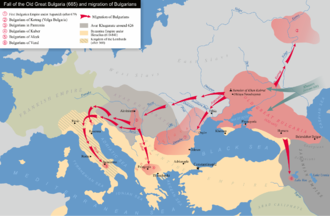
After becoming Christian, the Slavs formed many kingdoms and areas to rule. The First Bulgarian Empire began in 681 when Bulgars and Slavs joined together. The South Slavs made places like the Duchy of Croatia and the Principality of Serbia. The West Slavs created states such as Samo's Empire, Great Moravia, and later the Kingdom of Poland.
After Yaroslav the Wise died in 1054, Kievan Rus' split into smaller parts. Over time, Muscovy grew to become the strongest. Some western areas joined the Grand Duchy of Lithuania.
Images
Related articles


This article is a child-friendly adaptation of the Wikipedia article on Early Slavs, available under CC BY-SA 4.0.
Images from Wikimedia Commons. Tap any image to view credits and license.