
French colonial empire
The French colonial empire was a large group of lands ruled by France, starting in the 16th century. It included places far away from France, called colonies, protectorates, and mandate territories. At its biggest, just before World War I, it was the second-largest empire in the world, after the British Empire.
France first built colonies in the Americas, the Caribbean, and India, but lost many after the Seven Years' War. Later, France got back some land, like Louisiana from Spain, and sold it to the United States in 1803. After 1850, France built a new empire, mostly in Africa, Indochina, and the South Pacific. Having colonies helped France trade and feel important again after losing wars.
One big idea behind French colonialism was the Mission civilisatrice, or "civilizing mission." This was the belief that France should spread its language, rules, and ways to other people. But not everyone agreed with this, and many people in the colonies resisted. After World War II, many colonies fought for independence, and by the 1960s, most had become free from French rule. Some parts stayed connected to France in special ways.
First French colonial empire (16th century to 1814)
The Americas
See also: New France
In the 1500s, the French began exploring and settling parts of North America. Explorers like Giovanni da Verrazzano and Jacques Cartier started French interest in the New World. But other European powers, like Spain, were also claiming land, making it hard for France to build colonies.
France’s first big colony in North America started in 1605 with the founding of Port Royal in what is now Nova Scotia, Canada. In 1608, Samuel de Champlain founded Quebec, which became important for the fur trade. New France grew slowly because France focused more on trading furs than on large farms.
French settlers in North America worked with local Indigenous peoples, forming important alliances. They built trading posts along rivers like the St. Lawrence River and later expanded into areas around the Mississippi River, including Louisiana. In the Caribbean, France also built colonies like Saint-Domingue (now Haiti), which became a major sugar producer.
Asia (first empire)
With support from King Henry IV, France began trying to trade with Asia in the late 1500s and early 1600s. Explorers like François Martin de Vitré traveled to places such as Ceylon and Aceh. France later established trading posts in India, including Chandernagore in 1673 and Pondichéry in 1674.
Africa (first empire)
See also: Category:French colonisation in Africa
See also: Françafrique
France also set up small colonies and trading posts along the coast of Africa. Early efforts focused on areas like modern-day Senegal and Madagascar. These settlements often focused on trade and sometimes farming, though many people faced hard conditions.
Collapse of First French colonial empire
Colonial conflict with Britain
Further information: France in the Seven Years' War and France in the American Revolutionary War
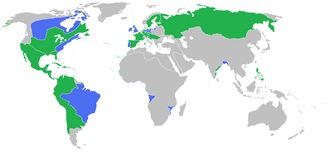
In the 1700s, France and Britain competed for control of colonies around the world. This led to many wars, including the Seven Years' War and conflicts during the American Revolution. These wars often ended with France losing many of its colonies in North America and the Caribbean to Britain.
Haitian Revolution
See also: Haitian Revolution
In the late 1700s, people in Saint-Domingue (now Haiti) fought for their freedom. This conflict, known as the Haitian Revolution, led to Haiti becoming an independent nation in 1804, marking a major shift in the history of European colonies.
Failed invasion of Egypt
The French attempt to establish a colony in Egypt in 1798–1801 was not successful.
Second French colonial empire (post-1830)
At the end of the Napoleonic Wars, France got back many of its colonies from Britain. These included places like Guadeloupe and Martinique in the West Indies, French Guiana in South America, and islands in the Indian Ocean. But Britain kept areas like Saint Lucia and Mauritius.
The second French colonial empire started in 1830 when France took over Algeria. By 1903, France fully controlled Algeria. This new empire grew and became one of the largest in the world by the early 1900s.
Africa (second empire)
Morocco
From 1912 to 1956, France controlled Morocco. They allowed local leaders to stay but made all the important decisions. This treated Moroccans unfairly and hurt their economy. For example, Moroccans paid more for land and owned less land than French settlers.
Tunisia
France ruled Tunisia from 1881 to 1956. They kept the local government but took more control over time, making choices that helped French interests instead of the Tunisian people.
French West Africa
French West Africa included places such as Senegal, Guinea, and Ivory Coast. France built forts, roads, and schools, but mostly to help their own economy and control the area. They also introduced new crops like peanuts for trade.
French Equatorial Africa
This area included Gabon and Chad. France set up control here, though the way they managed these places was complicated.
Cameroon
Originally a German colony, Cameroon became French after World War One and stayed that way until 1960 when it became independent.
Madagascar
France took control of Madagascar in 1896. The island and nearby islands were part of the French colony until the 1960s.
Algeria
France invaded Algeria in 1830 and fully controlled it by 1903. The local people suffered from unfair laws and loss of land.
Pacific Islands
France took control of islands such as Tahiti and New Caledonia in the 1800s. They ruled these islands, sometimes facing resistance from local people who opposed French control.
Asia (second empire)
France increased its presence in places like Vietnam and Cambodia. They took over areas and set up control, changing local cultures and lives.
Middle East
France got involved in places like Lebanon and Syria during conflicts. They tried to help some groups but also increased their influence in the region.
Evolution in the use of the term "empire" between the years of 1870–1939
After Napoleon III, the word "empire" was not used much because it had bad meanings. But by the late 1800s, some French people began using "colonial empire" again, connecting it to their nation.
Causes and justifications for colonialism
Civilizing mission
French colonists believed it was their duty to share their way of life with others. They thought they were helping, but this led to unfair treatment and control over local cultures.
Education
France set up schools in their colonies, but these mainly trained people to work for the government. This was not helpful for local development and made many locals unhappy. After World War II, people asked for better education.
Critics of French colonialism
Some people spoke out against the harm and unfairness caused by French rule. They shared their concerns with the world, trying to get others to see the problems faced by people in the colonies.
Decolonization
Further information: Decolonization in Africa
The French colonial empire started to fall apart during the Second World War. Different areas were taken over by foreign powers, such as Japan in Indochina, Britain in Syria, Lebanon, and Madagascar. After the war, Charles de Gaulle tried to bring control back to France. Though the French Union was created, most power stayed in France.
During World War II, battles happened in the colonies between forces loyal to France and others. By 1943, most colonies joined the side fighting for France, except Indochina under Japanese control. The colonies helped France, but France did not plan to give them freedom. This made many people upset and led to long conflicts in places like Indochina and Algeria.
France faced many challenges as people in its colonies wanted independence. There were uprisings and wars. Over time, many colonies gained their freedom, though some stayed connected to France in different ways.
Demographics
French census statistics from 1936 show an imperial population, outside of Metropolitan France itself, of 69.1 million people. Most of them lived in North Africa, sub-Saharan Africa, and East and South-East Asia.
The largest colonies included French Indochina with 23.0 million people, French West Africa with 14.9 million, Algeria with 7.2 million, the protectorate of Morocco with 6.3 million, French Equatorial Africa with 3.9 million, and Madagascar and Dependencies with 3.8 million.
In 1936, about 2.7 million Europeans and assimilated natives lived in the French colonial empire, along with 66.4 million non-assimilated natives.
French settlers
France did not have many people moving to the Americas, except for some groups called Huguenots. A small number of French people settled in places like New France, Louisiana, and the West Indies. After Quebec City was founded in 1608, it became hard to encourage more settlers, and by 1763, New France only had around 65,000 people.
French law made it easier for thousands of people from former colonies to live in mainland France. Many moved from places like Saigon, Algeria, Tunisia, and Morocco. In the 1970s, many left Cambodia during a difficult time in the country.
| 1921 | 1926 | 1931 | 1936 | |
|---|---|---|---|---|
| Metropolitan France | 39,140,000 | 40,710,000 | 41,550,000 | 41,500,000 |
| Colonies, protectorates, and mandates | 55,556,000 | 59,474,000 | 64,293,000 | 69,131,000 |
| Total | 94,696,000 | 100,184,000 | 105,843,000 | 110,631,000 |
| Percentage of the world population | 5.02% | 5.01% | 5.11% | 5.15% |
| Sources: INSEE, SGF | ||||
Territories
Territories in Africa
The French colonial empire included many areas in Africa. Some of these were:
- French Algeria (1830–1961)
- French Protectorate in Morocco (1912–1956)
- French Protectorate of Tunisia (1881–1956)
- French West Africa (1895–1958)
- French Equatorial Africa (1910–1958)
- French Madagascar (1897–1958)
- French Somalia (1896–1967)
Territories in Asia
France also had territories in Asia, including:
- French mandate of Syria (1923–1946)
- Greater Lebanon (1923–1943)
- French India (1673–1950)
- French Indochina (1887–1954)
Territories in the Caribbean
In the Caribbean, France controlled places such as:
- Guadeloupe (1635–)
- Haiti (1697–1804)
- Martinique (1635–)
Territories in South America
France had a few areas in South America, like:
- French Guiana (1503–)
Territories in North America
North America had many French territories, including:
- New France (1534–1763)
- Louisiana (1682–1762), (1801–1803)
Territories in Oceania
In Oceania, France controlled regions such as:
- New Caledonia (1853–)
- French Polynesia (1842–)
- Wallis and Futuna (1887–)
Territories in Antarctica
France also claimed Adélie Land in Antarctica from 1840 onward.
These territories show the wide reach of the French colonial empire across different continents.
Pictures
Keep exploring


This article is a child-friendly adaptation of the Wikipedia article on French colonial empire, available under CC BY-SA 4.0.
Images from Wikimedia Commons. Tap any image to view credits and license.