 Safekipedia
Frequency
Adapted from Wikipedia · Adventurer experience
Frequencies redirects here. For other uses, see Frequencies (film), Frequencies (album), and Frequency (disambiguation).
Frequency is how often something happens in a certain amount of time. It helps us know how quickly events repeat. Scientists and engineers use frequency to describe many things, like how fast a heart beats or how a guitar string vibrates.
The time between each event is called the period. If something happens a lot, its period is short. For example, if a heart beats 120 times in one minute, the period between beats is half a second.
There are special ways to talk about frequency in different situations. Angular frequency looks at how fast something spins or moves in circles. Spatial frequency looks at how often patterns repeat in space, like the lines on a brick wall.
The unit for measuring frequency is the hertz, written as Hz. One hertz means one event happens every second.
Definitions and units
For repeating events like oscillations, waves, or simple back-and-forth motion, frequency means how many times something happens in a given time. We often use the letter f or the Greek letter ν (nu) to stand for frequency. The period is the time it takes for one full cycle to happen. Frequency and period are connected by the simple rule: frequency equals one divided by the period.
The official unit for measuring frequency is the hertz (Hz), named after the scientist Heinrich Hertz. It tells us how many cycles happen each second. Before 1960, people used to say "cycles per second" instead of hertz. For measuring how fast something spins, we sometimes use revolutions per minute (rpm). Sixty rpm equals one hertz.
Period versus frequency
Long and slow waves, such as ocean waves, are often talked about by how long their period is. Short and fast waves, like audio and radio waves, are usually described by their frequency. Some common ways to change between these two are shown below:
| Frequency | Period |
|---|---|
| 1 mHz (10−3 Hz) | 1 ks (103 s) |
| 1 Hz (100 Hz) | 1 s (100 s) |
| 1 kHz (103 Hz) | 1 ms (10−3 s) |
| 1 MHz (106 Hz) | 1 μs (10−6 s) |
| 1 GHz (109 Hz) | 1 ns (10−9 s) |
| 1 THz (1012 Hz) | 1 ps (10−12 s) |
Related quantities
- Rotational frequency, usually shown with the Greek letter ν (nu), measures how quickly something spins. It tells us how many times an object turns in a certain time.
- Angular frequency, shown with the Greek letter ω (omega), is about how fast something moves in a circle. It links the spinning to angles and waves.
- Spatial frequency, shown with ξ (xi), is like counting how often something repeats in space, such as patterns or waves moving from one place to another.
In wave propagation
Further information: Wave propagation
When waves travel through materials where their speed does not change with frequency, the frequency is linked to the distance between wave peaks, called the wavelength. For these waves, you can find the frequency by dividing the wave’s speed by its wavelength.
In empty space, such as a vacuum, you can use the speed of light instead. When waves move from one material to another, their frequency stays the same, but their wavelength and speed can change.
Measurement
See also: Frequency meter
To learn how often something happens, we count how many times it occurs in a set time. For example, if 71 events happen in 15 seconds, we divide 71 by 15 to get about 4.73 events per second. We call this hertz (Hz).
One way to measure frequency is with a special light called a stroboscope. This light flashes many times. We change the flash speed until a moving object looks still. At this point, the flash speed matches the object's speed, and we can read the frequency from the stroboscope.
For higher frequencies, we use a tool called a frequency counter. This electronic device counts how many times a signal repeats in a set time. It shows the result in hertz on a screen. It can measure many types of vibrations and movements after they become an electronic signal.
For very high frequencies, we use a method called heterodyning. We mix the unknown frequency with a known frequency using a special device. This makes a new signal we can measure with a frequency counter. This helps us measure frequencies higher than normal counters can handle.
Examples
Light
Main articles: Light and Electromagnetic radiation
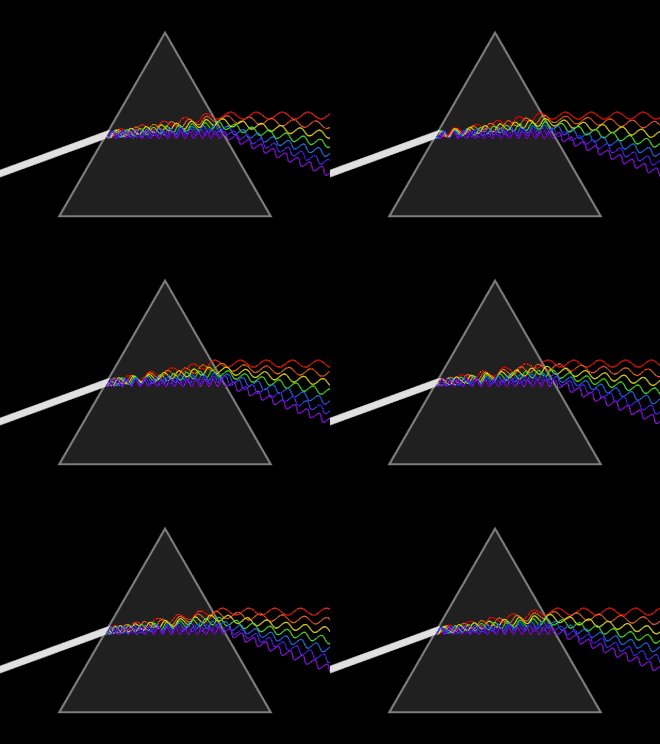
Visible light is a wave that moves through space. The frequency of this wave decides its color. Lower frequencies look red, while higher frequencies look violet. Frequencies below what our eyes can see are called infrared, microwaves, or radio waves. Frequencies above what we see are called ultraviolet, X-rays, or gamma rays. All these waves move at the same speed in empty space.
Sound
Main article: Audio frequency
Sound travels as waves of pressure and movement in air or other materials. The frequency of a sound wave mostly decides how high or low the pitch sounds. Humans can usually hear sounds between 20 Hz and 20,000 Hz, but this range changes with age. Some animals, like dogs, can hear higher frequencies than humans.
Line current
Main article: Utility frequency
In many parts of the world, including Europe, Africa, Australia, and parts of Asia and South America, household electricity changes direction at a frequency of 50 Hz. In North America and some other areas, it changes direction at 60 Hz. This difference can be heard as a "hum" in audio recordings from different regions.
Aperiodic frequency
Aperiodic frequency measures how often something happens that doesn't repeat in a cycle, like some random events. It is measured in a special unit called reciprocal second (s−1) or, for things like radioactivity, in a unit called becquerel.
We find this frequency by counting how many events happen in a certain amount of time. This helps us understand how quickly these events occur.
Images
Related articles


This article is a child-friendly adaptation of the Wikipedia article on Frequency, available under CC BY-SA 4.0.
Images from Wikimedia Commons. Tap any image to view credits and license.