
Georg Wilhelm Friedrich Hegel
Georg Wilhelm Friedrich Hegel (27 August 1770 – 14 November 1831) was a German philosopher. He was born in Stuttgart during a time of big changes, like the French Revolution and the Napoleonic wars.
Hegel tried to bring together different ideas that seemed opposite. He created a big system to explain everything as one whole. One of his most important ideas was about “spirit” or Geist. He thought this was about people learning through history. He believed history showed progress in understanding freedom.
His way of thinking is called dialectical thinking. This means looking at ideas, finding problems, and bringing them together into something better.
Hegel wrote many important books, like the Phenomenology of Spirit and the Science of Logic. After he died, his teachings split his followers into two groups. Some, like Karl Marx, used his methods to question society and religion. Today, Hegel's ideas still influence many areas of philosophy around the world.
Life
Hegel was born on 27 August 1770 in Stuttgart, the capital of the Duchy of Württemberg in the Holy Roman Empire, which is now part of southwestern Germany. His father worked at the court, and his mother passed away when Hegel was thirteen. Hegel grew up reading many books and studying at schools in Stuttgart.
At eighteen, Hegel went to the Tübinger Stift, a school for future religious leaders at the University of Tübingen. There, he became close friends with two other students, Friedrich Hölderlin and Friedrich Schelling. They shared ideas and were very interested in history and philosophy.
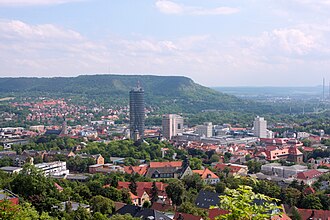
Later, Hegel lived in Berne and Frankfurt, where he wrote about religion and ideas. In 1801, he moved to Jena and began teaching at the university. He wrote important books, including The Phenomenology of Spirit.
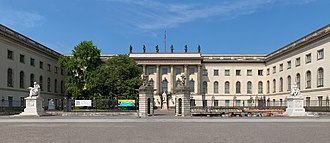
After Jena, Hegel worked in Bamberg as a newspaper editor and later taught at a school in Nuremberg. He married and had children during this time. In 1816, Hegel moved to Heidelberg and then to Berlin in 1818, where he became famous for his lectures.
In Berlin, Hegel continued to update his books and give lectures until his death on 14 November 1831. He was buried in a cemetery next to other important thinkers.
Influences
When Hegel began his studies, he was inspired by thinkers like Rousseau and Lessing. He loved studying ancient Greek philosophers, especially Plato. Later, he admired Aristotle even more, but his love for ancient philosophy always influenced his ideas.
He cared deeply about how people can feel connected to themselves, to others, and to nature. He thought division was a big problem and saw love as a way to bring people together. This idea came from both ancient Greek thoughts and Christian beliefs.
Hegel was also influenced by many other thinkers. His school friends, Schelling and Hölderlin, helped him see that philosophy should be organized like a system. He read books about economies, like those by Adam Smith. The ideas of Kant helped him understand big questions in philosophy. He also studied the works of Spinoza and Johann Gottfried von Herder.
The Phenomenology of Spirit
Main article: The Phenomenology of Spirit
The Phenomenology of Spirit was published in 1807 when Hegel was thirty-six years old. In this book, Hegel shared his ideas about big questions in philosophy. Many people found it hard to understand because it used special words and moved between topics in confusing ways.
One famous part of the book talks about how two people see each other. Hegel explained that for people to respect each other, they must both recognize and be recognized by the other person. He believed that how we see ourselves is shaped by how others see us, and that we are all connected in this way.
Philosophical system
Hegel's philosophy has three main parts: the science of logic, the philosophy of nature, and the philosophy of spirit. Together, these make up his real philosophy. This idea came from older thoughts and Christian beliefs. The system was not finished until 1817.
The science of logic is about understanding basic ideas. It is the foundation of Hegel's philosophy. It is not about normal thinking but about deep truths that make up reality.
The philosophy of nature and spirit is about how the world and human ideas grow over time. Hegel believed that as the world changes, philosophy grows to explain it better.
The philosophy of nature tries to organize our knowledge of nature clearly. It does not tell nature how to act but tries to understand it deeply. Hegel thought nature has its own purpose and order.
The philosophy of spirit is about the human mind and what it creates. Spirit, or mind, is the highest power of nature. Hegel believed the true nature of spirit is freedom. He thought freedom means being independent and making your own choices.
Subjective spirit
This part looks at the basic parts needed for people to work together. It talks about the human mind, how we think, and how we remember. It also talks about free will, which is very important in Hegel's ideas.
Objective spirit
This is Hegel's social and political philosophy. It is about how the human spirit shows itself in society and history. It talks about rights, laws, and how society should be organized. Hegel believed a good society needs balance between different powers.
Absolute spirit
This part talks about the highest way of knowing. Hegel said that art, religion, and philosophy all try to understand the same truth but in different ways. Art shows it directly, religion uses pictures and stories, and philosophy uses ideas and concepts.
Philosophy of art
Main article: Lectures on Aesthetics
Hegel talked about art in his books about how people see the world. He believed that art could show important truths in its own way. Hegel thought that great art could share ideas that matter to everyone, but he also knew that art has limits because it uses things we can see, hear, or touch. Because of this, he saw art as one way—along with other ways—to understand big ideas about life and the world.
Christianity
Hegel thought of himself as a Lutheran his whole life. He respected Christianity's idea that every person has worth and freedom. In his early writings, he believed Christianity should be more open and loving, like Jesus' teachings.
In his famous work The Phenomenology of Spirit, Hegel discussed Christianity as a way to show important truths about the world. He talked about ideas like the Trinity in his own philosophical style. Later, in lectures in Berlin, he spoke about Christianity as the highest form of religion. Some people wondered if his ideas matched traditional Lutheran beliefs, but Hegel always said he was talking about the Christian God.
Philosophy of history
History was very important to Hegel's ideas about philosophy. He believed that true philosophy needs to understand the past, where ideas come from, and how they change over time. For Hegel, history wasn't just about what happened, but also about how people’s understanding of important ideas, like freedom, grows.
Hegel thought that freedom is the most important idea in history. As people learn more about freedom, their societies become more advanced. He divided history into three main parts: in the "Oriental" world, only one person, like a ruler, was free; in the Greco-Roman world, some people, like wealthy citizens, were free; and in the "Germanic" world, meaning Europe, all people should be free. He said that slavery was wrong and should be rejected because every person deserves to be free.
Dialectics, speculation, idealism
Hegel is often known for using a special way of thinking called a "dialectical method." He thought correct thinking involved three steps:
- simple thinking,
- looking at things in a negative way, and
- thinking in a positive and creative way.
For example, self-consciousness is when our mind thinks about itself.
Hegel believed we should understand the "inner necessity" of the subject we are studying. His way of thinking often makes it hard to know exactly what he thinks about specific issues.
A key idea for Hegel was "sublation," which means to raise up, cancel, and also keep or preserve. He used this idea to show how seeming opposites can be brought together in a higher understanding. His idealism says that what we call "real" depends on a larger whole that supports it.
Thesis–antithesis–synthesis
Some people talk about Hegel using a three-step process of thesis, antithesis, and synthesis. But Hegel himself never used these three terms together in his writings. This way of describing his ideas came from other philosophers who tried to simplify his complex thinking.
What is true is that, for Hegel, correct understanding grows from mistakes and conflicts over time. But he did not see thesis and antithesis as separate and opposing things. Any contradictions we find are part of the subject, not because of an outside method we apply.
Legacy
Hegel had a big effect on later thinkers. In the late 1800s and early 1900s, a group in England called British idealism studied his work. Other famous thinkers like Marx, Derrida, and Adorno used parts of Hegel's ideas in their own work. Some others, like Schopenhauer and Kierkegaard, disagreed with Hegel.
In Germany, some people split into two groups: the Right Hegelians, who supported traditional ideas, and the Left Hegelians, who wanted big changes. The Left Hegelians included important thinkers like Marx and Engels. Their idea was that philosophers should not just think about the world, but change it.
In France, a teacher named Alexandre Kojève talked a lot about Hegel's ideas. This influenced many later thinkers, including Jean-Paul Sartre and Simone de Beauvoir.
In the United States, Hegel's ideas also influenced thinkers like John Dewey. President Woodrow Wilson used Hegel's ideas when he created plans for ending World War I and starting The League of Nations.
Publications and other writings
See also: Georg Wilhelm Friedrich Hegel bibliography
Georg Wilhelm Friedrich Hegel wrote many important books and articles. His early works talked about religion and love. Later, he wrote about logic, the world, and ideas about right and wrong.
In Berlin, Hegel gave many talks on logic, nature, history, art, and religion. His talks were popular, and he shared his ideas with students for many years.
Pictures
Keep exploring




This article is a child-friendly adaptation of the Wikipedia article on Georg Wilhelm Friedrich Hegel, available under CC BY-SA 4.0.
Images from Wikimedia Commons. Tap any image to view credits and license.