
Habsburg Spain
Habsburg Spain
Habsburg Spain, also known as the Catholic Monarchy, was the time when kings from the House of Habsburg ruled Spain and the Spanish Empire from 1516 to 1700.
During this time, the Spanish Empire grew very powerful. Spain controlled many lands, including parts of Pan-America and the West Indies, European areas like the Low Countries, Italian territories, Portugal, and parts of France, as well as the Philippines and other areas in Southeast Asia.
This time is often called the "Age of Expansion". The Habsburg rulers were sometimes called the "House of Austria," but historians use the name Habsburg for convenience.
The union of Isabella I of Castile and Ferdinand II of Aragon in 1469 helped bring the parts of Spain together. Spain became fully united after the Reconquista ended with the conquest of Granada in 1492 and the taking of Navarre between 1512 and 1529. Pope Alexander VI gave them the title of "Catholic Monarchs of Spain" in 1494.
Under the Habsburgs, Spain was a leading political and military power in Europe and the world for much of the 16th and 17th centuries.
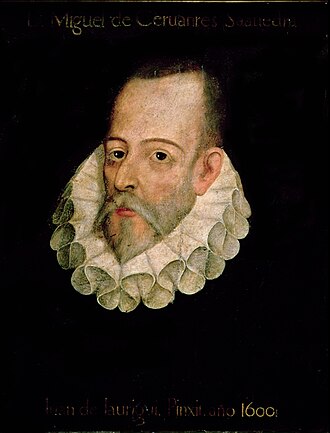
The Habsburg period was also a time of great arts and learning, known as the Spanish Golden Age. Many famous writers, artists, and thinkers lived during this time, such as Teresa of Ávila, Pedro Calderón de la Barca, Miguel de Cervantes, Francisco de Quevedo, Diego Velázquez, El Greco, Domingo de Soto, Francisco Suárez, and Francisco de Vitoria.
When Charles II, the last Habsburg king, died in 1700, it led to the War of the Spanish Succession, and Philip V from the Bourbon dynasty became the new king.
History
See also: History of Spain
The time of Habsburg Spain, called the Catholic Monarchy, lasted from 1516 to 1700. During these years, Spain was ruled by kings from the House of Habsburg. Spain grew into one of the most powerful empires in the world. It controlled many lands, including parts of the Americas, Europe, and Asia.
In the early days, Spain started to build its empire. Leaders like Ferdinand II of Aragon and Isabella I of Castile began to spread Spain's influence. Later, under Charles V, Spain became even stronger, controlling large areas in Europe and the Americas. Charles V was also the Holy Roman Emperor, making him one of the most important rulers of his time.
Spain kept growing under Philip II. He faced many challenges, including wars with other European countries and issues with rebellious areas. Even with these problems, Spain stayed a major power. In the 17th century, the empire faced more difficulties, like money problems, wars, and inner conflicts. By the end of Habsburg rule in Spain, the empire had begun to weaken, preparing the way for future changes in Europe.
Religion and the Spanish Inquisition
The Spanish Inquisition began under the Catholic Monarchs and lasted until the 19th century. It was very important in the government under Charles I.
Philip II made strong religious rules very important. He wanted Spain to stay Catholic and stopped other beliefs like Lutheran and Calvinist. He also tried to choose popes who would support Spain.
Two important people helped shape Spain's religion: Theresa of Avila and Ignatius Loyola. Theresa focused on religious practices, and Ignatius started the Jesuit Order, which helped with education in Europe.
The Moriscos, people from Muslim backgrounds who had been made to become Christian, faced strict rules. They were eventually forced to leave Spain in 1609. This hurt the economy, especially in Aragon and the Kingdom of Valencia.
Administration and bureaucracy
Spain got lots of gold from new lands they discovered, which helped pay for wars in Europe. Later, they found rich silver mines, like at Potosí and Zacatecas. They taxed this silver, taking one-fifth for the government. All the silver had to go through a special office in Seville, overseen by the Council of the Indies.
As Spain grew, it also got into debt, partly because of all the silver. This caused money problems later on. Sadly, many native people were treated very badly.
To keep their treasure ships safe from pirates, Spain used big groups of ships called treasure fleets that traveled together. This usually worked well. Spain also had to protect its faraway places, which was very hard.
Spain’s leaders focused mostly on Europe, so they let local leaders in the new lands make many of their own rules. This sometimes caused problems because each place had its own taxes and rules. Over time, the government became slow and full of corruption.
Economy
Spain had hard times with hunger and sickness in the 1300s and 1400s. By 1500, things got better, and many people moved to cities to work. The 1500s were good years for Spain with more people, better farming, and more trade. Cities like Seville, Burgos, Segovia, Cuenca, and Toledo became busy with new jobs.
But later in the 1500s, prices for things like wool and grain went up because of silver and gold from the New World. This made life harder for many people. Many villages lost their homes as people moved to cities, and Spain's wars cost a lot of money. By the time of Louis XIV, France had become bigger than Spain.
Art and culture
Main article: Spanish Golden Age
The Spanish Golden Age was a wonderful time for art and writing in Spain, lasting from about 1550 to 1650. Famous people from this time include El Greco, a painter from Greece, and Diego Velázquez, whose paintings inspired many artists later. Two great writers were Miguel de Cervantes, who wrote the famous story Don Quixote de la Mancha, and Pedro Calderón de la Barca. This period had many smart thinkers from the School of Salamanca, whose ideas were important in Europe.
Colegio Mayor de San Ildefonso
Main article: Royal reform of the Colegio Mayor de San Ildefonso
In 1666, the Colegio Mayor de San Ildefonso at the University of Alcalá changed under a plan by King Philip IV. New rules were made to organize the school and who could teach there.
Pictures
Keep exploring



This article is a child-friendly adaptation of the Wikipedia article on Habsburg Spain, available under CC BY-SA 4.0.
Images from Wikimedia Commons. Tap any image to view credits and license.