
Illinois Confederation
The Illinois Confederation, also called the Illiniwek or Illini, was a group of 12 or 13 tribes that lived near the Mississippi River Valley. Their land stretched from Lake Michigan to Iowa, Illinois, Missouri, and Arkansas. The five main tribes were the Cahokia, Kaskaskia, Mitchigamea, Peoria, and Tamaroa.
These tribes lived by farming, hunting, and fishing. They built homes called longhouses and wigwams depending on the season. The men hunted and fought, while the women grew crops, made tools, and saved food for later. Though they did not have one single leader, a Great Chief led each village, with other chiefs leading smaller groups within it.
When French explorers arrived, they called the people "Illinois" from the word iliniwe. Sadly, diseases and wars brought by the Europeans caused many of these tribes to disappear. By the 1800s, the remaining people were moved to Oklahoma, where their descendants are now known as the "Peoria Tribe of Indians."
Name
French missionaries spoke with the tribes and learned that they called themselves the Inoka. We do not know what this name means.
Jacques Marquette, a French Jesuit missionary, said the word Illinois came from Illini in their Algonquian language. This word means "the men". Another explorer, Louis Hennepin, thought it described strong, fully grown men.
Later, we learned the word Illinois really comes from irenweewa, meaning "he speaks in the ordinary way". When French explorers met the Ojibwa near the eastern Great Lakes, the way they said this word sounded like ilinwe to the French. The explorers wrote it in many ways, such as "liniouek", "Aliniouek", "Iliniouek", and "Abimiouec".
History
The Illinois Confederation was made up of 12 tribes who shared a common language and culture. These tribes included the Kaskaskia, Cahokia, Peoria, Tamaroa, and others. Sadly, many of these tribes were lost over time due to diseases and conflicts.
When the French first met the Illiniwek tribes, there were as many as 10,000 people living in a large area from Lake Michigan to Iowa and down to Arkansas. The Kaskaskia had a big village that the French visited, and they even set up a mission and a trading post there. However, diseases from Europe and wars with other tribes caused the Illinois population to drop sharply.
Over time, the number of tribes in the Confederation shrank from 12 to just five. The Illinois faced many challenges, including wars with other tribes and new diseases brought by Europeans. By the late 1800s, the remaining Illinois people joined together with other tribes and moved to a new home in Oklahoma, where their descendants still live today.
Culture
Miami and Illinois are types of the same Algonquian language, once spoken in Indiana and later Oklahoma. Though no one speaks the language today, efforts are underway to bring it back, and children from the Miami and Peoria nations are learning it again.
The Algonquian language family was spoken across Canada, New England, the Atlantic coastal region, and the Great Lakes region, extending towards the Rocky Mountains. There are many Algonquian languages, such as Cree, Ojibwa, Blackfoot, and Cheyenne.
In Illinois society, men were mainly hunters and warriors, while women took care of the home and farming. Some women also held leadership roles. Both men and women could earn respect in their community.
The Illinois people believed in spirits and used them for guidance. With the arrival of European missionaries in the late 1600s, many Illinois people learned about Christianity, though some kept their original beliefs.
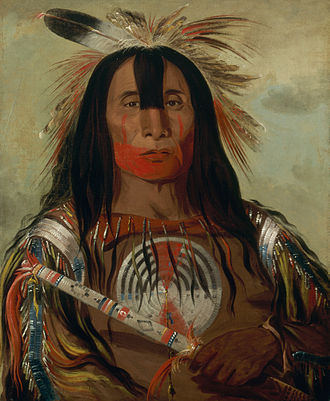
The Illinois had special traditions for young people turning fifteen. They would paint their faces, fast, and pray to find a spirit guide, called manitou, to help them through life.
Society
The Illinois people were good at farming, hunting, and fishing. They grew crops like maize, beans, squash, pumpkins, and watermelons. They also gathered food from the forests. They lived in villages near rivers where the soil was rich. They hunted bison in groups, and women helped prepare the meat for winter.
War chiefs organized raids against enemies such as the Pawnee, Quapaw, and later the Iroquois Confederacy. Before battles, warriors would pray for strength. They preferred using arrows and spears over guns.
The Illinois had a central leader called the Great Chief, with other chiefs leading each tribe. Peace chiefs organized hunts and talked with other tribe leaders, while war chiefs planned raids. Important decisions were often made together by the community. By the 1760s, new chiefs needed approval from colonial authorities. The Illinois lived in villages along the Mississippi and Illinois Rivers.
Keep exploring


This article is a child-friendly adaptation of the Wikipedia article on Illinois Confederation, available under CC BY-SA 4.0.
Images from Wikimedia Commons. Tap any image to view credits and license.