 Safekipedia
Joan of Arc
Adapted from Wikipedia · Adventurer experience
Early Life and Visions
Joan of Arc was born around 1412 in a small village. From a young age, she felt messages from saints, which she believed guided her. These saints were archangel Michael, Saint Margaret, and Saint Catherine.
Helping France
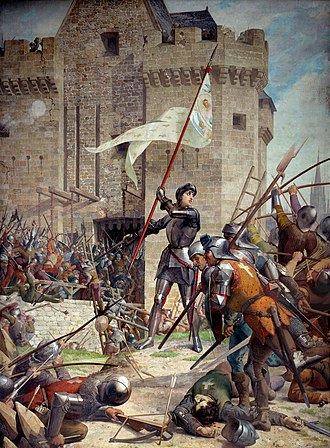
During a difficult time called the Hundred Years' War, Joan decided to help the French king, Charles VII. Her most famous moment was during the siege of Orléans in 1429. Her brave leadership gave the French people hope and strength. Thanks in part to her efforts, Charles was able to be coronation as king in Reims.
Challenges and Capture
Even with her early wins, Joan faced hard times. She was captured by the Burgundians in 1430. She was put on trial and faced very serious accusations.
Legacy
After her death, Joan's name was cleared, and she was recognized as a saint by the Catholic Church in 1920. Today, Joan of Arc is remembered as a brave hero who inspired many people. Her story continues to be told around the world.
Domrémy Charles VII of France Hundred Years' War Loire Campaign victory at Patay siege of Paris siege of La Charité Compiègne trial Pierre Cauchon heresy French Revolution canonized Pope Benedict XV numerous cultural works
Name
Joan of Arc's name was written in many different ways. At that time, there was no standard spelling. Her last name was often written as "Darc" without an apostrophe, but there were also versions like "Tarc", "Dart", or "Day". She might not have ever heard herself called "Jeanne d'Arc"; the first time she was recorded with this name was in 1455, long after she passed away.
Joan could not read or write when she was a child and had to dictate her letters. She later may have learned to sign her name. She often called herself Jeanne la Pucelle, meaning "Joan the Maiden," to highlight her virginity. By the sixteenth century, she was widely known as the "Maid of Orleans."
Birth and historical background
Joan of Arc was born around 1412 in Domrémy, a small village in the Vosges department in northeast France. Her parents, Jacques d'Arc and Isabelle Romée, were peasant farmers. She grew up during the Hundred Years' War, a long conflict between England and France. At the time, France was struggling, as the French king Charles VI was often very sick, and two powerful nobles, the Duke of Orléans and the Duke of Burgundy, were fighting for control of the country. This made it hard for France to stay strong.
Early life
Joan of Arc grew up in a small village in northeast France. She helped with chores, worked in the fields, and cared for animals. Her mother taught her about religion. When Joan was about thirteen, she began having special visions. In these visions, saints told her to help France during a hard time.
Joan felt she should help the French leader, Charles, who had not yet been officially crowned king. Even though many people doubted her, she got support and traveled to meet Charles. This started her important role in French history.
Chinon
Charles VII met Joan of Arc for the first time at the Royal Court in Chinon in early 1429. She was seventeen and told him she wanted to help raise the siege of Orléans and lead him to his coronation in Reims. After talking with Charles, Joan was sent to Poitiers where theologians examined her and found her to be a good person and a good Catholic. She was also examined by women to prove her purity.
With these tests completed, Charles gave Joan plate armor and she created her own banner. She believed she was acting under divine guidance, which inspired hope among the French forces. Before traveling to Orléans, Joan sent a letter to the Duke of Bedford, warning him that she was sent by God to drive the English out of France.
Military campaigns
Orléans
In the last week of April 1429, Joan left from Blois with an army carrying supplies to help Orléans. She arrived there on 29 April and met the commander Jean, the Bastard of Orléans. Joan was seen as a symbol to raise hope, carrying her banner on the battlefield. She was not given a formal command but soon earned the support of the soldiers. She often appeared where the fighting was strongest, giving them courage. Commanders sometimes followed her advice.
On 4 May, the soldiers attacked a fortress outside Orléans. Joan rode out with her banner and arrived as the soldiers were retreating after a failed try. Her presence inspired them, and they attacked again and took the fortress. On 5 May, there was no fighting because it was Ascension Thursday, a special feast day. The soldiers attacked again on 6 May, taking Saint-Jean-le-Blanc, which the English had left.
The soldiers took Saint-Jean-le-Blanc on 6 May. On 7 May, they attacked the main English fortress. Joan was hurt by an arrow while holding her banner but came back to help in the final attack that took the fortress. The English left Orléans on 8 May, ending the siege.
Loire Campaign
After helping Orléans, Joan wanted the army to move quickly toward Reims to crown the Dauphin. Charles allowed her to go with the army led by John II, Duke of Alençon, who worked with Joan and often followed her advice. Before going to Reims, they needed to take back towns along the Loire: Jargeau, Meung-sur-Loire, and Beaugency.
The effort to take the Loire towns began on 11 June when the army led by Alençon and Joan arrived at Jargeau. The English withdrew into the town walls. The army then moved to Meung-sur-Loire. On 15 June, they took the town's bridge, and the English garrison moved to a castle. The main English army went toward Paris; Joan urged the soldiers to follow them, and the two armies fought at the Battle of Patay. The English army was defeated. Many leaders were captured.
Coronation and siege of Paris
After the victory at Patay, some leaders wanted to attack Normandy, but Joan insisted that Charles must be crowned. The Dauphin agreed, and the army left Gien on 29 June to march on Reims. Reims opened its gates on 16 July 1429, and Charles's ceremony happened the next morning. Joan had an honored place at the ceremony.
After the ceremony, the royal court discussed a truce with the Duke of Burgundy. When the truce ended, Burgundy changed his mind. Joan and the Duke of Alençon wanted to move quickly toward Paris, but there were disagreements in Charles's court. The soldiers attacked Paris on 8 September. During the fighting, Joan was hurt in the leg. The attack was stopped the next morning.
Siege of Compiègne and capture
The Duke of Burgundy started to take back towns. Compiègne was one of these towns. Joan left with volunteers at the end of March 1430 to help the town, which was under attack.
In April, Joan arrived at Melun. As she moved forward, more commanders joined her. Her troops went to Lagny-sur-Marne and defeated a force led by the mercenary Franquet d'Arras, who was captured.
Joan reached Compiègne on 14 May. On 23 May 1430, Joan went with soldiers from Compiègne to attack the Burgundian camp at Margny. The attack failed, and Joan was captured. She was taken to a castle. She tried to escape but was hurt. Later, she was moved to the Burgundian town of Arras.
The English and Burgundians were happy that Joan was no longer leading soldiers. The English worked with the Burgundians to pay for Joan and take her to their headquarters at Rouen. Bishop Pierre Cauchon of Beauvais helped with these talks.
Trials and execution
Trial
Main article: Trial of Joan of Arc
Joan had a trial for saying she heard God's voice. She was accused of wearing men's clothes and saying God told her what to do. The trial was not fair, but Joan answered questions well.
Execution
Joan broke a promise and was executed on May 30, 1431, when she was nineteen years old. She was allowed to see a priest before she died. Her death was sad, but she helped inspire France.
Aftermath and rehabilitation trial
Main article: Rehabilitation trial of Joan of Arc
After Joan's death, people remembered her. Later, a new trial said the first trial was unfair. This made Joan honored again in French history.
Visions
Joan of Arc believed that her visions came from guidance from a higher power. These visions gave her strength and hope, especially when things were hard.
Later scholars have tried to explain her visions using medical reasons, such as epilepsy or other conditions. But these ideas are debated, and the records from her trial make it hard to know for sure what caused her visions.
Clothing
Main article: Cross-dressing, gender identity, and sexuality of Joan of Arc
Joan of Arc often wore men's clothes when she led in battles. She chose this because she felt it was a sign from God. Her clothing became important during the trials against her. Some people thought it was wrong, but Joan believed it was right for her role.
She wore things like a coat of mail, a breastplate, and boots. These helped her in battles. Joan said she would wear women’s clothes again when her mission was done. Some thought her clothes helped protect her and showed her special role as a warrior.
Legacy
Joan is one of the most studied people of the Middle Ages. People see her in many ways: as a hero of France, a loyal member of the Catholic Church, an early voice for women's rights, and a symbol of freedom.
She became known as a leader who helped drive the English out of France. Even before she died, people honored her for helping France. After her death, she was remembered in celebrations, especially in the city of Orléans. Over time, she became an important symbol for France, standing for the country’s history and identity.
Joan is also a saint in the Catholic Church. She was officially made a saint in 1920, and her feast day is celebrated on May 30th, the day she died. People admire her for her courage and strong beliefs. Her story has inspired many artists and writers and continues to influence people around the world.
Images
Related articles



This article is a child-friendly adaptation of the Wikipedia article on Joan of Arc, available under CC BY-SA 4.0.
Images from Wikimedia Commons. Tap any image to view credits and license.