 Safekipedia
Maastricht
Adapted from Wikipedia · Adventurer experience
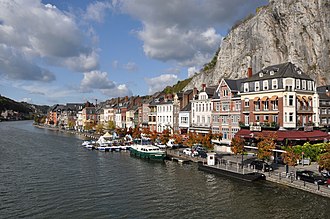
Maastricht is a city and municipality in the southeastern part of the Netherlands. It is the capital and largest city of the province of Limburg. The city lies on both sides of the Meuse River (called the Maas in Dutch), where it meets the Jeker River. Nearby is Mount Saint Peter, which is mostly inside the city's borders. Maastricht is close to the border with Belgium and is part of a large international area called the Meuse-Rhine Euroregion, which includes cities like Aachen, Liège, and Hasselt.
The city began a long time ago and grew into an important place for trade and religion. In later years, it became a place where soldiers were stationed and then an early center for industry. Today, Maastricht is known for its rich culture and as a regional center. It is famous for being the place where the Maastricht Treaty was signed and for being the birthplace of the euro currency.
Maastricht has many old buildings, with over 1,600 national heritage sites, which is the second highest number in the Netherlands, after Amsterdam. The city attracts visitors for shopping and fun, and it is also a popular place for students from around the world. The last part of a major geological period called the Cretaceous is named after Maastricht.
History
For a chronological guide, see Timeline of Maastricht.
Toponymy
Maastricht has had many names throughout history. It was mentioned in old documents as Ad Treiectinsem urbem around 575. The name "Maastricht" comes from an old Dutch word for the Meuse river, combined with a word meaning "ford" or "passage." This tells us it was a place where people crossed the river.
People from Maastricht are called Maastrichtenaar, or in the local dialect, Mestreechteneer or Sjeng.
Early history
Old remains show that people lived near Maastricht a very long time ago. Celts lived there around 500 BC. The Romans built a bridge there in the first century AD, which helped people travel between important places.
Roman buildings, roads, and other items have been found in the city. According to stories, a bishop named Saint Servatius died in Maastricht in 384 and was buried there. A church was built on his grave, which later became an important place for Christians.
Middle Ages
In the early Middle Ages, Maastricht was an important town for trading and making things. It was part of a group of important places ruled by leaders called the Carolingians.
Maastricht had two big churches and many valuable items called relics. Every seven years, many people came to Maastricht for a big religious event called the Maastricht Pilgrimage.
The town grew and got more powerful during this time. In 1204, two leaders shared control of the town. Later, a new bridge was built after the old one fell down.
16th to 18th centuries
Because Maastricht was in a good spot by a river, leaders built strong walls around it. Different armies, including Spanish and French forces, fought over the town many times.
Famous leaders like Louis XIV of France tried to capture Maastricht. After each fight, the town's walls were fixed and made stronger. Later, Maastricht became part of France for a while before returning to the Netherlands.
19th and early 20th century
After big changes in Europe, Maastricht became part of the Netherlands. Even though many people around it wanted to join Belgium, Maastricht stayed with the Netherlands.
During World War I, the town took in many people who had to leave their homes. In World War II, Maastricht was taken over by German forces at first, but later was freed by Allied troops. Many important buildings were damaged during the war.
After World War II
In the years after World War II, Maastricht changed from making things to providing services. A university was opened there in 1976. Important meetings about Europe were held in Maastricht, leading to big changes in how European countries work together.
The town has been renewed in many ways, with new buildings and areas for people to enjoy. Projects to improve the city are still happening today.
Geography
Maastricht is a city in the Netherlands. It lies on both sides of the Meuse River. The city has seven main areas and 44 smaller neighbourhoods.
Maastricht shares borders with places in Belgium. Because the Netherlands and Belgium are part of the Schengen Area, there are no border checks between them.
Maastricht has an oceanic climate, like most of the Netherlands. Because it is in a valley between hills, summers can feel warmer and winters colder than in other parts of the country. The hottest temperature ever recorded there was 39.6 °C (103.3 °F) on July 25, 2019.
Demographics
Maastricht is a city with many different languages and cultures.
The city has many languages spoken there. Dutch is the main language used in schools and government. Many people also speak Limburgish, a local dialect. French and German are taught in schools, and English is widely used, especially at universities.
Many people in Maastricht follow different religions. Most people are Roman Catholic, but there are also Protestants, Muslims, Hindus, Buddhists, Jews, and people who do not follow any religion.
| Year | Pop. | ±% p.a. |
|---|---|---|
| 1400 | 7,000 | — |
| 1500 | 10,000 | +0.36% |
| 1560 | 13,500 | +0.50% |
| 1600 | 12,600 | −0.17% |
| 1650 | 18,000 | +0.72% |
| 1740 | 12,500 | −0.40% |
| 1796 | 17,963 | +0.65% |
| 1818 | 20,000 | +0.49% |
| 1950 | 77,710 | +1.03% |
| 1960 | 90,202 | +1.50% |
| 1970 | 93,927 | +0.41% |
| 1980 | 109,285 | +1.53% |
| 1990 | 117,008 | +0.69% |
| 2000 | 122,070 | +0.42% |
| 2010 | 118,533 | −0.29% |
| 2020 | 121,575 | +0.25% |
| Source: Lourens & Lucassen 1997, pp. 32–33 (1400–1795) Statistics Netherlands | ||
| Nationality | 2021 | 2014 | 2010 | 2000 |
|---|---|---|---|---|
 Netherlands Netherlands | 100,297 | 107,418 | 109,722 | 116,171 |
 Germany Germany | 3,908 | 3,869 | 1,956 | 783 |
 Italy Italy | 1,572 | 653 | 387 | 280 |
 Belgium Belgium | 1,475 | 1,055 | 946 | 909 |
 Spain Spain | 913 | 431 | 232 | 241 |
 United Kingdom United Kingdom | 842 | 815 | 386 | 280 |
 China China | 739 | 595 | 248 | 87 |
 France France | 686 | 351 | 214 | 120 |
 United States United States | 665 | 623 | 277 | 162 |
 Turkey Turkey | 436 | 404 | 368 | 404 |
| Country of birth | 2020 | 2013 | 2010 | 2000 |
|---|---|---|---|---|
| Netherlands | 93,162 | 100,269 | 102,433 | 109,632 |
| Germany | 3,949 | 4,100 | 2,467 | 1,444 |
| Belgium | 2,355 | 1,920 | 1,839 | 1,900 |
| United States | 1,380 | 753 | 383 | 217 |
 Indonesia Indonesia | 1,020 | 1,199 | 1,267 | 1,556 |
| China (excl. Hong Kong and Macau) | 1,019 | 651 | 373 | 215 |
| Turkey | 973 | 919 | 836 | 784 |
| United Kingdom | 926 | 677 | 404 | 310 |
 Morocco Morocco | 829 | 838 | 867 | 859 |
 Poland Poland | 563 | 437 | 316 | 152 |
Economy
Maastricht is a city where many businesses and important groups have offices. Some well-known companies based in Maastricht include Sappi for paper products, Royal Mosa for tiles, and BASF for special paints. There are also big names like Hewlett-Packard, Vodafone, and Mercedes-Benz with centers in the city.
Since the 1980s, many important European and international groups have chosen Maastricht as their home. These groups create jobs for people living in the area, including those from other countries. Some of these groups are the Administration of the Dutch province of Limburg, Eurocontrol for air safety, and the European Journalism Centre.
Private companies based in Maastricht
- Sappi – South African Pulp and Paper Industry
- Royal Mosa – ceramic tiles
- O-I Manufacturing – glass
- BASF – pigments
- Mondi – packaging
- Rubber Resources/Elgi Rubber – rubber recycling
- Radium Foams – Talalay products
- Hewlett-Packard – electronic data systems
- Vodafone – mobile phone company
- Q-Park – parking garages
- DHL – express mail services
- Teleperformance – contact center services
- Mercedes-Benz – customer contact centre for Europe
- VGZ – health insurance, customer contact centre
- Pie Medical Imaging – software
- Esaote – medical equipment
- BioPartner Centre Maastricht – life sciences companies
- Medtronic – medical devices
Public institutions
Since the 1980s, many European and international institutions have made Maastricht their base. They provide jobs for people living in the area.
- Administration of the Dutch province of Limburg
- Meuse-Rhine Euroregion
- Limburg Development Company LIOF
- RHCL and SHCL – archives of the province of Limburg
- Eurocontrol
- European Journalism Centre
- European Institute of Public Administration (EIPA)
- European Centre for Development Policy Management (ECDPM)
- European centre for work and society (ECWS)
- Maastricht Centre for Transatlantic Studies (MCTS)
- Expert Centre for Sustainable Business and Development Cooperation (ECSAD)
- Council of European Municipalities and Regions (REGR)
- European Centre for Digital Communication (EC/DC)
- UNU-MERIT
- Maastricht Research School of Economics of TEchnology and ORganization (METEOR)
- Research Institute for Knowledge Systems (RIKS)
- Cicero Foundation (CF)
Culture and tourism
Maastricht is famous for its lively squares, narrow streets, and historic buildings. The city has many important old buildings. The whole city center is a protected area and mostly free of cars.
The city’s main sights include the Meuse river with parks, promenades, and interesting bridges like the Sint Servaasbrug, the oldest bridge in the Netherlands, and the modern Hoge Brug. You can explore city fortifications with medieval walls, towers, and gates.
The Binnenstad area has popular shopping streets and three main squares: Vrijthof, Onze Lieve Vrouweplein, and Markt. Vrijthof is the largest square with many cafes and restaurants. There are also important churches. Onze Lieve Vrouweplein has a basilica, and Markt has the beautiful Town Hall.
Other neighborhoods like Jekerkwartier, Kommelkwartier, Statenkwartier, Boschstraatkwartier, Wyck, Céramique, and Sint-Pietersberg each have their own unique sights.
Museums in Maastricht
Maastricht has several interesting museums. The Bonnefanten Museum shows old and modern art. The Treasury of the Basilica of Saint Servatius holds special religious items. The Treasury of the Basilica of Our Lady has medieval religious art. Derlon Museumkelder shows ancient Roman remains. The Maastricht Natural History Museum displays geology, fossils, and local wildlife. Fotomuseum aan het Vrijthof is a photography museum.
Events and festivals
Maastricht hosts many events and festivals throughout the year. These include the Dies natalis birthday celebration for the University of Maastricht, Carnival, the European Fine Art Fair, Tattoo Expo Maastricht, the Amstel Gold Race cycling event, KunstTour art festival, EuroMUN conference, Stadsprocessie religious procession, Pilgrimage of the Relics, Giants' Parade, Maastrichts Mooiste running event, Fashionclash fashion event, Vrijthof concerts by André Rieu, Preuvenemint culinary event, Inkom academic year opening, Musica Sacra music festival, Nederlandse Dansdagen dance festival, Jazz Maastricht, the start of the carnival season, Jumping Indoor Maastricht showjumping event, and Magic Maastricht winter funfair and Christmas market. The Maastricht Exposition and Congress Centre (MECC) also hosts many events.
Nature
Maastricht has many beautiful parks and natural areas. Some parks include Stadspark, the main public park with old city walls and a mini-zoo, and Jekerpark along the Jeker river. Other parks such as Frontenpark and Charles Eykpark offer lovely green spaces to explore.
The city is also home to natural areas like the Meuse river with its green banks, Pietersplas lake with a beach and marina, and the Jeker Valley with meadows and vineyards. There are also hills and valleys, such as Dousberg, and country estates in the northeast part of the city.
Sports
Maastricht has many sports teams. The city’s football team is MVV Maastricht. They play in the Dutch first division at the Geusselt stadium.
Maastricht is also home to the Maastricht Wildcats, an American football team. Each year, the Amstel Gold Race, a big cycling race, starts in the city. There is also a lacrosse team called Maaslax, which is linked to Maastricht University.
Politics
City council
The government of Maastricht has a city council, a mayor, and several aldermen. The city council has 39 members who are elected every four years. They choose the aldermen based on agreements between different political parties.
Aldermen and mayors
The mayor and aldermen help run the city's daily work.
In 2010, the mayor at the time stepped down, and another person took over. Later, in 2015, a new mayor began. In 2023, the mayor changed again.
Cannabis
Maastricht has talked about how to handle some special products in the Netherlands. Many visitors came to the city for these products, which caused some problems. The city made rules to help manage this, which helped with some issues.
Transport
By bike
Maastricht is a great city for biking. Cyclists can cross the river using any of the bridges in the city.
By car
Maastricht has the A2 and A79 motorways. You can reach the city from Brussels and Cologne in about one hour, and from Amsterdam in about two and a half hours.
The A2 motorway goes through Maastricht in a special tunnel with two levels. Before 2016, the motorway went through the city and caused traffic and air pollution. The tunnel was built to solve these problems and opened in December 2016.
Even though there are big underground car parks, finding a parking spot in the city centre can be hard on weekends and holidays because many visitors come to town. Parking fees are high to encourage people to use public transport or park and ride places outside the centre.
By train
Maastricht has three train companies. All of them stop at the main Maastricht railway station near the centre. Two of them also stop at the smaller Maastricht Randwyck station near the business and university area. Only one company stops at Maastricht Noord, which opened in 2013. Trains go north to Amsterdam, Eindhoven, Den Bosch and Utrecht. Trains also go south to Liège in Belgium. Some older train lines have closed, but you can still travel to nearby places.
By bus
Buses connect the city centre, outer areas, business districts and train stations. The regional Arriva bus network covers most of South Limburg and Aachen in Germany. Regional buses by De Lijn go to Hasselt, Tongeren and Maasmechelen, and one bus goes to Liège, operated by TEC. FlixBus offers bus services from Maastricht to many places in Europe.
By air
The nearby Maastricht Aachen Airport is about 10 kilometres north of the city centre. It is served mostly by the low-cost airline Wizz Air. The closest big airports are in Germany: Düsseldorf Airport and Cologne Bonn Airport. Many people also use Amsterdam Schiphol Airport, which is far away but has many international flights.
By boat
Maastricht has a river port called Beatrixhaven. It is connected to Belgium and the rest of the Netherlands by the river Meuse, the Juliana Canal, the Albert Canal and the Zuid-Willemsvaart. There are no regular boat trips to other cities, but tourists can take organized boat trips to cities in Belgium like Liège.
Distances to other cities
These distances are straight-line distances and are not the actual travel distances.
Education
Maastricht has many schools for children and adults to learn and grow.
Secondary education
Some schools for older children in Maastricht include:
- Bernard Lievegoedschool (Anthroposophical education)
- Bonnefantencollege
- Porta Mosana College
- Sint-Maartenscollege
- United World College Maastricht
Tertiary education
For adults and students, there are universities and colleges such as:
- Maastricht University (Dutch: Universiteit Maastricht or UM) including:
- University College Maastricht
- Maastricht School of Management (merged with UM in 2022)
- Zuyd University of Applied Sciences (Dutch: Hogeschool Zuyd, also has departments in Sittard and Heerlen) including:
- Academy for Dramatic Arts Maastricht (Dutch: Toneelacademie Maastricht)
- School of Fine Arts Maastricht (Dutch: Academie Beeldende Kunsten Maastricht)
- Maastricht Academy of Music (Dutch: Conservatorium Maastricht)
- Academy of architecture
- Faculty of International Business and Communication
- Maastricht Hotel Management School
- Teikyo University (Maastricht campus closed in 2007)
Other
Other learning places include:
- Jan Van Eyck Academie - post-academic art institute
- Berlitz Language School Maastricht
- Talenacademie Nederland
International relations
See also: List of twin towns and sister cities in the Netherlands
Twin towns
Maastricht has friendly ties with many cities across the globe.
Notable people
See also: Category:People from Maastricht
Born in Maastricht
- Jean-Eugène-Charles Alberti (1777 – after 1843) – painter
- Henri Arends (1921–1993) – conductor
- Doris Baaten (born 1956) – voice actress
- Gerard Bergholtz (born 1939) – footballer
- Mieke de Boer (born 1980) – darts player
- Alphons Boosten (1893–1951) – architect
- Theo Bovens (born 1959) – politician
- Joseph Bruyère (born 1948) – Belgian cyclist
- Jeu van Bun (1918–2002) – footballer
- Gerard Caris (1925–2025) – sculptor and artist
- Jean-Baptiste Coclers (1696–1772) – painter
- Louis Bernard Coclers (1740–1817) – painter
- Wilhelm René de l'Homme de Courbière (1733–1811) – Prussian field marshal
- Peter Debye (1884–1966) – Nobel Prize winning chemist
- Tom Dumoulin (born 1990) – cyclist, Giro d'Italia winner
- Huub Felix (1895–1967) – football player
- Robin Frijns (born 1991) – Racing Driver
- Hendrick Fromantiou (1633/4 – after 1693) – still life painter
- Joop Haex (1911–2002) – politician
- André Henri Constant van Hasselt (1806–1874) – French-writing poet
- Hubert Hermans (born 1937) – psychologist and creator of Dialogical Self Theory
- Pieter van den Hoogenband (born 1978) – swimmer and a triple Olympic champion
- Ben Hoogstede (1888–1962) – football player
- Gaite Jansen (born 1991) – actress
- Pierre Kemp (1886–1967) – poet
- Sjeng Kerbusch (1947–1991) – behavior geneticist
- Mathieu Kessels (1784–1836) – sculptor
- Lambert of Maastricht (c. 636 – c. 705) – bishop, saint
- Marie-Louise Linssen-Vaessen (1928–1993) – freestyle swimmer
- Eric van der Luer (born 1965) – footballer, football manager
- Pierre Lyonnet (1708–1789) – naturalist, cryptographer, engraver
- Félix de Mérode (1791–1857) – politician, writer
- David de Meyne (1569–1620) – painter and cartographer
- Andreas Victor Michiels (1797–1849) – military and administrative officer in the Dutch East Indies
- Jan Pieter Minckeleers (1748–1824) – scientist and inventor of coal gas lighting
- Bram Moszkowicz (born 1960) – ex-barrister
- Benny Neyman (1951–2008) – singer of popular songs
- Tom Nijssen (born 1964) – tennis player
- Jacques Ogg (born 1948) – harpsichordist
- Henrietta d'Oultremont (1792–1864) – second wife of William I of the Netherlands
- Jan Peumans (born 1951) – Belgian politician
- Guido Pieters (born 1948) – film director
- Dick Raaymakers (1930–2013) – composer, theater maker
- Prince Rajcomar (born 1985) – football player
- Louis Regout (1861–1915) – politician
- André Rieu (born 1949) – violinist, conductor and composer
- Fred Rompelberg (born 1945) – cyclist, former world record holder
- Louis Rutten (1884–1946) – Dutch geologist
- Henri Sarolea (1844–1900) – railway entrepreneur and contractor
- Mathieu Segers (1976-2023), historian
- Bryan Smeets (born 1992) – football player
- Hubert Soudant (born 1946) – conductor
- Victor de Stuers (1843–1916) – politician, monument conservationist
- Jac. P. Thijsse (1865–1945) – botanist, conservationist
- Germaine Thyssens-Valentin (1902–1987) – pianist
- Ad van Tiggelen (born 1958) – fantasy writer Adrian Stone
- Frans Timmermans (born 1961) – politician
- Johann Friedrich August Tischbein (1750–1812) – portrait painter
- Maxime Verhagen (born 1956) – politician
- Carel de Vogelaer (1653–1695) – painter
- Hubert Vos (1855–1935) – painter
- Ad Wijnands (born 1959) – cyclist, Tour de France stage winner
- Jeroen Willems (1962–2012) – actor, singer
- Henri Winkelman (1876–1952) – general
- Danny Wintjens (born 1983) – football goalkeeper
- Boudewijn Zenden (born 1976) – football player
- Kim Zwarts (born 1955) – photographer
Residing in Maastricht
- Jo Bonfrère (born 1946) – football player
- Willy Brokamp (born 1946) – football player
- Jeroen Brouwers (1940–2022) – writer, journalist
- Gondulph of Maastricht (c.524–c.607) – bishop, saint
- Theo Hiddema (born 1944) – lawyer
- Willem Hofhuizen (1915–1986) – painter
- Theodoor van Loon (c.1581–1649) – painter
- Monulph of Maastricht (6th century) – bishop, saint
- Max Moszkowicz (1926–2022) – lawyer
- Servatius of Maastricht (4th century–384?) – bishop, saint
- Jan van Steffeswert (15th/16th century) – sculptor, wood carver
- Aert van Tricht (15th/16th century) – metal caster
- Henric van Veldeke (12th century) – poet, hagiographer
Local anthem
In 2002, Maastricht chose a special song as its local anthem. The words are in the Maastrichtian language and were written by Alfons Olterdissen. The music was made by his brother, Guus Olterdissen. The tune sounds like a piece called "Pe al nostru steag e scris Unire" by a Romanian composer named Ciprian Porumbescu, but we don’t know if the Olterdissen brothers knew about it.
Images
Related articles




This article is a child-friendly adaptation of the Wikipedia article on Maastricht, available under CC BY-SA 4.0.
Images from Wikimedia Commons. Tap any image to view credits and license.