 Safekipedia
Machine
Adapted from Wikipedia · Adventurer experience
A machine is a thermodynamic system that uses power to apply forces and control movement to do something. Machines help us do work more easily. They can be driven by animals and people, by natural forces such as wind and water, and by chemical, thermal, or electrical power.
Throughout history, people have made machines to make tasks easier. During the Renaissance, natural philosophers found six simple machines. These are basic devices that help move heavy loads. These simple machines are the basis for more complex machines we use today.
Modern machines are everywhere. They include many types of vehicles, such as trains, automobiles, boats, and airplanes. We also use machines in our homes and offices, like appliances and computers. In farms, factories, and automated systems, machines help finish important tasks quickly, including farm machinery, machine tools, factory automation, and robots.
Etymology
The word machine comes from Middle French. It came from Latin machina. Latin got the word from Greek, where it meant a clever tool. Over time, people used the word for tools that help us do work, like levers and wheels. By the 1700s, it meant any tool that could move things or make work easier.
History
The hand axe, made by shaping flint, is one of the oldest tools. It is a simple machine called a wedge. Simple machines help us do work by changing the force or direction of movement. Other simple machines include the inclined plane (a ramp), the wheel and axle, the lever, the pulley, and the screw. People invented these machines thousands of years ago in places like Mesopotamia and ancient Egypt.
Later, people made machines that used wind, water, and steam to work. These new machines made tasks easier and faster. During the Industrial Revolution, machines changed how people lived and worked. They brought big changes to factories, transportation, and everyday life.
Simple machines
Main article: Simple machine
Simple machines are basic tools that help us do work more easily. Long ago, thinkers like Archimedes identified simple machines such as the lever, pulley, and screw. During a time called the Renaissance, more simple machines were added, including the wheel and axle, wedge, and inclined plane.
These machines make work easier by changing the force or direction of a push or pull. For example, a lever pivots on a point called a fulcrum, letting a small force lift a heavy object. A wheel helps move things by rolling, making it easier to push or pull a load. Simple machines are the building blocks for more complex tools and machines we use today.
Mechanical systems
A mechanical system uses power to do tasks by using forces and controlling movement. Modern machines have a power source and actuators that make forces and motion. They also have a system of mechanisms that shapes this motion for a special purpose. There is a controller with sensors to guide the machine, and an interface for an operator using levers and switches.
The word "mechanical" describes skills in using tools or science related to movement and forces, as studied in mechanics. Machines help us learn how devices from simple levers to cars and robots work by showing how forces and motion create useful power.
Power sources
People first used human and animal effort to power machines. Over time, many ways were found to use natural forces and energy.
Waterwheels appeared around the world around 300 BC. They used flowing water to help with tasks like milling grain. Today, modern water turbines use water to make electricity.
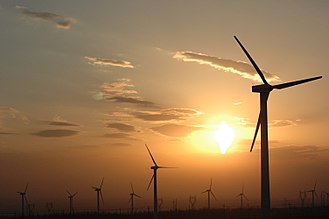
Windmills used wind power for milling. Now, wind turbines also make electricity to power many machines.
Engines come in many types. A steam engine uses heat to move, while automobile engines burn fuel to power cars. Jet engines burn fuel to push airplanes forward.
Power plants make electricity using heat from coal, natural gas, or nuclear reactions. This electricity travels through wires for people and industries to use.
Motors use electric current to make things move, from simple machines to complex robots.
Fluid Power systems use pumps to move water or air to create straight-line motion.
Electrochemical sources like batteries, solar cells, and thermoelectric generators also provide power, each using different ways to change energy into usable forms.
Mechanisms
The mechanism of a mechanical system is made from parts called machine elements. These parts give the system its shape and help control how it moves.
Some important parts that help control movement are gears and gear trains, which include belt drives and chain drives. There are also special parts like linkages, indexing mechanisms, and escapements. These parts work together to make machines move in useful ways.
Machine elements
The basic parts of a machine are called machine elements. These parts come in three main types: structural parts, mechanisms, and control parts.
Structural parts include frames, bearings, splines, and seals. They help hold the machine together and let it move smoothly. For example, bearings help manage movement and reduce friction. Springs can hold parts in place or act like a suspension. Fasteners like screws and bolts are also important for putting machine parts together.
Mechanisms control how the machine moves. This includes things like gears, belts, chains, and levers.
Control parts, such as buttons, switches, and sensors, help operate the machine. Even the shape and color of a machine’s cover can be important, making it easier and more pleasant for people to use.
Controllers
Controllers help machines work well. They use sensors, logic, and parts that make things move. One old example is the flyball governor. It helped control how fast a steam engine went. Thermostats are another example. They open valves to cool things down when they get too hot. Cruise control in cars keeps the speed steady. Today, computers called programmable logic controllers are used to control machines. Servomotors are special motors that move parts of a machine exactly where they need to go. This helps make robotic systems work.
Computing machines
Charles Babbage designed machines in 1837 to help with math. His Difference engine was a very early mechanical calculator. His Analytical Engine was like an early computer, but it was never fully built.
The Arithmometer and the Comptometer were also early machines for math before today’s computers. Now, we study special models called State machines and Turing machines to learn about computers.
Main articles: Difference engine, Analytical Engine, Modern digital computers, State machine, Turing machine
Molecular machines
Inside living cells, special molecules act like tiny machines. For example, myosin helps muscles contract by changing shape. Another molecule, kinesin, moves things inside cells. There are machines that make energy, like ATP synthase. Other machines help read and copy the cell's instructions, such as DNA polymerases and the ribosome that builds proteins. These natural machines are very complex.
Impact
Main articles: Mechanization and Automation
Mechanization means using machines to help people with hard work. Instead of using just hand tools, modern machines have gears, pulleys, and motors that make work easier and faster. After electricity became common, most small machines were powered by motors.
Automation uses computers and control systems to do jobs with little or no human help. It can do the work on its own. Automation is very important in factories and is becoming a bigger part of our everyday lives.
Main article: Automaton
An automaton is a machine that works by itself. The term is sometimes used to describe a robot, especially one that can work independently. One early example of a toy automaton was patented in 1863.
Mechanics
Hero of Alexandria's work on Mechanics looked at how to lift heavy weights. Today, mechanics is about understanding the forces and movement in mechanical systems.
This includes studying how things move (kinematics) and how forces affect their motion.
The movement of machines can be studied by thinking of their parts as stiff, unchanging objects. This makes it easier to figure out how these parts will move and react when forces are applied. By using basic physics, scientists and engineers can predict how machines will work in real life. This is important for designing things like cars and robots.
Machine design
Machine design is about planning and making machines. It has three main parts. First is invention, where people think of ideas to create a new machine. Next is performance engineering, which helps the machine work better and be easier to care for. Finally, there is the recycle phase, where old machines are taken apart and their parts are reused.
Images
Related articles



This article is a child-friendly adaptation of the Wikipedia article on Machine, available under CC BY-SA 4.0.
Images from Wikimedia Commons. Tap any image to view credits and license.