 Safekipedia
Malayan tiger
Adapted from Wikipedia · Adventurer experience
The Malayan tiger is a tiger from a specific population of the Panthera tigris tigris subspecies that lives in Peninsular Malaysia. This group of tigers lives in the southern and central parts of the Malay Peninsula.
In the Malay language, these tigers are called harimau, sometimes shortened to rimau. They are also known as the southern Indochinese tiger to tell them apart from a similar tiger group that lives farther north in Myanmar and Thailand.
These tigers help keep the forests healthy by controlling the numbers of other animals. However, they face big challenges because they lose their homes and sometimes have trouble finding food.
Taxonomy
The Malayan tiger is a type of tiger. It was identified as a special group in 2004 through genetic studies. By 2017, it was grouped with other tigers called P. t. tigris. Newer studies from 2018 show that the Malayan tiger might be different from other Asian tigers, which means there could be many types of tigers.
When the Malayan tiger was found to be special in 2004, some people thought it should be called Panthera tigris malayensis after its home region. But it was named the "Malayan tiger" and given the scientific name jacksoni, to honor conservationist Peter Jackson. Some scientists still use the name P. t. malayensis.
Characteristics
Malayan tigers look very similar to Indochinese tigers and are smaller than Bengal tigers. Males are usually about 8 feet 6 inches long, while females are a bit shorter, around 7 feet 10 inches. These tigers vary in weight, with males weighing between about 104 to 285 pounds and females between 52 to 195 pounds.
Distribution and habitat
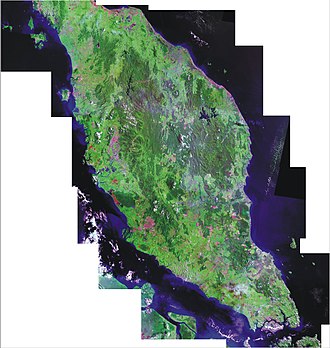
The Malayan tiger lives in the southern and central parts of the Malay Peninsula, close to Southern Thailand. In the past, tigers were also found on Singapore Island, but they disappeared there by the 1950s.
Today, tigers in Malaysia are found in areas such as Kelantan, Terengganu, Pahang, Johor, and Perak, especially near rivers. Their habitat covers a large area, but their numbers have been decreasing due to threats like poaching and loss of their natural home.
Ecology and behaviour
Malayan tigers hunt animals such as sambar deer, barking deer, Indian hog deer, wild boar, Bornean bearded pig, and mainland serow. They sometimes hunt larger animals like Asian black bear, young Asian Elephant calves, and sun bear. These tigers live in the forests of Peninsular Malaysia and are very good at hiding and catching their food.
Threats
Habitat loss due to development and farming is a big problem for the Malayan tiger. Lots of forest has been cut down to make room for farms, especially for palm oil crops. This loss of habitat makes it hard for tigers to find space to live.
Hunting for tigers is also a serious issue. Some people hunt tigers for their meat and bones, which are used in some medicines. This hurts the tiger population. Workers work hard to find and remove traps that danger tigers.
Conservation
The Malayan tiger is protected by law to stop trading. Groups like the Malaysian Conservation Alliance for Tigers work to support the tiger population. They help people report crimes against tigers and organize patrols to stop poaching.
In 2021, the Malaysian government announced plans to help protect the Malayan tiger until 2030. These plans include better patrols, protecting tiger habitats, creating a special task force, and working with zoos and universities to study ways to keep tiger populations healthy. The government also extended bans on hunting deer to help protect the tigers' environment.
Cultural references
The Malayan tiger is the national animal of Malaysia. In stories by Emilio Salgari about a pirate named Sandokan, the hero is called "The Tiger of Malaysia".
Related articles



This article is a child-friendly adaptation of the Wikipedia article on Malayan tiger, available under CC BY-SA 4.0.
Images from Wikimedia Commons. Tap any image to view credits and license.