
Mozambique
Mozambique, officially the Republic of Mozambique, is a country in Southeast Africa. It touches the Indian Ocean on its eastern side. It shares borders with Tanzania to the north, Malawi and Zambia to the northwest, Zimbabwe to the west, and Eswatini and South Africa to the south and southwest. The capital and biggest city is Maputo.
Long ago, between the 7th and 11th centuries, towns along the coast grew and helped create a special Swahili culture. In 1498, a sailor named Vasco da Gama arrived, which started Portuguese control of the area. After more than four hundred years under Portuguese rule, Mozambique gained independence in 1975. After that, the country had a difficult time with conflict. Since 1994, Mozambique has had elections and works as a presidential republic.
Mozambique has many natural resources. Its economy depends mostly on fishing and farming. Even though it has improved since 2001, Mozambique is still one of the poorer and most underdeveloped countries in the world. About 34.8 million people live there, from many different groups. The official language is Portuguese, and most people practice Christianity as the religion in Mozambique.
Etymology
Mozambique was named by the Portuguese after the Island of Mozambique. The name comes from an Arab trader named Mussa who lived there. When explorer Vasco da Gama arrived in 1498, Mussa was still on the island. The island was the capital of the Portuguese colony until 1898. Then the capital moved to Lourenço Marques, now called Maputo.
History
Main article: History of Mozambique
Bantu migrations
Further information: Bantu expansion
People who spoke Bantu languages moved into Mozambique as early as the 4th century BC. Between the 1st and 5th centuries AD, more groups came from the west and north through the Zambezi River valley. They created farming communities and societies based on raising cattle. They also brought skills for working with iron.
Swahili Coast
From the late first millennium AD, big trade networks along the Indian Ocean reached as far south as today’s Vilankulo. Ancient port towns like Chibuene show this. Starting in the 9th century, more port towns grew along the East African coast, including parts of modern Mozambique. These towns were often independent and took part in the early Swahili culture. Many leaders in these areas followed Islam, which helped with trade. By the 15th century, places like Sofala, Angoche, and Mozambique Island were important.
These towns traded with people from Africa’s interior and the wider Indian Ocean world. Gold and ivory from places like the Kingdom of Zimbabwe and Kingdom of Mutapa were traded to big port cities like Kilwa and Mombasa.
Portuguese Mozambique (1498–1960)
Further information: Portuguese Mozambique
The Island of Mozambique, which the country is named after, is a small coral island at the mouth of Mossuril Bay on the Nacala coast. Europeans first explored it in the late 15th century.
Portuguese explorers reached Mozambique in 1498. Arab traders had been on the coast and nearby islands for hundreds of years. Starting around 1500, Portuguese trading posts and forts took over from Arab traders, becoming stops on Europe’s sea route to the east. This was the start of colonisation.
Vasco da Gama sailed around the Cape of Good Hope in 1498, beginning Portugal’s involvement in the area. The Portuguese took control of the Island of Mozambique and the port city of Sofala in the early 1500s. By the 1530s, Portuguese traders and explorers looking for gold went into the interior, setting up small forts and trading places at Sena and Tete along the Zambezi River.
In central Mozambique, the Portuguese tried to make their trade and settlements stronger by giving out land grants called prazos to settlers. These grants tied people to the land, and much of inland Mozambique was run by prazeiros, the people who got the grants. Portugal focused more on its other colonies in Asia and the Americas, so power was often left to these local leaders. Slavery existed before Europeans arrived. African leaders sold captured people to Arab traders and later to the Portuguese. The prazeiros used armies of enslaved people called Chikunda to keep control.
Portuguese control grew but was limited. They took over much coastal trade from Arab traders between 1500 and 1700, but lost a key fort in Mombasa in 1698. After that, Portugal paid less attention to Mozambique while focusing on richer trade in India, the Far East, and Brazil.
The Mazrui and Omani Arabs took back much of the Indian Ocean trade, pushing the Portuguese south. Many prazos declined by the mid-1800s, but some stayed. During the 1800s, other European powers like the British and the French became more involved in the area.
By the early 1900s, Portugal let big companies like the Mozambique Company, the Zambezia Company, and the Niassa Company run much of Mozambique. These companies, funded mostly by British investors like Solomon Joel, built railroads to their colonies in South Africa and Rhodesia. Even though slavery was made illegal, these companies used forced labour for mines and plantations in nearby British colonies and South Africa. The Zambezia Company built roads and ports, including a railroad from present-day Zimbabwe to the port of Beira.
Because these companies did not perform well, and Portugal wanted more control under its corporatist Estado Novo regime led by Oliveira Salazar, their control ended. The Mozambique Company stopped in 1942, and the Niassa Company in 1929. In 1951, Portugal renamed its African colonies as Overseas Provinces.
The Mueda massacre on 16 June 1960, where Makonde protestors were killed, led to calls for Mozambique to break free from Portuguese rule.
Mozambican War of Independence (1961–1974)
Main articles: Mozambican War of Independence and Portuguese Colonial War
As ideas about fighting against colonial rule spread in Africa, many secret political groups formed to support Mozambique’s independence. These groups said that Portugal’s policies mainly helped Portuguese people, ignoring the needs of Mozambique’s native communities. This caused suffering for many local people. In response, the Portuguese government started making changes in the 1960s and early 1970s.
The Front for the Liberation of Mozambique (FRELIMO) began fighting against Portuguese rule in September 1964. This war, along with similar conflicts in Angola and Portuguese Guinea, was part of the Portuguese Colonial War (1961–1974). The Portuguese army held the main towns, while FRELIMO tried to influence rural and tribal areas in the north and west. The Portuguese worked to improve social development and the economy in response.
Independence (1975)
FRELIMO took control after ten years of fighting, and Portugal became a democracy after the Carnation Revolution in April 1974. Most of the 250,000 Portuguese people in Mozambique left, and Mozambique became independent on 25 June 1975. A law allowed the Portuguese to leave quickly, and many returned to Portugal with little.
Mozambican Civil War (1977–1992)
Main articles: People's Republic of Mozambique and Mozambican Civil War
The new government under President Samora Machel created a one-party state based on Marxist ideas. It received support from Cuba and the Soviet Union. Starting in 1977, the country had a long civil war between the FRELIMO government and the anti-communist Mozambican National Resistance (RENAMO) rebels. This war, along with actions by neighbouring Rhodesia and South Africa, poor policies, and economic problems, caused big problems. Infrastructure was damaged, investment stopped, industries were taken over by the government, and there was widespread famine.
During the war, the government could not control areas outside the main cities. RENAMO controlled about half of the rural areas in some provinces. Health services suffered as spending was cut. Both sides committed serious violations, using fear and attacks on ordinary people.
RENAMO suggested a peace agreement to make some areas independent, but FRELIMO refused. The FRELIMO government supported rebel groups in South Africa and Zimbabwe, while Rhodesia and later South Africa supported RENAMO.
On 19 October 1986, Machel’s plane crashed in the Lebombo Mountains near Mbuzini in South Africa. He and thirty-three others died, including government ministers and officials.
Machel’s successor Joaquim Chissano made big changes, moving from Marxism to capitalism and starting peace talks with RENAMO. The new constitution in 1990 allowed many parties, a market economy, and free elections. The civil war ended in October 1992 with the Rome General Peace Accords, supervised by United Nations peacekeepers.
Democratic era (1993–present)
Mozambique has held elections since 1994 as part of the peace agreements to end the civil war. The first elections were seen as free and fair, but later elections have had problems.
In 1994, FRELIMO won under Joaquim Chissano, while RENAMO became the opposition. In 1995, Mozambique joined the Commonwealth of Nations.
By 2000, many refugees had returned home after the war. In 1999, elections were won again by FRELIMO, but RENAMO said there was fraud.
In 2004, Armando Guebuza became president. He served two terms. In 2015, Filipe Nyusi became president.
From 2013 to 2019, there was a small conflict with RENAMO. In 2014, they agreed to stop fighting. But after elections in 2014, RENAMO did not accept the results and wanted control of six provinces.
In 2019, Filipe Nyusi was re-elected. FRELIMO won most seats in parliament.
Since 2017, the country has faced attacks by armed groups. In 2020, an armed group took over an island for a short time. In 2021, attacks on a city caused many people to flee. In 2025, Daniel Chapo became president. Some groups did not accept the election results.
Geography
Main article: Geography of Mozambique
Mozambique is a country in Southeast Africa. It is the 35th largest country in the world, with an area of 309,475 square miles (801,537 km2). It borders the Indian Ocean to the east, Tanzania to the north, Malawi and Zambia to the northwest, Zimbabwe to the west, and Eswatini and South Africa to the south and southwest.
The land in Mozambique has two main parts divided by the Zambezi River. North of the river, there are hills and low plateaus. South of the river, the land is broader with plateaus and mountains. The country has five main rivers, with the Zambezi being the largest. It also has four important lakes, all in the northern part of the country. Major cities include Maputo, Beira, Nampula, and others.
Main articles: Climate of Mozambique and Climate change in Mozambique
Mozambique has a tropical climate with a wet season from October to March and a dry season from April to September. The weather changes with altitude, and heavy rains fall along the coast. Cyclones sometimes occur during the wet season.
Main article: Wildlife of Mozambique
See also: Category:Flora of Mozambique, List of marine molluscs of Mozambique, and List of non-marine molluscs of Mozambique
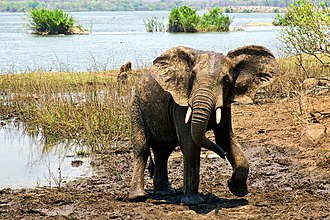
Mozambique is home to many bird species and over 200 mammal species. The country has protected areas, such as national parks and nature reserves.
Government and politics
Main article: Politics of Mozambique
The Constitution of Mozambique says that the President of the Republic is the leader of the country. The president is chosen by voting for a five-year term. The prime minister is chosen by the president to help run the government.
The Assembly of the Republic has 250 members who are elected to help make laws. The country's courts include a Supreme Court and smaller courts in different areas.
Mozambique has a small military to protect the country. The Mozambique Defence Armed Forces handle all parts of national defense.
Administrative divisions
Main articles: Subdivisions of Mozambique, Provinces of Mozambique, Districts of Mozambique, and Postos of Mozambique
Mozambique is divided into ten provinces and one main city that has the same status as a province. These areas are split into smaller parts called districts. The districts are then split into even smaller areas called administrative posts.
Foreign relations
Main article: Foreign relations of Mozambique
Mozambique works to keep good relationships with its neighbors and partners that help with development. Today, Mozambique focuses on building strong ties with its neighbors and international friends.
Mozambique has relationships with many countries. It joined groups like the World Bank and International Monetary Fund. It also works with European countries such as Sweden, Norway, Denmark, and Iceland. Mozambique is part of many international groups, including the Non-Aligned Movement, the African Union, and the Southern African Development Community.
Human rights
Main article: Human rights in Mozambique
See also: Human trafficking in Mozambique
Since 2015, laws in Mozambique allow people to live as they choose, but many still face unfair treatment because of who they are.
Economy
Main article: Economy of Mozambique
Mozambique is a poorer and less developed country. Between 1994 and 2006, its economy grew by about 8% each year. But since 2014/15, people have had less money to spend, and there are big differences between rich and poor people. In 2006, many people in Mozambique said their lives had not improved in the past five years.
The official money used in Mozambique is called the metical (in October 2023, US$1 was worth about 64 meticals). People also use U.S. dollars, South African rand, and euros for buying things. The least amount someone can legally earn each month is about US$60. Mozambique is part of a group of countries called the Southern African Development Community (SADC). This group works together to help each other by removing taxes and other barriers to trade. In 2007, the World Bank talked about Mozambique's "fast economic growth."
Rebounding growth
After refugees returned home and the government made good changes, Mozambique's economy grew quickly. From 1996 to 2006, and again from 2006 to 2011, the economy grew by 6–8% each year. In the future, growth will depend on big projects with money from other countries, continuing good changes, and helping farming, roads, and tourism grow. In 2013, most people worked in farming, mostly growing food just for their families because they did not have good roads or enough money to buy things.
Economic reforms
The government sold more than 1,200 small businesses that used to belong to the government. They are also making changes to other big businesses like telephone companies, power companies, ports, and railways. They have also made it easier to trade by lowering taxes and changing how customs work. In 1999, they started a tax to help get more money for the government.
Corruption
Mozambique has had problems with corruption, where public money was stolen. In 2011, the government made new laws against stealing public money and other unfair actions. Mozambique has been trying to fix these problems.
Natural resources
Main article: Mineral industry of Mozambique
In 2010–2011, companies found a big area with natural gas off the coast of Mozambique. Once this is developed, Mozambique could become one of the biggest makers of natural gas in the world. In 2017, three companies were chosen to help develop this gas. Production was planned to start in 2018, and Mozambique is now set to start selling natural gas worldwide in 2024. In 2019, many investors gave money to help bring this gas to markets. TotalEnergies is the main company working on this project.
Tourism
Main article: Tourism in Mozambique
Mozambique's beaches, animals, and history make it a good place for tourists. The north has clean beaches far from cities, like the Quirimbas Islands and the Bazaruto archipelago. Inhambane Province is popular with divers because of its sea life, including whale sharks and manta rays. There are also several national parks, including Gorongosa National Park.
Transport
Main articles: Transport in Mozambique and Rail transport in Mozambique
Mozambique has over 30,000 km of roads, but many are not paved. People drive on the left side of the road, even though Mozambique was not ruled by Britain. There is an international airport in Maputo, 21 other paved airports, and over 100 small airports. There are also 3,750 km of rivers that can be used for travel. Mozambique has railways that connect it to Malawi, Zimbabwe, and South Africa. These railways were damaged during a civil war and are now being fixed.
Demographics
Main article: Demographics of Mozambique
Mozambique has many different groups of people. The north-central areas, especially Zambezia and Nampula, have the most people. The Makua group is the largest in the north, while the Sena and Shona groups are common around the Zambezi River. In the south, the Tsonga people are the most numerous. Other groups include the Makonde, Yao, Swahili, Tonga, Chopi, and Nguni, which includes the Zulu. Most people in Mozambique belong to Bantu groups. The rest include people of Portuguese, Euro-African (mestiço), and Indian ancestry.
Portuguese is the official language and is spoken by many people. In Maputo, about half of the people speak Portuguese as their first language. Many other languages are also spoken, including Swahili, Makonde, Yao, and several Shona-related languages. The country has a mix of religions. Most people are Christian, many are Muslim, some follow animism, and others have no specific religious beliefs.
Largest cities
Languages
Main article: Languages of Mozambique
Religion
Main article: Religion in Mozambique
Cathedral of Our Lady of the Immaculate Conception, Maputo
A mosque in downtown Maputo
Recent surveys show that most people in Mozambique are Christian, with many also being Muslim. There are also people who follow animism or have no religion. The Catholic Church has many dioceses across the country. There are also many Protestant groups. Muslims are more common in the northern parts of the country.
Health
Further information: Health in Mozambique
Mozambique faces health challenges. The country has relatively few doctors. Many mothers and young children face health risks. The country also deals with food shortages.
Education
Main article: Education in Mozambique
Portuguese is the main language used in schools. Children are required to attend school, but many cannot because they help their families on farms. In recent years, more girls have started going to school. After primary school, students must pass exams to continue to secondary school. There are not many places available in universities, so many students work or train in other ways after finishing school. The ability to read and write has been improving over time.
Largest cities or towns in Mozambique According to the 2017 Census | |||||||||
|---|---|---|---|---|---|---|---|---|---|
| Rank | Name | Province | Pop. | Rank | Name | Province | Pop. | ||
| 1 | Maputo | Maputo | 1,080,277 | 11 | Gurúè | Zambézia | 210,000 | ||
| 2 | Matola | Maputo | 1,032,197 | 12 | Pemba | Cabo Delgado | 201,846 | ||
| 3 | Nampula | Nampula | 663,212 | 13 | Xai-Xai | Gaza | 132,884 | ||
| 4 | Beira | Sofala | 592,090 | 14 | Maxixe | Inhambane | 123,868 | ||
| 5 | Chimoio | Manica | 363,336 | 15 | Angoche | Nampula | 89,998 | ||
| 6 | Tete | Tete | 307,338 | 16 | Inhambane | Inhambane | 82,119 | ||
| 7 | Quelimane | Zambézia | 246,915 | 17 | Cuamba | Niassa | 79,013 | ||
| 8 | Lichinga | Niassa | 242,204 | 18 | Montepuez | Cabo Delgado | 76,139 | ||
| 9 | Mocuba | Zambézia | 240,000 | 19 | Dondo | Sofala | 70,817 | ||
| 10 | Nacala | Nampula | 225,034 | 20 | Moçambique | Nampula | 65,712 | ||
Culture
Main article: Culture of Mozambique
Mozambique was ruled by Portugal, so many people speak Portuguese and practice Roman Catholicism. Most people are Bantu, so their culture has strong native roots. In cities, you can see a mix of Portuguese and native traditions.
The Makonde people are known for their wood carvings and masks. Their carvings include figures called shetani and family tree carvings called ujamaa. After Mozambique gained independence in 1975, artists began creating new kinds of art.
Music in Mozambique is important for religion and ceremonies. Common instruments include drums, the lupembe (a woodwind), and the marimba, a type of xylophone.
Football is the most popular sport, but people also enjoy track and field, basketball, roller hockey, and beach volleyball.
| Date | National holiday designation |
|---|---|
| 1 January | Universal fraternity day |
| 3 February | Mozambican heroes day |
| 7 April | Mozambican women day |
| 1 May | International workers day |
| 25 June | National Independence day |
| 7 September | Victory Day |
| 25 September | National Liberation Armed Forces Day |
| 4 October | Peace and Reconciliation |
| 25 December | Family Day |
Pictures
Keep exploring




This article is a child-friendly adaptation of the Wikipedia article on Mozambique, available under CC BY-SA 4.0.
Images from Wikimedia Commons. Tap any image to view credits and license.