 Safekipedia
Nairobi
Adapted from Wikipedia · Adventurer experience
Nairobi is the capital and largest city of Kenya. It is in the south-central part of the country. As of 2024, it has a population of 4.8 million and a metropolitan population of 5.7 million. It is the 11th most populous city in Africa.
Nairobi is nicknamed the "Green City under the Sun" because it is the only capital city in the world that has a national park inside its borders. The name Nairobi comes from the Maasai phrase Enkare Nyirobi, meaning "place of cool waters".
As the national capital, Nairobi is home to important buildings such as the Kenyan Parliament Buildings, the State House, and the Supreme Court Building. It is a major financial and economic center for East Africa. It hosts many businesses and international organizations like the United Nations Environment Programme (UN Environment) and the United Nations Office at Nairobi (UNON). The Nairobi Securities Exchange is one of the largest stock exchanges in Africa.
Nairobi was founded in 1898 by colonial authorities in British East Africa as a rail depot on the Uganda–Kenya Railway. The city grew quickly because of its high elevation, temperate climate, and good water supply. It became the capital of Kenya in 1907, replacing Mombasa. After Kenya gained independence in 1963, Nairobi continued to grow into a modern city with a strong economy.
History
Main article: History of Nairobi
For a chronological guide, see Timeline of Nairobi.
The area where Nairobi now stands was once a swamp used by the Maasai, Akamba People, and Kikuyu people. The name Nairobi comes from a Maasai phrase meaning 'cool waters', after a cold stream that ran through the area. When the Uganda Railway was being built, the spot was chosen for a store and resting place because of its high position, nice climate, and water supply.
The railway reached Nairobi in 1899, and it quickly became an important town. Early problems included diseases like malaria and plague, which caused changes to the town’s layout.
Nairobi became the capital of the East Africa Protectorate in 1907 and grew fast, especially after World War II. Growth brought challenges, like crowded neighborhoods and planning issues.
After Kenya gained independence in 1963, Nairobi stayed the capital. New buildings and projects helped the city grow, such as the Kenyatta International Conference Centre in 1973 and the renaming of the airport to Jomo Kenyatta International Airport in 1978.
In recent years, Nairobi has continued to develop with new roads like the Nairobi Expressway and bus terminals to help with traffic. Housing projects are also underway to give people more places to live.
Geography
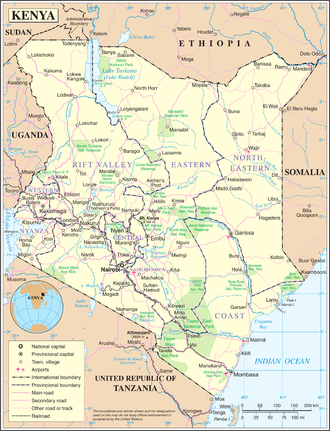
Nairobi is in south-central Kenya and covers 696 square kilometres. It lies between the cities of Kampala and Mombasa. The city is near the Rift Valley, so small earthquakes and tremors can happen. Important landmarks include the Ngong Hills to the west, Mount Kenya to the north, and Mount Kilimanjaro to the southeast.
The Nairobi River and its smaller streams flow through the area and join the larger River Athi to the east. The city’s western suburbs stretch about 20 kilometres from Kenyatta National Hospital to the UN headquarters. Nairobi’s centre is around City Square, where important buildings like the Kenyan Parliament, Holy Family Cathedral, Nairobi City Hall, and Kenyatta Convention Centre are located.
Climate
Nairobi has a cool, subtropical highland climate. At about 1,795 metres above sea level, evenings can be chilly, especially from June to July. The warmest time of year is from December to March, with daytime temperatures often reaching the high twenties in Celsius. Rainfall is moderate, with rainy seasons followed by drier periods. Because Nairobi is near the equator, the difference between seasons is small.
Nairobi metropolitan region
Nairobi is part of a larger metropolitan area that includes parts of five Kenyan counties. This region produces a large part of Kenya’s economy. Nairobi County alone is very important to the country’s GDP.
Districts and neighbourhoods
Nairobi is divided into several areas. Some well-known neighbourhoods include Central, Dagoretti, Embakasi, Kasarani, Kibera, Makadara, Pumwani, and Westlands. Upscale suburbs like Karen, Langata, and Lavington are mostly in the west and north-central parts of the city. More affordable areas are found in the eastern parts, such as Dandora, Kariobangi, and Kayole. Many people live and work within the greater Nairobi area.
Kibera slum
Main article: Kibera
The Kibera area in Nairobi is one of the largest urban settlements in Kenya. The government estimates its population to be around 185,777, while other sources suggest it may be much larger.
Parks and gardens
Nairobi has many beautiful parks and open spaces. The city is full of trees and green areas that make it a nice place to visit.
The most famous park is Uhuru Park. It is next to the busy part of the city and is used for speeches and events. Jeevanjee Gardens is one of the oldest parks and is right in the center of the city. Karura Forest is a nature reserve where you can see birds, monkeys, and even small waterfalls. Nairobi Arboretum is a place where many different kinds of trees grow and is both a fun place to visit and a spot for learning.
There are many other parks too, like Ngong Road Forest where you can walk, jog, or have a picnic, and the Nairobi Botanical Gardens which has special gardens for learning about plants. These parks help keep the city green and give people places to relax and enjoy nature.
Political divisions
The City of Nairobi is a full administrative county.
Nairobi used to be one of eight provinces in Kenya before 2013. In 2010, it became a county called Nairobi City County. This county is completely urban and has 17 areas called constituencies. These constituencies are split into 85 smaller areas called wards.
Economy
See also: List of companies and organizations based in Nairobi
Nairobi has the Nairobi Securities Exchange, one of the biggest stock exchanges in Africa. It was named an overseas exchange by the London Stock Exchange in 1953. The exchange helps with trading and money in Africa.
Many big international companies and groups have their main offices in Nairobi. For example, General Electric, Google, and the United Nations Office at Nairobi are here.
Nairobi makes many things, such as clothes, food, and drinks. It has factories for big companies like Goodyear Tire and Rubber Company and Toyota. The city is also a popular place for tourists.
Central Business District (CBD)
Nairobi grew around its central business district, often called "the CBD". This area has important buildings like City Hall and the Parliament Building. Many tall buildings here are offices for businesses.
Upper Hill
Main article: Upper Hill, Nairobi
Two areas outside the main city centre, Upper Hill and Westlands, are becoming busy places for companies. Big office buildings are being built there, like the UAP Tower.
Construction boom and real estate development projects
Nairobi is building many new tall buildings and shopping places. Projects include the Garden City Mall and new homes for people.
Also see List of tallest buildings in Kenya
| Pinnacle Towers (estimated completion in 2029) | 314 m (1,030 ft) |
| Britam Tower | 200 m (660 ft) |
| UAP Tower | 163 m (535 ft) |
| Times Tower | 140 m (460 ft) |
| Teleposta Towers | 120 m (390 ft) |
| Kenyatta International Conference Centre | 105 m (344 ft) |
| NSSF Building | 103 m (338 ft) |
| I&M Bank Tower | 100 m (330 ft) |
| Nyayo House | 84 m (276 ft) |
| Cooperative Bank House | 83 m (272 ft) |
| National Bank House | 82 m (269 ft) |
| Hazina Towers | 81 m (266 ft) |
| Rahimtulla Tower | 80 m (260 ft) |
Demographics
As of 2024, Nairobi has about 4.8 million people, making it the largest city in Kenya. The city covers around 696 square kilometers, and many people live close together. Nairobi is growing quickly, and its population may reach 5 million by 2025.
Nairobi has many different kinds of people and beliefs. Most people in Nairobi follow Christianity, with many belonging to Protestant, Catholic, or Evangelical groups. Islam is also practiced by some residents. There are also smaller communities that follow Hinduism, traditional African religions, or no specific religion at all.
| Year | 2009 | 2019 | 2023 | 2030 |
|---|---|---|---|---|
| Population size | 3,138,372 | 4,397,073 | 4,677,677 | 5,212,500 |
Culture
Nairobi is a city where many African cultures come together. It is home to people from all of Kenya's tribes and welcomes visitors from other African countries.
Nairobi has two fun nicknames. People call it "The Green City in the Sun" because of its plants and warm weather. Another nickname is "Safari Capital of the World" because the city is a big place for safari tours.
In 2026, Nairobi was a finalist for the "World Capital of Kindness" title.
Literature and film
Kwani? is Kenya's first literary journal and was started by writers living in Nairobi. The city’s publishers have brought us books by famous Kenyan authors like Ngũgĩ wa Thiong'o and Meja Mwangi.
Many filmmakers work in Nairobi, with famous names like producer Njeri Karago and director Judy Kibinge leading the way. One well-known book and movie set in Nairobi is Out of Africa. It was written by Karen Blixen, who lived near Nairobi from 1917 to 1931. The story was turned into a movie in 1985, directed by Sydney Pollack.
Nairobi has been a filming location for many movies from America and Britain, including The Constant Gardener. One of Kenya’s most famous actors, Lupita Nyong'o, grew up connecting with Nairobi.
Food
Nairobi has many places to eat. You can find local dishes like nyama choma, which is roasted meat, as well as famous fast-food places like KFC, Subway, Domino's Pizza, Pizza Hut, Hardee's, and Burger King. There are also popular restaurants from South Africa, such as Galito's, Steers, PizzaMojo, and Spur Steak Ranches.
Coffee houses like Artcaffe Nairobi Java House and Dormans are favorite spots for some people. Traditional food places, like K'osewe's and Amaica, serve African dishes. Upscale restaurants often focus on foods from Italy, Lebanon, Ethiopia, and France.
Every year in January and February, Nairobi holds a special restaurant week called NRW. During this time, restaurants offer meals at lower prices. NRW is organized by Eatout Kenya, a website where people can read about and review restaurants in Nairobi.
Music
Nairobi is the heart of Kenya’s music world. The city gave birth to Benga, a mix of jazz and Luo music. Another popular style is Mugithi, coming from central Kenya. Many music videos by top local singers are filmed in Nairobi.
In the 1970s, Nairobi became a key place for soukous music, a style that started in Congo. Many musicians from there moved to Nairobi and became very successful.
Today, Nairobi is also where you’ll find Kenya’s thriving hip hop scene. Local artists like Jua Cali, Nonini, Camp Mulla, Juliani, Eric Wainaina, and Nameless are very popular. The city is also a center for EDM, with talented DJs like DJ Fita.
Many nightclubs in Nairobi are filled with people loving Electronic Dance Music, especially younger folks. Gospel music is also widely enjoyed in the city, just like across all of Kenya. The group Sauti Sol even performed for U.S. President Barack Obama during a visit in 2015.
Sports
Nairobi is a big city for sports in the African Great Lakes region. The city holds important events every year, like the Safari Rally, the Safari Sevens rugby union tournament, and the Nairobi Marathon.
The main sports place in Nairobi and Kenya is the Moi International Sports Centre in Kasarani. It was finished in 1987 and has a large stadium, a smaller gym, and an aquatic center.
Football is very popular in Nairobi. The city has many football clubs, and Kenya will help host big football tournaments in 2025 and 2027 with Tanzania and Uganda. There are also places to play golf near the city, and Nairobi is an important place for rugby, basketball, and marathons.
Places of worship
Nairobi has many places where people can worship. Most of these are Christian churches and temples. Some of these include the Roman Catholic Archdiocese of Nairobi, Anglican Church of Kenya, Presbyterian Church of East Africa, Baptist Convention of Kenya, and Assemblies of God. There are also Muslim mosques, like the Jamia Mosque.
Education
Most schools in Nairobi use a system called the Kenyan Competence Based Education. The city also hosts Nairobi Innovation Week. This event started in 2015. It brings together people from around the world to share ideas and work on projects.
Nairobi is home to many universities and colleges. The University of Nairobi is the largest and oldest, with many students. Other schools include Kenyatta University, Strathmore University, and United States International University – Nairobi, among many others. These universities offer many subjects for students to study.
Infrastructure
Transport
Big plans are in place to help make traffic easier in the city. The completion of Thika Road has improved the city a lot, as this road meets global standards. Several projects have been finished, such as Syokimau Rail Station and the Eastern and Northern Bypasses, while many other projects are still being worked on.
These transport projects will lower travel costs by moving goods and people faster. They will also boost trade, improve living conditions for people in Northern Kenya, and help the country attract investments from around the world.
Airports
Jomo Kenyatta International Airport is the biggest airport in Kenya. In 2016, 40% of travelers were from within Kenya. Over 7 million people passed through JKIA in 2016. In February 2017, JKIA got a Category One Status from the FAA, making it a top regional airport.
Wilson Airport handles smaller planes, mostly ones with propellers. In July 2016, building started on a new air traffic control tower.
Moi Air Base is a military airport. In the past, it was used as a landing strip. Back in the 1930s and 1940s, it was mainly used for British passengers and mail between Southampton and Cape Town. Flights used flying boats between Britain and Kisumu.
Matatu
Main article: Matatu
Matatus are the most common way people get around in Nairobi. Matatu are privately owned small buses. They operate in Nairobi and nearby areas, plus trips to towns around the country. Each matatu shows its route on a yellow stripe.
In 2004, a law was passed requiring all matatus to have seat belts and a yellow stripe. Matatus are now limited to driving at 80 km/h (50 mph).
In November 2014, President Uhuru Kenyatta allowed matatus to keep their colorful designs. Matatus in Nairobi are famous for their bright paint, showing things like favorite football teams or hip hop stars.
Buses
Buses are becoming more common in the city, with some even having free WiFi. There are four main bus companies: the traditional Kenya Bus Service (KBS) and newer private companies like Citi Hoppa, Compliant MOA, and Double M.
Companies like Easy Coach, Guardian Angel, Transline, Tahmeed, NorthWest, Kisii Classic, and Ena coach run scheduled buses and luxury coaches to other cities and towns.
A Bus rapid transit system will start running in July 2022 with 100 big buses on Thika Road between Kasarani and the Kenyatta National Hospital. After testing, the Nairobi Metropolitan Area Transport Authority (Namata) plans to add more buses to extend the BRT line. Later, the line will go from Kenol in Murang'a County to Ongata Rongai in Kajiado County.
Trains
Nairobi started as a railway town, and the main office of Kenya Railways (KR) is still at Nairobi railway station, close to the city center. The railway runs through Nairobi from Mombasa to Kampala. It is mostly used for moving goods. Some trains connect the city center to the suburbs. Plans are in place to build a commuter rail line.
In November 2012, President Mwai Kibaki started the Syokimau Rail Service. The new station helps cut travel time between Syokimau and the city center.
The new station is part of the first phase of the Nairobi Commuter Rail Network. Other modern stations include Imara Daima Railway Station and Makadara Railway Station.
The new Mombasa–Nairobi Standard Gauge Railway links the port city of Mombasa with Nairobi. The new railway mostly replaced the old railway. The Nairobi Terminus is at Syokimau, about 20 km from the city center.
Roads
Two major African road routes go through Nairobi: the Cairo-Cape Town Highway and the Lagos-Mombasa Highway. Nairobi has highways connecting it to Mombasa, Kampala in Uganda, and Arusha in Tanzania. Most roads are paved, and there are signs showing where different neighborhoods are.
Nairobi is linked to the Jomo Kenyatta International Airport by the Mombasa Highway. Ongata Rongai, Langata, and Karen connect to the city center through Langata Road. Lavington, Riverside, and Westlands are connected by Waiyaki Way. Kasarani, Eastlands, and Embakasi are linked by Thika Road, Jogoo Road, and Outer Ring Road.
Highways connect the city to other big towns such as Mombasa, Machakos, Voi (A109), Eldoret, Kisumu, Nakuru, Naivasha, and Namanga Border in Tanzania (A104).
Nairobi is building new roads to improve its roads and highways. New roads, overpasses, and bridges are being built to handle heavy traffic. This is also part of Kenya's Vision 2030 and Nairobi Metropolis plans. Most roads now have lights and good signs.
In 2020, building started on The Nairobi Expressway. This toll road links Mulolongo in Eastern Nairobi to Westlands at James Gichuru junction, going through Nairobi’s center. The road leads straight to Jomo Kenyatta International Airport. The work includes widening the road and adding sidewalks, drainage, overpass bridges, and street lights. It opened to the public in May 2022.
Private car population projection for Nairobi
Water supply and sanitation
Further information: Water supply and sanitation in Nairobi
Most of the water for Nairobi comes from rivers and lakes in the Aberdare Range to the north, especially from the Thika Dam. People in crowded neighborhoods get water from water kiosks and end up paying more than those with pipes at home.
Housing
There are many kinds of homes in Nairobi, from houses people own to apartments for rent. Many wealthy Kenyans live in Nairobi, but most people earn average or low wages. About half of Nairobi’s people live in slums, which only cover 5% of the city.
Kibera is one of Africa’s biggest slums, west of Nairobi. Other well-known slums are Mathare and Korogocho. In total, there are 66 slum areas in Nairobi.
Many people not in slums live in better homes. Big houses are common in wealthy parts of the city, especially west of Nairobi. Upscale neighborhoods include Gigiri, Muthaiga, Langata, and Karen. Other nice areas are Parklands, Westlands, Hurlingham, Kilimani, Milimani, Spring Valley, Lavington, Rosslyn, Kitisuru, and Nairobi Hill.
To give more middle-class families places to live, many new apartments and homes are being built around the city. One big project is Greenpark, at Athi River, Machakos County, about 25 km from Nairobi’s business center. Over 5,000 houses, villas, and apartments are being built there, along with places to shop, relax, and do business.
| YEAR | 2004 | 2010 | 2015 | 2025 |
|---|---|---|---|---|
| Number of private cars | 207,339 | 327,366 | 486,207 | 716,138 |
Crime and law enforcement
Crime in Nairobi has improved a lot in recent years. Serious violent crime is rare, but small crimes like pickpocketing can still occur. These small crimes are usually not aggressive. There have been a few rare attacks in Kenya from a group in nearby Somalia, but these events are very uncommon.
Media
Nairobi is where most of Kenya's news and media groups are based. The city has big newspapers like the Daily Nation and The Standard, both printed in English. There is also a free paper called People Daily sold on the streets.
The city is home to many radio and TV stations, such as Kenya Broadcasting Corporation and Kenya Television Network. International news companies like the BBC, CNN, and Reuters also have offices in Nairobi.
Notable people
- Ishmael Awange (born 1989), basketball player
- Dvora Bochman (born 1950), Israeli artist, painter, sculptor, graphic designer and art educator
- Elsa Conrad (1887–1963), German businesswoman and night club entrepreneur
- Richard Dawkins (born 1941), British evolutionary biologist
- Roshanara Ebrahim (born 1993), TV host, model, author and beauty pageant titleholder
- Chris Froome (born 1985), born in Nairobi, British professional cyclist 4x Tour de France Winner
- Edi Gathegi (born 1979), actor
- Fena Gitu (born 1991), rapper
- Polly Irungu, photographer and journalist
- Pamela Jelimo (born 1989), Olympic champion runner
- Wanuri Kahiu (born 1980), film director, producer, and author
- Mike Kirkland (born 1947), rally driver
- Prosper Masatu Makonya, Tanzanian sportsperson
- Susan Murabana, astronomer
- Alice Wairimu Nderitu (born 1968), human rights activist, and United Nations Under-Secretary-General and Special Adviser on the Prevention of Genocide to UN Secretary-General
- Dorothy Ooko, activist and technology professional
- Aaron Rimbui (born 1979), pianist, keyboardist, bandleader, producer, festival curator, and radio host
- Johnny Rozsa, photographer
- Israel Somen (1903–1984), Mayor of Nairobi
- Abdi Salim (born 2001), Somali footballer
- Carl Tundo (born 1973), rally driver
- Jeremy Wahome (born 1998), racing driver
- McDonald Mariga Wanyama, retired footballer
- Victor Wanyama (born 1991), footballer
Pop culture
The city of Nairobi has appeared in several movies and TV shows. A 1981 film called Rise and Fall of Idi Amin shows how Nairobi helped oppose a difficult leader from nearby Uganda.
In 2012, a Kenyan movie named Nairobi Half Life was chosen to represent Kenya for an important award. Also, a popular character named 'Nairobi' appears in the Netflix series Money Heist. She helps manage big money tasks in the story.
Twin towns and sister cities
See also: List of twin towns and sister cities in Kenya
Nairobi has friendly connections with several cities around the world, called "twin towns and sister cities." These include:
Images
Related articles


This article is a child-friendly adaptation of the Wikipedia article on Nairobi, available under CC BY-SA 4.0.
Images from Wikimedia Commons. Tap any image to view credits and license.