 Safekipedia
Parallelepiped
Adapted from Wikipedia · Adventurer experience
In geometry, a parallelepiped is a special 3D shape made of six parallelograms. Think of it as a stretched box where each face is a slanted rectangle. It is like how a cube relates to a square in flat shapes.
There are a few ways to describe a parallelepiped. It has six sides where each pair of opposite sides are parallel. You can also see it as a solid with six faces, and every face is a parallelogram. Imagine it as a prism that starts with a parallelogram as its base.
Some common shapes that are types of parallelepipeds include the rectangular cuboid, which has six flat rectangular faces, the cube with six perfect square faces, and the rhombohedron made of six diamond-shaped faces called rhombus. The word "parallelepiped" comes from Ancient Greek and means a body with parallel planes.
| Parallelepiped | |
|---|---|
| Type | Prism Plesiohedron |
| Faces | 6 parallelograms |
| Edges | 12 |
| Vertices | 8 |
| Symmetry group | Ci, [2+,2+], (×), order 2 |
| Properties | convex, zonohedron |
Properties
A parallelepiped is a 3D shape with six faces. Each face is a flat shape called a parallelogram. You can choose any two opposite faces to be the base, and the shape will still look the same. The edges of a parallelepiped come in three groups of four. All edges in each group are the same length.
Parallelepipeds can be made by changing the shape of a cube. Because of this, they fit together perfectly to fill space without any gaps. Each face looks like a mirror image of the face across from it.
Volume
A parallelepiped is a prism with a parallelogram as its base. To find the volume, multiply the area of the base by the height.
The volume can also be found using vectors and angles, but the easiest way is to use the base area and height.
The volume of a tetrahedron that shares three edges of a parallelepiped is one sixth of the parallelepiped's volume.
| V = | det [ a 1 b 1 c 1 a 2 b 2 c 2 a 3 b 3 c 3 ] | . {\displaystyle V=\left|\det {\begin{bmatrix}a_{1}&b_{1}&c_{1}\\a_{2}&b_{2}&c_{2}\\a_{3}&b_{3}&c_{3}\end{bmatrix}}\right|.} | V1 |
| V = a b c 1 + 2 cos ( α ) cos ( β ) cos ( γ ) − cos 2 ( α ) − cos 2 ( β ) − cos 2 ( γ ) , {\displaystyle V=abc{\sqrt {1+2\cos(\alpha )\cos(\beta )\cos(\gamma )-\cos ^{2}(\alpha )-\cos ^{2}(\beta )-\cos ^{2}(\gamma )}},} | V2 |
Surface area
The surface area of a parallelepiped is the total area of all its sides. You can find it by adding up the areas of the six parallelogram shapes that make up the figure. This tells us how much space the outside of the shape covers.
Special cases by symmetry
- The parallelepiped with Oh symmetry is known as a cube, which has six identical square faces.
- The parallelepiped with D4h symmetry is known as a square cuboid, which has two square faces and four matching rectangular faces.
- The parallelepiped with D3d symmetry is known as a trigonal trapezohedron, which has six matching rhombic faces.
- For parallelepipeds with D2h symmetry, there are two cases:
- Rectangular cuboid: it has six rectangular faces.
- Right rhombic prism: it has two rhombic faces and four matching rectangular faces.
- For parallelepipeds with C2h symmetry, there are two cases:
- Right parallelogrammic prism: it has four rectangular faces and two parallelogrammic faces.
- Oblique rhombic prism: it has two rhombic faces, with the other faces arranged in pairs that are mirror images of each other.
Octahedral symmetry subgroup relations with inversion center | Special cases of the parallelepiped |
| Form | Cube | Square cuboid | Trigonal trapezohedron | Rectangular cuboid | Right rhombic prism | Right parallelogrammic prism | Oblique rhombic prism |
|---|---|---|---|---|---|---|---|
| Constraints | a = b = c {\displaystyle a=b=c} α = β = γ = 90 ∘ {\displaystyle \alpha =\beta =\gamma =90^{\circ }} | a = b {\displaystyle a=b} α = β = γ = 90 ∘ {\displaystyle \alpha =\beta =\gamma =90^{\circ }} | a = b = c {\displaystyle a=b=c} α = β = γ {\displaystyle \alpha =\beta =\gamma } | α = β = γ = 90 ∘ {\displaystyle \alpha =\beta =\gamma =90^{\circ }} | a = b {\displaystyle a=b} α = β = 90 ∘ {\displaystyle \alpha =\beta =90^{\circ }} | α = β = 90 ∘ {\displaystyle \alpha =\beta =90^{\circ }} | a = b {\displaystyle a=b} α = β {\displaystyle \alpha =\beta } |
| Symmetry | Oh order 48 | D4h order 16 | D3d order 12 | D2h order 8 | C2h order 4 | ||
| Image | 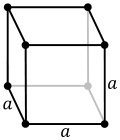 |  |  |  |  |  |  |
| Faces | 6 squares | 2 squares, 4 rectangles | 6 rhombi | 6 rectangles | 4 rectangles, 2 rhombi | 4 rectangles, 2 parallelograms | 2 rhombi, 4 parallelograms |
Perfect parallelepiped
A perfect parallelepiped is a special shape. In this shape, all the edges, face diagonals, and space diagonals have whole number lengths. In 2009, many of these special shapes were found. This solved a question asked by Richard Guy. One example has edges of 271, 106, and 103 units.
Some of these special shapes have two rectangle-like faces. But we still do not know if any exist with all faces rectangle-like. If they did, they would be called a perfect cuboid.
Parallelotope
Coxeter used the term parallelotope for shapes like parallelepipeds but in higher dimensions. Today, we often use "parallelepiped" to talk about these shapes in any number of dimensions.
In n-dimensional space, such a shape is called an n-dimensional parallelotope, or simply an n-parallelotope. For example, a parallelogram is a 2-parallelotope, and a parallelepiped is a 3-parallelotope.
The diagonals of an n-parallelotope all meet at one point and are cut in half by that point. Inversion around this point leaves the shape unchanged. The edges from one vertex form a k-frame, and the parallelotope can be built from these edges using certain math rules.
The size, or volume, of an n-parallelotope can be found using special math tools. When the space has the same number of dimensions as the parallelotope, the volume is linked to a matrix made from the edges.
Etymology
The word parallelepiped comes from Ancient Greek. It means "body with parallel plane surfaces." It is made from two parts: parallēl (parallel) and epípedon (plane surface).
The word has been used in English since 1570. Its spelling has changed a little over time. Some older forms include parallelipipedon and parallelepipedum. Today, we usually say parallelepiped.
Related articles


This article is a child-friendly adaptation of the Wikipedia article on Parallelepiped, available under CC BY-SA 4.0.