 Safekipedia
Pope Julius II
Adapted from Wikipedia · Adventurer experience
Pope Julius II (Latin: Iulius II; Italian: Giulio II; born Giuliano della Rovere; 5 December 1443 – 21 February 1513) was the leader of the Catholic Church and the Papal States from 1503 until he passed away in 1513. He was called the Warrior Pope because he was very strong and bold.
Julius II helped make art and culture grow during the High Renaissance. He made the Papal States stronger and more important. Because of his work, the leader of the Catholic Church was very important in Europe during the 1500s.
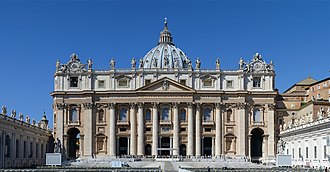
In 1506, he started the Vatican Museums and began rebuilding the famous St. Peter's Basilica. He also created the Swiss Guard to protect him and led a successful fight in Romagna. Julius II was very interested in the New World. He approved the Treaty of Tordesillas, which helped set up the first church areas in the Americas.
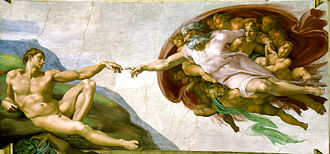
He asked artists to create wonderful works, such as the Raphael Rooms and Michelangelo’s paintings in the Sistine Chapel. Even after he died, people still talked about him a lot. One writer named Erasmus of Rotterdam wrote a story called Julius Excluded from Heaven.
Overview of the Italian politics of his reign
Julius II became pope when big countries in Europe were fighting over Italy. France, Spain, and the Holy Roman Empire all wanted power there. Julius wanted to make the Papal States stronger and "free Italy from the barbarians".
Early in his time as pope, Julius worked against the family of the previous pope, the Borgias, and removed their influence. He joined with France and other countries to fight against Venice. Later, he switched sides to fight against France, hoping to push them out of Italy. Even though he faced some losses, he forced French troops to leave.
By the end of his time as pope, Julius helped restore power to Italian families in places like Milan and Florence. Though Italy was not fully united, he made the Church a major force in the wars there.
Early life
Giuliano della Rovere was born in Albisola near Savona in the Republic of Genoa. He came from the House of della Rovere, a noble but poor family. His parents were Raffaello della Rovere and Theodora Manerola, who had Greek ancestry. He grew up with three brothers and one sister.
Giuliano was taught by his uncle, a Franciscan priest, who later sent him to study in Perugia. As a young man, Giuliano was known for being rough. Later, he became friends with two important church leaders who would become popes. He liked military leaders more than religious studies.
Cardinalate
After his uncle became Pope Sixtus IV in 1471, Giuliano became the Bishop of Carpentras in the Comtat Venaissin. He was quickly made a cardinal and given important jobs, including being the archbishopric of Avignon. He also held several bishoprics at once.
Giuliano led armies to places like Todi, Spoleto, and Città di Castello for the Pope. He later served as a special representative for the Pope in France and helped arrange peace between leaders and gather support for wars.
Election
Main article: Papal conclave, October 1503
Giuliano della Rovere was a well-known member of the Sacred College. He helped choose Pope Pius III with help from Lorenzo de' Medici, the leader of Florence. To become Pope Julius II, della Rovere used clever diplomacy. He won support by promising money and help to Cesare Borgia. His election happened quickly on November 1, 1503, and he received almost all the votes. The only two votes he did not get were his own and that of Georges d'Amboise, who was supported by the French monarchy.
A Renaissance pope
Giuliano della Rovere took the name Julius and was pope for nine years, from 1503 to 1513. He worked to defeat powers that challenged his rule. He made it impossible for the Borgias to keep their power over the Papal States. He also worked to bring peace between two important Roman families, the Orsini and Colonna.
Julius used his influence to take back towns and fortresses from the Republic of Venice. He formed alliances with France and the Holy Roman Empire to fight against Venice. In 1506, he led an army to Perugia and Bologna, freeing these cities from their rulers. He also founded the Swiss Guard to protect the pope and supported efforts to restore the glory of ancient Rome.
League of Cambrai and Holy League
Main article: War of the League of Cambrai
Julius led troops to take back Bologna and tried to recover the Duchy of Ferrara for the Papal States. In 1508, he formed the League of Cambrai with King Louis XII of France, Maximilian I, Holy Roman Emperor, and King Ferdinand II of Aragon to fight against the Republic of Venice. They won a big battle near Cremona, but soon the goals of the League changed.
Julius created the anti-French Holy League, which included the Venetians and King Ferdinand II of Aragon. King Henry VIII of England also joined. Julius saw France as a big threat to the Papal States. He fought hard to keep control, even leading armies himself.
Lateran Council
Main article: Fifth Council of the Lateran
In May 1512, Julius held a big meeting called the Fifth Council of the Lateran in Rome. He wanted to make sure his rules about choosing new popes were followed and to stop bad practices. Even though he was very sick, Julius attended some meetings to make sure his plans were carried out.
Death
Pope Julius II knew he was very sick in May 1512. He told his friend Paris de Grassis that he didn't have much longer to live, but he kept doing his duties as pope. By December 1512, he was very weak and stayed in bed with a fever. On February 20, 1513, he received special blessings from a church leader and passed away the next night.
His funeral was held on February 21, 1513. His body was placed in a church and later buried in St. Peter's Basilica in Rome. Although there is a famous tomb by Michelangelo in another church, Julius II is actually buried in St. Peter's Basilica next to his uncle, Pope Sixtus IV.
Legacy
Patronage of the arts
Main article: Art patronage of Julius II
Pope Julius II helped make Rome more beautiful. He supported artists like Andrea Mantegna, Donato Bramante, Raphael, and Michelangelo. He started building a new St. Peter's Basilica to replace an older church. He also asked Bramante to design two new streets in Rome, the Via Giulia and the Via della Lungara.
Character
Before becoming Pope, Julius had a strong personality. He could be strict with people who worked for him. Some say he didn’t joke much, while others say he had a rough, funny way of speaking. Many people thought he was brave and full of energy.
Physical appearance
Julius is often shown with a beard because of a famous painting by Raphael. He grew a beard for a short time to show sadness. This was unusual because popes usually didn’t have beards.
Depiction
- Julius is talked about in a book called The Prince by Niccolò Machiavelli.
- He was shown in a 1965 movie called The Agony and the Ecstasy about the artist Michelangelo, played by Rex Harrison.
- Cardinals and historians remember him for starting the building of the new St. Peter's Basilica and creating the Swiss Guard to protect the Pope.
Images
Related articles




This article is a child-friendly adaptation of the Wikipedia article on Pope Julius II, available under CC BY-SA 4.0.
Images from Wikimedia Commons. Tap any image to view credits and license.