 Safekipedia
Radiometric dating
Adapted from Wikipedia · Adventurer experience
Radiometric dating is a way scientists find out how old things are, like rocks or old objects. It looks at tiny bits of special materials that slowly change over time. By measuring how much of the original material is left, scientists can figure out the age of the object.
This method was first used by scientists Ernest Rutherford and Bertram Boltwood a long time ago. Now, it is very important for learning about Earth's history and when different things happened, like when dinosaurs lived.
There are many kinds of radiometric dating, like radiocarbon dating for younger objects and uranium-lead dating for much older ones. These methods help us understand how Earth and its life have changed over millions of years.
Fundamentals
All ordinary matter is made up of tiny parts called chemical elements. Each element has a special number, called its atomic number, which tells how many protons are in its atomic nucleus.
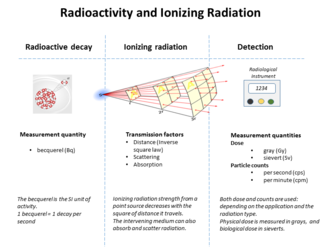
Elements can have different versions called isotopes. These isotopes have the same number of protons but different numbers of neutrons. Some isotopes are unstable and change over time through a process called radioactive decay. When they change, they turn into a different isotope. This change happens in predictable ways.
The rate at which this change happens is constant and is called the half-life. This rate stays the same, no matter what the temperature or pressure is. Because of this, scientists can look at how much of the original isotope is left and how much of its decay product has formed. This helps them estimate how long ago the material was made. This method is called radiometric dating. It was first used by scientists like Ernest Rutherford and Bertram Boltwood in the early 1900s.
Main article: Closure temperature
Modern dating methods
Radiometric dating has been used since 1905 when it was invented by Ernest Rutherford to find the age of the Earth. Over time, these methods have improved and can now work with very small pieces of material. Scientists use special tools called mass spectrometers to measure tiny bits of radioactive materials in rocks and objects.
One common way to date very old rocks is called uranium-lead dating. It uses two types of uranium that change over time into lead. By measuring how much lead is left, scientists can tell the age of a rock. Another method, radiocarbon dating, works well for things that were once alive, like bones or wood. It measures a special kind of carbon that disappears over time after an organism dies. These methods help us learn about the history of our planet and ancient objects.
Main article: Uranium–lead dating
Main article: Samarium–neodymium dating
Main article: Potassium–argon dating
Main article: Rubidium–strontium dating
Main article: Uranium–thorium dating
Main article: Radiocarbon dating
Main article: fission track dating
Main article: Luminescence dating
Dating with decay products of short-lived extinct radionuclides
Absolute radiometric dating needs some of the original material to be in a rock sample. For very old rocks, such as those from the start of the Solar System, this can be hard because the original materials may have decayed away.
Scientists can look at the decay products of short-lived materials that are no longer in rocks. These materials, like 26Al, 60Fe, 53Mn, and 129I, were made when stars exploded long ago. By measuring how much of these decay products are in very old materials like meteorites using a special tool called a mass spectrometer, scientists can learn the relative ages of events from the early solar system. This method helps create a more detailed timeline than using longer-lasting materials.
Images
Related articles




This article is a child-friendly adaptation of the Wikipedia article on Radiometric dating, available under CC BY-SA 4.0.
Images from Wikimedia Commons. Tap any image to view credits and license.