 Safekipedia
Religion
Adapted from Wikipedia · Adventurer experience
Religions are ways that people live and think. They include special actions, rules, beliefs, and ideas about life. These ways help people feel connected to things beyond everyday life, like spirits or a higher power. What counts as a religion can be different for different people, and religions can look very different from each other.
Religions often have important stories and traditions. These stories help explain big questions, like how the world began. People practice their religions in many ways, such as through ceremonies, prayers, and special events.
There are thousands of different religions in the world, but most people belong to just a few. Some of the largest include Christianity, Islam, Hinduism, and Buddhism. Many people also do not follow any specific religion, including those who are atheists or agnostics. Scholars study religion by looking at its history, ideas, and how it affects society.
Etymology and history of the concept of "religion"
Etymology
See also: History of religion
The word religion comes from old words in Old French and Anglo-Norman from the 1200s. It means respect, duty, or reverence for gods or sacred things. It comes from the Latin word religiō. The Roman philosopher Cicero thought it meant to think about things carefully. Others think it meant to bind or connect. In the middle ages, it was also used to describe groups like monastic orders, such as the followers of the Golden Fleece or a knight of the religion of Avys.
Religiō
Main article: Religio
In old times, religiō meant conscientiousness, duty, or obligation. It was not about gods at first. For the ancient Romans, it was about feelings of caution, anxiety, or fear. It was also linked to terms like scrupulus, meaning precision. When the word religiō entered English in the 1200s, it meant life bound by vows, like in monastic orders. The idea of separating religious and worldly things only started in the 1500s, around the Peace of Augsburg.
History of the concept of "religion"
For a chronological guide, see Timeline of religion.
The idea of religion is a modern one and not the same across all history, cultures, or languages. It started in the 17th century because of events like the Protestant Reformation and globalization during the Age of Exploration. Some think it’s not right to call non-Western cultures “religious.” Many cultures don’t separate the natural from the supernatural.
The idea of “ancient religion” comes from modern views of practices that fit today’s idea of religion. The concept of religion was created in the 1500s and 1600s, even though ancient texts like the Bible or the Quran didn’t have a word for it. In the Quran, the Arabic word din is often called religion today. In South Asia, the Sanskrit word dharma means both religion and law.
The idea of “nonreligion” or “secular” is also new and not found in many cultures. Outside the West, these ideas may not even exist.
Definition
Main article: Definition of religion
People have different ideas about what religion means. Some think it is about beliefs and practices that connect us to something bigger than ourselves. Others see it as a way people live together, with shared values and special traditions.
The word "religion" came from older times. Many cultures around the world have their own ways of thinking and acting that are similar but don’t use the word “religion.” Because of this, it’s hard to find one simple definition that works for everyone.
Aspects
Beliefs
Main article: Religious beliefs
People have many reasons for believing in religions. Some think about life and death. Others feel a sense of togetherness with others. In the past, many thought that faith and reason were both important for religious beliefs. Philosophers and religious leaders have talked about how faith and reason work together.
Mythology
Main article: Mythology
The word myth can mean a few different things. It might be a traditional story that helps explain something about the world. It can also mean something that isn’t real, like a make-believe person or thing. Sometimes, myth is used to describe deep, spiritual ideas about humans.
Ancient religions, like those from Greece, Rome, and Scandinavia, often have stories we call myths. Small cultures also have these kinds of stories. For example, the story of the resurrection of Jesus is very important to Christians.
Practices
Main articles: Religious behaviour and Cult (religious practice)
Religions have many practices. These can include rituals, talks by leaders called sermons, celebrating a deity (a god or goddess), special events called festivals, times of quiet thinking called meditation, and prayer. There are also ways to mark important life events like births, marriages, and deaths.
Social organisation
Religions often have a community part. They might be passed down by everyday people or led by special groups called a clergy. There are usually clear ideas about who belongs to the religion and who doesn’t.
Academic study
Main articles: Religious studies and Classifications of religious movements
Many subjects study religion, including theology, comparative religion, history of religion, evolutionary origin of religions, anthropology of religion, psychology of religion (including neuroscience of religion and evolutionary psychology of religion), law and religion, and sociology of religion.
Daniel L. Pals talks about eight important ideas about religion. These ideas come from different thinkers like E.B. Tylor, J.G. Frazer, Sigmund Freud, Émile Durkheim, Karl Marx, Max Weber, Mircea Eliade, E.E. Evans-Pritchard, and Clifford Geertz.
Michael Stausberg looks at newer ideas about religion, including how our minds and bodies understand it.
Theories
Main article: Theories of religion
Sociological and anthropological theories try to explain where religion comes from and what it does. They look for common parts in religious beliefs and actions.
Origins and development
Main article: History of religion
No one really knows where religion began. There are many ideas about how religious practices started.
Anthropologists John Monaghan and Peter Just say that many big religions began when a special person, called a prophet, inspired others. These prophets helped people find answers to their problems. Over time, groups of followers helped keep these ideas alive.
Religion grows differently in different places. Some focus on what people believe, others on what they do. Some think everyone should follow the same rules, while others are just for small groups. In many places, religion is linked to schools, hospitals, families, governments, and leaders.
John Monoghan and Peter Just also say that religion helps people deal with hard times and big problems. Religious ideas give people ways to understand the world.
Cultural system
Religion is hard to describe, but one way to think about it comes from Clifford Geertz. He called it a "cultural system". Some scholars see religion and culture as two different things that still affect each other.
Social constructionism
Main article: Social constructionism
Some modern scholars think that the idea of religion comes mostly from Christianity. They believe it was then used to describe other cultures in ways that might not fit. This idea is called social constructionism.
Cognitive science
Main article: Cognitive science of religion
Cognitive science of religion studies how people think and behave in religious ways. It uses ideas from many areas, like cognitive psychology, evolutionary psychology, cognitive anthropology, artificial intelligence, cognitive neuroscience, neurobiology, zoology, and ethology. Researchers want to understand how people learn, share, and pass on religious ideas using normal brain processes.
Comparativism
Main article: Comparative religion
Comparative religion compares the beliefs and practices of different religions. This helps us understand big questions about life, like ethics, what is real, and how people can find peace. Studying these ideas helps us see how people think about things that are holy, powerful, and spiritual.
In comparative religion, the main religions of the world are often grouped by where they started. These groups include Middle Eastern religions, Indian religions, East Asian religions, African religions, American religions, Oceanic religions, and classical Hellenistic religions.
Classification
Main article: History of religion
Long ago, people often sorted religions into three groups: big world religions found everywhere, smaller ones tied to special places or groups, and new religions that just started. Today, some thinkers say it’s hard to fit every belief into just one group, because many mix with culture, politics, and daily life.
Morphological classification
Some experts say there are two kinds of religions. One kind tries to welcome everyone, looking for new followers. Examples include the Baháʼí Faith, Buddhism, Christianity, Islam, and Jainism. The other kind is tied to one group of people and usually doesn’t look for new followers. Not everyone agrees with this idea, because they think all religions grow from particular cultures.
Demographic classification
Main articles: Major religious groups and List of religious populations
The largest groups of believers in the world are Christians, Muslims, Hindus, Buddhists, and people who follow traditional folk beliefs. In a survey from 2012, about 59% of people around the world said they were religious. By 2015, this number had risen to 63%. Usually, women tend to be more religious than men. Some people follow more than one set of religious beliefs at the same time. Scholars think the number of religious people might be growing because families in religious countries often have more children.
| Five largest religions | 2015 (billion) | 2015 (%) | Demographics |
|---|---|---|---|
| Christianity | 2.3 | 31% | Christianity by country |
| Islam | 1.8 | 24% | Islam by country |
| Hinduism | 1.1 | 15% | Hinduism by country |
| Buddhism | 0.5 | 6.9% | Buddhism by country |
| Folk religion | 0.4 | 5.7% | |
| Total | 6.1 | 83% | Religions by country |
Specific religions
Main article: List of religions and spiritual traditions
Abrahamic
Abrahamic religions are monotheistic religions which believe they descend from Abraham.
Judaism
Main article: Judaism
Judaism is the oldest Abrahamic religion, from the people of ancient Israel and Judah. The Torah is its most important book, part of a larger collection called the Tanakh or Hebrew Bible. It also has traditions written later, like the Midrash and the Talmud. Judaism has many practices and beliefs. There are groups such as Orthodox, Conservative, and Reform Judaism.
Christianity
Christianity is based on the life and teachings of Jesus of Nazareth. Christians believe in Jesus as the Son of God and their Savior. Most Christians believe in the Trinity, meaning one God who exists as three persons: the Father, the Son (Jesus Christ), and the Holy Spirit. Christianity spread around the world and is the largest religion today. The main groups in Christianity are the Catholic Church, Eastern Christianity, and Protestantism.
Islam
Islam is a monotheistic religion based on the Quran and the teachings of the prophet Muhammad. Islam believes in one God and accepts prophets from earlier Abrahamic religions. It is widely practiced in Southeast Asia, North Africa, Western Asia, and Central Asia. There are two main groups in Islam: Sunni Islam and Shia Islam.
Other
Judaism, Christianity, and Islam are the three most popular Abrahamic faiths, but there are also smaller and newer traditions.
For example, the Baháʼí Faith, founded in 19th-century Iran, teaches the unity of all great religious traditions. There are also smaller regional Abrahamic groups such as Samaritanism, the Rastafari movement, and Druze.
East Asian
East Asian religions include Taoism and Confucianism, as well as folk religions like Chinese folk religion. Other folk and new religions in East Asia include Korean shamanism, Shinto in Japan, and Vietnamese folk religion.
Indian religions
Indian religions include Hinduism, Jainism, Buddhism, and Sikhism.
Hinduism is one of the oldest religions, with beliefs in karma, reincarnation, and many deities.
Jainism teaches non-violence and truth.
Buddhism was founded by Siddhartha Gautama and focuses on ending suffering.
Sikhism was founded in the 15th century and emphasizes faith in one God and social justice.
Indigenous and folk
Indigenous religions or folk religions are traditional beliefs tied to specific groups of people. These often include shamanism, animism, and ancestor worship. Examples include Australian Aboriginal religions and Native American religions.
Traditional African
African traditional religion includes beliefs from many different groups across Africa, such as the Yoruba religion and Zulu mythology. There are also African diasporic religions practiced in the Americas, such as Santeria and Vodun.
Iranian
Iranian religions include Zoroastrianism, based on the teachings of the prophet Zoroaster, which worships the creator Ahura Mazda.
New religious movements
New religious movements include groups like the Baháʼí Faith, Cao Đài in Vietnam, Scientology, and Wicca. These are newer religions that have developed in recent history.
Related aspects
Law
Main article: Law and religion
Experts study how laws and religions are connected. They look at how religious beliefs shape laws and how courts think about religion. They also study rules made by religious groups, ideas about right and wrong, and laws made by governments. People learn about how religion and fairness worked together in history, like in Christianity. Some topics include marriage, family life, and human rights. Scholars also study religion and law in places like the Middle East and ancient Rome.
Science
Main articles: Faith and rationality, Relationship between religion and science, and Epistemology
Science learns about the world by testing and evidence. Religions use faith, holy writings, and thinking to understand life and the universe. Both science and religion change over time. Science tests ideas to find facts. Religion tries to find meaning and explain our place in the world. Even though they study different things, they can help each other in some ways.
Morality
Main article: Morality and religion
Many religions teach people right from wrong. Examples include promises in Jainism, rules in Judaism, laws in Islam, and paths in Buddhism. But ideas about right and wrong can also come from places that are not religious. Studying how religion and morality connect can be tricky because people have different views.
Politics
Impact
Religion often affects politics in many countries. For example, some countries follow Islamic law called sharia. In the United States, many leaders are Christian, and voters may prefer candidates who believe in a god. In Europe, religion used to have more power, but now it has less. In places like India, religion still strongly affects politics, while in China and Japan, it has less influence.
Secularism
Main articles: Secularism and Secularization
Secularization means a country’s politics change from focusing on one religion to more general, non-religious ideas. This helps modern life and respects people with different beliefs.
Economics
Main article: Economics of religion
Some studies show that richer countries often have fewer people who call themselves very religious. Some believe that Protestant Christian countries became wealthy because of their strong work ethic. Different groups hold different amounts of wealth around the world.
Health
Studies show that being involved in a religion and thinking about spiritual things can help people stay healthy, feel happier, and live longer. But the way this works can be complex and different for each person.
Superstition
Further information: Superstition, Magical thinking, and Magic and religion
Long ago, some people were scared of gods and called this fear superstition. Some think that superstition is not logical, while religion is more deep and organized. Some religions might include superstitions or magical ideas. People of one religion might see others’ beliefs as superstition.
Agnosticism and atheism
Main articles: Atheism, Agnosticism, Irreligion, and Humanism
Some people do not believe in gods (atheists) or think we cannot know if gods exist (agnostics). These ideas are not the same as having no religion at all. Some religions, like Buddhism, include people who do not believe in gods.
Interfaith cooperation
Main article: Interfaith dialogue
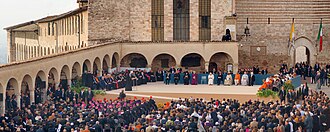
Many religious people work together to solve problems and share ideas. Big meetings like the Parliament of the World’s Religions help different groups talk and understand each other better. Recent efforts bring together leaders from Islam, Christianity, Buddhism, and more to work for peace.
Criticism
Main article: Criticism of religion
Sometimes people wonder about the ideas and practices of religion. They also think about how religion can affect politics and society.
Images
Related articles


This article is a child-friendly adaptation of the Wikipedia article on Religion, available under CC BY-SA 4.0.
Images from Wikimedia Commons. Tap any image to view credits and license.