 Safekipedia
Saros (astronomy)
Adapted from Wikipedia · Adventurer experience
Saros (astronomy)
In astronomy, the saros is a special time period that helps us know when eclipses of the Sun and Moon will happen. This period is exactly 223 synodic months. It is about 18 years, 11 days, and 8 hours long.
During this time, the Sun, Earth, and Moon line up almost the same way as before. This means a similar eclipse will happen again.
Because of this pattern, each eclipse is part of a group called a saros series. Eclipses in the same series happen one saros apart. For example, if there is a solar eclipse or a lunar eclipse, after one saros period, the Moon will be at the same spot in its path around Earth. This makes another eclipse possible.
This natural cycle happens because of how the Moon’s phases, its path around Earth, and its closest and farthest points all line up just right. By studying the saros, scientists can learn when future eclipses will happen and what they will look like.
History
The earliest record of the saros was made by Chaldean astronomers long ago. Later, famous thinkers like Hipparchus, Pliny, and Ptolemy also learned about it.
The name "saros" was given to this eclipse cycle by Edmond Halley in 1686. He took the name from a book called the Suda. The saros period of 223 lunar months is shown on the Antikythera Mechanism, an ancient Greek device made around 150–100 BCE.
Description
The saros is a special time period that helps us know when eclipses will happen. It lasts for 6,585 days, which is about 18 years and 11 days. During this time, the Moon, Earth, and Sun line up almost the same way as before, so a very similar eclipse will happen.
Eclipses can only happen when the Moon is between the Earth and the Sun (for a solar eclipse) or when the Earth is between the Sun and the Moon (for a lunar eclipse). This lining up happens when the Moon is at a special point in its orbit called a node. Because the saros matches the Moon's phases and its orbit, eclipses that happen one saros apart look almost the same.
Saros series
A saros series is a way to group together similar eclipses that happen over many years. Each series starts with a small, partial eclipse. Over time, the Moon’s path shifts a little with each eclipse. This means the eclipses in a series can happen in different parts of the world.
For example, lunar saros series 131 began in 1427 with a partial eclipse. Over time, it created total eclipses. The most recent total eclipse in this series happened in 1950. These total eclipses will continue until 2078. After that, the eclipses will become partial again before the series ends in 2707. During this time, the best place to see an eclipse changes with each one, moving across different parts of the Earth.
| May 10, 1427 (Julian calendar) | First penumbral (southern edge of shadow) |
| ...6 intervening penumbral eclipses omitted... | |
| July 25, 1553 (Julian calendar) | First partial |
| ...19 intervening partial eclipses omitted... | |
| March 22, 1932 Final partial | 12:32 UT 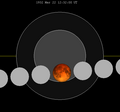 |
| April 2, 1950 First total | 20:44 UT  |
| April 13, 1968 | 04:47 UT  |
| April 24, 1986 | 12:43 UT 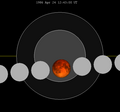 |
| May 4, 2004 | 20:30 UT  |
| May 16, 2022 First central | 04:11 UT  |
| May 26, 2040 | 11:45 UT 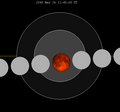 |
| June 6, 2058 | 19:14 UT 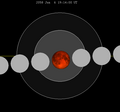 |
| June 17, 2076 Central | 02:37 UT 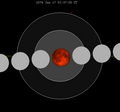 |
| ...6 intervening total eclipses omitted... | |
| September 3, 2202 Last total | 05:59 UT |
| September 13, 2220 | First partial |
| ...18 intervening partial eclipses omitted... | |
| April 9, 2563 | Last partial umbral |
| ...7 intervening penumbral eclipses omitted... | |
| July 7, 2707 | Last penumbral (northern edge of shadow) |
Relationship between lunar and solar saros (sar)
After a solar or lunar eclipse, wait about 9 years and 5 and a half days — this is called a sar. During this time, the type of eclipse switches: if the Sun’s shadow partly covers Earth during a solar eclipse, half a sar later the Earth’s shadow will partly cover the Moon during a lunar eclipse. This pattern helps us understand how solar and lunar eclipses are connected.
The sar includes 111 and a half synodic months, with the extra half month (called a fortnight) allowing the eclipse type to change. You can see this pattern clearly in this chart.
Images
Related articles


This article is a child-friendly adaptation of the Wikipedia article on Saros (astronomy), available under CC BY-SA 4.0.
Images from Wikimedia Commons. Tap any image to view credits and license.