 Safekipedia
Sayan Mountains
Adapted from Wikipedia · Adventurer experience
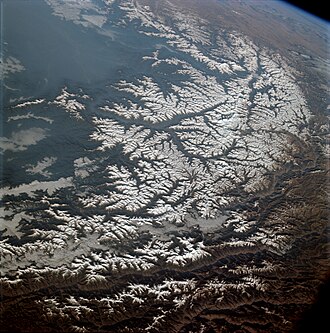
The Sayan Mountains (Mongolian: Соёны нуруу, Soyonii nuruu; Old Turkic: 𐰚𐰇𐰏𐰢𐰤, romanized: Kögmen) are a mountain range in southern Siberia. They stretch across southeastern Russia, including areas like Buryatia, Irkutsk Oblast, Krasnoyarsk Krai, Tuva, and Khakassia, and extend into northern Mongolia.
Long ago, before Russia grew larger, the Sayan Mountains acted like a natural border between Mongolian and Russian lands. Today, the high peaks and cool lakes near Tuva help create small rivers that join together to form the Yenisei River. This river flows north for over 3,400 kilometres (2000 mi) to the Arctic Ocean. Because the area is remote and protected, it stayed closed to most visitors during the time of the Soviet Union, starting in 1944.
Geography
Western Sayan
The Western Sayan mountains are crossed by the Ulug-Khem, also called the Upper Yenisei River, at 92°E. At its eastern end, it stops above the depression of the Selenga-Orkhon Valley. The range runs for about 650 kilometers (400 miles) in a northeast to southwest direction. It lies between the Shapshal Range of the Eastern Altai to the west and the Abakan Range of the Kuznetsk Alatau to the east. Some smaller ranges include the Aradan, Borus, Oy, Kulumys, Mirsky, Kurtushibin, Uyuk, Sheshpir-Taiga, Ergak-Targak-Taiga, Kedran, and Nazarovsky ranges. The tallest peaks are Kyzlasov Peak, Aradansky Peak, Bedelig Golets, Samzhir, Borus, and Zvezdny Peak.
Between where the Yenisei River passes through and Lake Khövsgöl, this part of the range is also called Yerghik-Taiga. The plants here are not very rich, but the higher areas have forests of larch, pine, juniper, birch, and alder, along with rhododendrons and plants from the groups Berberis and Ribes. Lichens and mosses grow on many rocks scattered across the upper slopes.
Eastern Sayan
The Eastern Sayan runs for about 1,000 kilometers (620 miles) in a northwest to southeast direction, from the Yenisei River to the Angara Range. Some of its northwest subranges are called "White Mountains" or "Belki", including Manskoye Belogorye, Kanskoye Belogorye, Kuturchinskoye Belogorye, and Agul Belki, which always have snow on their peaks. In the central area, near the upper parts of the Kazyr and Kizir rivers, there are ridges like the Kryzhin Range that come together around Grandiozny Peak, the highest point in Krasnoyarsk Krai, which stands at 2,982 meters (9,783 feet).
To the southeast are the tallest and most isolated subranges, such as the Bolshoy Sayan and Kropotkin Range, along with "Goltsy" type mountains like the Tunka Goltsy, Kitoy Goltsy, and Botogolsky Goltsy. The highest point in the Eastern Sayan and the entire Sayan system is Mount Munku-Sardyk, which reaches 3,491 meters (11,453 feet). Another very tall peak is Pik Tofalariya, the highest point in Irkutsk Oblast, at 2,939 meters (9,642 feet). The Eastern Sayan mountains have dramatic shapes, and rivers flowing from them create deep valleys and many waterfalls.
The Ice Age Period
Long ago, when the world was much colder, huge glaciers flowed down from the Munku Sardyk mountains and other tall areas. These glaciers reached close to Lake Baikal. The snow that fed these glaciers was lower than it is today, showing that the Earth was much colder back then.
Origins of reindeer husbandry
According to Sev’yan I. Vainshtein, the Sayan reindeer herding is one of the oldest ways of caring for reindeer. It began with the Samoyedic taiga people in the Sayan Mountains around the start of the first millennium A.D.
The Sayan region was where many groups of reindeer hunters and herders developed their ways of life. The ancestors of today’s Evenki groups lived near the Sayan Mountains and likely helped in domesticating reindeer. Today, some local indigenous groups still live in the Eastern Sayan mountains and keep their traditional ways, even though many lost them due to changes brought by Russian and Soviet rule.
Science
The Sayan Solar Observatory is in the Sayan Mountains. It is 2,000 meters high. This place helps scientists learn about the sun and how it affects Earth.
Images
Related articles


This article is a child-friendly adaptation of the Wikipedia article on Sayan Mountains, available under CC BY-SA 4.0.
Images from Wikimedia Commons. Tap any image to view credits and license.