 Safekipedia
Schwerin
Adapted from Wikipedia · Adventurer experience
Schwerin is the capital and second-largest city of the northeastern German state of Mecklenburg-Vorpommern. It has around 96,000 inhabitants, making it the smallest of all German state capitals. The city sits on the southwestern shore of Lake Schwerin, the second-largest lake in the Mecklenburg Lake Plateau.
The name Schwerin has Slavic origins, possibly coming from words meaning "wild animal" or "game reserve." It was first mentioned in 1018 and granted city rights in 1160 by Henry the Lion. Schwerin is the oldest city in Mecklenburg-Vorpommern. Over time, it has been the capital of various states and duchies, including the Duchy of Mecklenburg-Schwerin and the Grand Duchy of Mecklenburg-Schwerin.
Today, Schwerin's famous landmarks include the romantic Schwerin Palace with its golden dome and the towers of Schwerin Cathedral. Because it suffered only minor damage in World War II, the city still has many of its historic buildings. Major industries in Schwerin include high technology, machine building, healthcare, and tourism. While there is a regional airport in nearby Parchim, Hamburg Airport serves as the main airport for the area.
Geography
Schwerin is a city in Germany. It borders places like Klein Trebbow, Seehof (Mecklenburg), and Leezen (Mecklenburg). A small part of the city is also in Klein Rogahn.
The city has many lakes—twelve are inside its borders. Schwerin has a mild climate because of the nearby Baltic Sea. Winters are cool, and summers are warm. Temperatures are usually between 1 °C in winter and 18 °C in summer.
| Name | Size | Islands | |
|---|---|---|---|
 | Lake Schwerin Schweriner See | 61.5 km2 (23.7 sq mi) | Kaninchenwerder & Großer Stein, Ziegelwerder |
 | Brick Lake Ziegelsee | 3.0 km2 (1.2 sq mi) | Kleine & Große Murrkiteninsel |
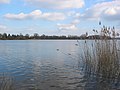 | Lake Ostorf Ostorfer See | 2.1 km2 (0.81 sq mi) | Toteninsel/Tannenwerder |
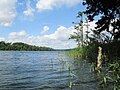 | New Mill Lake Neumühler See | 1.7 km2 (0.66 sq mi) | |
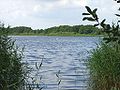 | Lake Medewege Medeweger See | 1.0 km2 (0.39 sq mi) | |
 | Lake Lankow Lankower See | 0.5 km2 (0.19 sq mi) | Rethhorst |
 | Foul Lake Fauler See | 0.5 km2 (0.19 sq mi) | |
 | Heathens Lake Heidensee | 0.2 km2 (0.077 sq mi) | |
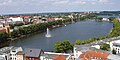 | Clergymen's Pond Pfaffenteich | 0.1 km2 (0.039 sq mi) | |
 | Castle Lake Burgsee | 0.1 km2 (0.039 sq mi) | Schlossinsel |
 | Lake Grimke Grimkesee | 0.04 km2 (0.015 sq mi) | |
 | Big Karausche Große Karausche | 0.02 km2 (0.0077 sq mi) | |
| Map | ||||
|---|---|---|---|---|
| Borough | District(s) | Population (2025) | Borough mayor (2024) | |
| Ortsteil 1 | Schelfstadt | 4,370 | 11,383 | Silvia Rabethge (CDU) |
| Werdervorstadt | 7,013 | |||
| Schelfwerder | 0 (2014) | |||
| Ortsteil 2 | Altstadt | 3,309 | 17,355 | Stephan Haring (CDU) |
| Feldstadt | 3,999 | |||
| Paulsstadt | 8,368 | |||
| Lewenberg | 1,679 | |||
| Ortsteil 3 | Großer Dreesch | 8,447 | Georg-Christian Riedel (CDU) | |
| Ortsteil 4 | Neu Zippendorf | 4,966 | Marco Rauch (LINKE) | |
| Ortsteil 5 | Mueßer Holz | 12,353 | Gret-Doris Klemkow (SPD) | |
| Ortsteil 6 | Gartenstadt | 2,291 | 4,613 | Daniel Meslien (SPD) |
| Ostorf | 2,322 | |||
| Ortsteil 7 | Lankow | 10,086 | Cordula Manow (LINKE) | |
| Ortsteil 8 | Weststadt | 10,825 | Thomas Munzert (CDU) | |
| Ortsteil 9 | Krebsförden | 5,926 | Jens Ludwig (CDU) | |
| Ortsteil 10 | Wüstmark | 769 | 910 | Solveig Dahl (UB/FDP) |
| Göhrener Tannen | 141 | |||
| Ortsteil 11 | Görries | 936 | Ralf Klein (CDU) | |
| Ortsteil 12 | Friedrichsthal | 3,945 | Rolf Bemmann (SPD) | |
| Ortsteil 13 | Neumühle | 3,071 | 3,071 | Martin Frank (LINKE) |
| Sacktannen | 0 (2014) | |||
| Ortsteil 14 | Warnitz | 1,602 | Heike Ehrhardt (UB/FDP) | |
| Ortsteil 15 | Wickendorf | 1,132 | 1,358 | Annelie Schröder (SPD) |
| Medewege | 226 | |||
| Ortsteil 16 | Zippendorf | 1,050 | Thilo Kreimer (CDU) | |
| Ortsteil 17 | Mueß | 894 | Hasko Schubert (CDU) | |
History
Schwerin is surrounded by beautiful lakes, with the largest being the Schweriner See. Long ago, a group called the Slavic Obotrites lived there. In 1160, a leader named Henry the Lion took over the area and built a castle.
In 1358, Schwerin became important as the center of a region called the Duchy of Mecklenburg. Over time, it grew and changed. Many people from Schwerin moved to the United States in the mid-1800s, especially to Milwaukee, Wisconsin. After World War II, Schwerin became part of a new state in Germany. In 1990, after Germany reunited, Schwerin was chosen to be the capital of Mecklenburg-Vorpommern again.
Demographics
Schwerin is the capital city of the German state of Mecklenburg-Vorpommern. As of 2022, it has about 96,000 people, making it the smallest state capital in Germany. By the end of 2025, the population grew to around 99,700, and it may soon become a larger city with over 100,000 people.
In 2007, Schwerin had a higher crime rate than many bigger cities in Germany. This was partly because some actions, like riding a bus without a ticket, were counted as crimes in Schwerin but not in other places.
Politics
Schwerin has a city council that was elected in June 2024. The mayor of Schwerin is Bernd Nottebaum from the CDU party, who has been in office since 2026.
Before 1919, Schwerin had two mayors at the same time. Since 1800, many people have served as mayor of Schwerin.
Infrastructure
Schwerin has city buses and trams to help people get around. These are run by a local service called NVS. The main train station connects the city to big places like Berlin, Hamburg, and Rostock. The nearest airport is Hamburg Airport, about 116 kilometers away.
The city has two colleges. It is special because it is the only state capital in Germany without a full university. These colleges are part of bigger schools, one for business and one for jobs.
Sights
Schwerin has many interesting places to see. The most famous is Schwerin Palace, on an island in Lake Schwerin. It was home to important leaders of Mecklenburg for many years and is now where the state parliament meets.
Another important building is Schwerin Cathedral, built between 1260 and 1416 in a style called Brick Gothic. The Alter Garten square has old buildings like the Altes Palais and the Staatliches Museum Schwerin, which shows beautiful artworks. There is also a city hall from the 1700s and the Schelfkirche, a church rebuilt after a storm.
Museums
The Staatliches Museum Schwerin-Kunstsammlungen has many artworks, including old Dutch paintings and pieces from famous artists. The State Museum of Technology used to be in Schwerin but moved to the nearby city of Wismar in 2012.
Twin towns – sister cities
See also: List of twin towns and sister cities in Germany
Schwerin has friendly connections with cities all over the world. These partnerships help people share ideas and culture. The twin towns of Schwerin are in many different places, showing friendship between different countries.
Notable people
Schwerin has been home to many interesting people over the years. Some were leaders and rulers, like Albert II, Duke of Mecklenburg and Sophia Louise of Mecklenburg-Schwerin.
Others became known in the arts, such as actor Konrad Ernst Ackermann and painter Johann Heinrich Suhrlandt.
Many from Schwerin have also succeeded in politics and science. For example, August Kundt was a physicist who invented Kundt's tube, and Walther Flemming helped start the study of cells.
In sports, athletes like rower Manfred Schneider and swimmer Andrea Pollack have won Olympic medals for their achievements.
Images
Related articles


This article is a child-friendly adaptation of the Wikipedia article on Schwerin, available under CC BY-SA 4.0.
Images from Wikimedia Commons. Tap any image to view credits and license.