 Safekipedia
Self-fulfilling prophecy
Adapted from Wikipedia · Adventurer experience
A self-fulfilling prophecy is a prediction that comes true because someone believes or expects it to happen. When people believe something will occur, they often act in ways that make it more likely.
This can lead to good or bad results. By labeling someone or something, it can change how people see and act toward it, helping that label become true. How people talk to each other plays a big role in creating these prophecies.
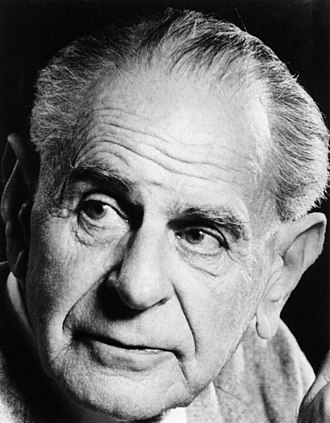
American sociologists W. I. Thomas and Dorothy Swaine Thomas were the first to study this idea. In 1928, they created the Thomas theorem, which says that if people think something is real, it will have real results. Later, sociologist Robert K. Merton named this idea a "self-fulfilling prophecy." Philosophers like Karl Popper and Alan Gewirth also added to this idea.
History
An early idea about this concept appeared in the work of Edward Gibbon in his book Decline and Fall of the Roman Empire. He noticed that predictions can sometimes make themselves come true.
The term "self-fulfilling prophecy" was created by sociologist Robert K. Merton. In his book Social Theory and Social Structure, he used the example of a bank run to show how beliefs can cause unwanted events. He described how rumors that a bank would fail made people take out their money all at once. Because banks do not keep all their money in cash do not keep their total assets in cash, they could not give everyone their money, which caused the bank to fail. Merton showed that the prediction of failure led to the failure itself.
This idea also works for people. Individuals often act in ways that match what others expect of them. This is known as the Pygmalion effect, from experiments by Robert Rosenthal and Lenore Jacobson. In their study, teachers were told certain students were expected to do very well, and by the end of the year, those students had higher test scores.
Applications
People often change how they act based on what they think others expect from them. This idea is used in many places, like in schools. For example, when teachers believe some students are very smart, those students often do better than expected. This happens because the teachers give them more attention and support.
Self-fulfilling prophecies can also happen in big situations, like between countries. When one country worries that another is becoming too strong, that worry can lead to actions that make the other country more of a threat. This is what some historians think happened when Athens became powerful and Sparta felt danger, which led to war.
Stereotype
Self-fulfilling prophecies can lead to unfair treatment of people because of their race or background. When people believe something negative about a group, they might act in ways that make that belief seem true, even if it isn’t.
For example, some people thought that black workers would not fit well with trade unions. Because of this, they were not hired, so they never had the chance to learn about unions. This made the original belief seem true, even though it wasn’t.
Teachers can also unintentionally create these kinds of expectations. If teachers think some students are not good at subjects like math, they might not encourage those students to work hard. This can make the students feel less confident and do worse, which then seems to prove the teacher’s original belief.
Literature, media, and the arts
In stories, self-fulfilling prophecies are used to make exciting plots. They are popular in science fiction and fantasy books and movies. These prophecies happen because someone tries to stop them, but their actions make the prophecy come true.
Many old myths and tales use this idea. For example, in the story of Oedipus, he was told he would kill his father and marry his mother. Because he tried to avoid this, he ended up meeting his real parents and unintentionally fulfilling the prophecy.
Shakespeare’s play Macbeth is another famous example. Three witches tell Macbeth he will become king. Wanting this to happen, he kills the current king, which leads to his own downfall, just as the prophecy said.
The idea of self-fulfilling prophecies also appears in modern beliefs like the law of attraction, where thinking positively is thought to bring good results. However, this idea has not been proven by science.
Sports
Some researchers in 2008 studied basketball teams. They found that head coaches gave more encouraging feedback, while assistant coaches were more critical. They thought this happened because of the expectations others had for the players, which could influence how the players performed.
Helen Brown did experiments with athletes to see how media expectations affect them. She found that athletes' performance often matched what people expected of them. Another experiment in London showed that these expectations could also affect how athletes think and make decisions.
Causal loop
See also: Causal loop and Newcomb's paradox
A self-fulfilling prophecy can be a circle where actions lead to their own result. It can happen because someone believes something will happen, and then they act in ways that make it come true. One famous story is the play Oedipus Rex. The movie 12 Monkeys also looks at ideas about fate.
Images
Related articles
This article is a child-friendly adaptation of the Wikipedia article on Self-fulfilling prophecy, available under CC BY-SA 4.0.
Images from Wikimedia Commons. Tap any image to view credits and license.