 Safekipedia
Smartwatch
Adapted from Wikipedia · Adventurer experience
A smartwatch is a portable wearable computer that looks like a wristwatch. Most smartwatches have a screen you can touch and need to connect to a phone to work.
Early smartwatches could show the time, do simple math, and play games. Newer smartwatches can do more, like running apps, connecting to the internet, and making phone calls.
Smartwatches usually have a screen that lights up and a battery you can charge again and again. Many can track movement, heart rate, and other health information. They can also play music, show maps, and have many different designs for the screen.
History
Early years
The first digital watch was the Pulsar, introduced by the Hamilton Watch Company in 1972. The "Pulsar" became a brand name and was later bought by Seiko in 1978. In 1982, a Pulsar watch was made that could store 24 digits, making it one of the first watches with memory you could change.
With personal computers in the 1980s, Seiko began to make computers in the shape of watches. The Data 2000 watch, named for its ability to store 2000 characters, came with a keyboard to put in data. Data was moved from the keyboard to the watch with no wires. Its memory was small, holding only 112 digits. It came out in 1984 in gold, silver, and black.
Many other watches followed from Seiko during the 1980s, most notably the "RC Series". The RC-1000 Wrist Terminal from Seiko Epson came out in 1984; it was the first Seiko watch to work with a computer and cost about £100. It had 2 KB of storage, a two-line, 12-character screen, and moved data with a computer using an RS232C connection. It used a computer on a chip and worked with most popular computers of that time. The RC-20 Wrist Computer came out in 1985, followed by the RC-4000 and RC-4500.
During the 1980s, Casio began selling a line of "computer watches" along with its calculator watches, most notably the Casio data bank series. Casio and other companies also made special "game watches".
Although watches that worked like pagers were talked about in the early 1980s, it took until the end of the decade for them to become more common. Two models were especially known: Motorola and Timex made the Wrist Watch Pager, while AT&T Corporation and Seiko made the MessageWatch.
1990s
The Timex Datalink, introduced in 1994, was the first watch that could move data from a computer with no wires. Appointments and contacts made with Microsoft Schedule Plus could be sent to the watch using patterns of light shown by a computer screen and seen by the watch's sensor.
In 1998, Steve Mann made and built the world's first Linux wristwatch. He showed it at the IEEE ISSCC on 7 February 2000, where he was called "the father of wearable computing". The watch later appeared on the cover of Linux Journal in July 2000.
Seiko launched the Ruputer in 1998 in Japan, a wristwatch computer with a 3.6 MHz processor. The Ruputer did not become very popular because of its small, hard-to-read screen, difficult way to move and type, and short battery life. Outside of Japan, this watch was sold as the Matsucom onHand PC. Even with low demand, it was sold until 2006. Ruputer and onHand PC work well together. This watch is sometimes thought of as the first smartwatch, as it was the first to show pictures and programs from other companies.
In 1999, Samsung launched the world's first watch phone, the SPH-WP10. It had a sticking-out antenna, a black and white LCD screen, and could talk for 90 minutes with a speaker and microphone.
2000s
In June 2000, IBM showed a model for the WatchPad, a wristwatch that ran Linux. The first version only worked for 6 hours, but this was later extended to 12. It had 8 MB of memory and ran Linux 2.2. The device was later updated with an accelerometer, a vibrating part, and a fingerprint sensor. IBM worked with Citizen Watch Co. to make the "WatchPad". The WatchPad 1.5 has a 320 × 240 QVGA black and white touch screen and runs Linux 2.4. It also has calendar software, Bluetooth, 8 MB of RAM and 16 MB of flash memory. Citizen hoped to sell the watch to students and business people, with a price of about $399. Epson Seiko introduced their Chrono-bit wristwatch in September 2000. The Chrono-bit watches have a turning circle for putting in data, match up date and contact details using a wire, and can change the way the watch looks.
In 2003, Fossil released the Wrist PDA, a watch that ran the Palm OS and had 8 MB of RAM and 4 MB of flash memory. It had a small black and white screen with a resolution of 160×160 pixels and a pen to help use it. Although many people said the watch was new and good, it was criticized for being heavy (108 grams) and stopped being made in 2005.
In the same year, Microsoft announced its SPOT smartwatch, which it released in early 2004. SPOT stands for Smart Personal Objects Technology, an effort by Microsoft to make everyday things personal. For example, the company showed coffee makers, weather stations, and alarms with built-in SPOT technology. The device was a standalone smartwatch that gave information quickly, unlike other devices that needed more use. The information included weather, news, stock prices, and sports scores, and was sent using FM waves. It needed a yearly payment between $39 and $59.
The Microsoft SPOT Watch had a black and white 90×126 pixel screen. Fossil, Suunto, and Tissot also sold smartwatches using SPOT technology. For example, Fossil's Abacus, which was a version of the Fossil Wrist PDA, cost from $130 to $150.
Sony Ericsson worked with Fossil and released the first watch, MBW-100, that connected to Bluetooth. This watch told the user when they were getting calls and text messages. The watch had trouble becoming popular, however, because it only worked with Sony Ericsson phones.
In 2009, Hermen van den Burg, CEO of Smartwatch and Burg Wearables, launched Burg, the first smartphone watch with its own SIM card. The watch worked on its own, meaning it did not need to be connected to a smartphone. Burg won an award for the Most Innovative Product at the Canton Fair in April 2009. Samsung also launched their S9110 Watch Phone, which had a 1.76-inch (45 mm) color LCD and was 11.98 millimetres (0.472 in) thin.
2010s
Sony Ericsson launched the Sony Ericsson LiveView, a wearable watch that was basically an outside Bluetooth screen for an Android smartphone.
Vyzin Electronics Private Limited launched a ZigBee smart watch called VESAG, which had cell service for watching health from far away.
Motorola released MOTOACTV on 6 November 2011.
Pebble is a smartwatch that was paid for through Kickstarter, which set a record for most money raised, getting $10.3 million between 12 April and 18 May 2012. The watch has a 32-millimetre (1.26 in) 144 × 168 pixel black and white memory LCD, using a very low-power "transflective LCD" made by Sharp. It has a light, a vibrating part, magnetometer, sensors for light, and a three-way accelerometer. It can talk to an Android or iOS device using Bluetooth 2.1 and Bluetooth 4.0 (Bluetooth Low Energy) using Stonestreet One's Bluetopia+MFi software. Bluetooth 4.0 was not turned on at first, but a update in November 2013 turned it on. The watch is charged using a special USB-cable that sticks to the watch with a magnet, so it can stay water proof. The battery was said in April 2012 to last seven days. Based on what Kickstarter supporters said, the makers added water proof to the watch. The Pebble is water proof up to 5 atm, meaning it can be under water up to 40 metres (130 ft) and has been tested in fresh and salt water, so you can shower, dive or swim with it.
In 2013, a company named Omate said its TrueSmart watch through a Kickstarter campaign, saying it was the first smartwatch to do everything a smartphone can. The campaign raised over $1 million, making it the 5th most successful Kickstarter at that time. The device came out in early 2014. A person who studies devices, Avi Greengart, from Current Analysis, guessed that 2013 might be the "year of the smartwatch", because "the parts have gotten small enough and cheap enough" and many people own smartphones that work with a wearable device. Wearable technology, such as Google Glass, was guessed to become a business worth US$6 billion each year, and a report in July 2013 said that most big consumer electronics companies were working on a smartwatch. The price of a smartwatch could be over US$300, plus extra cost for data, while the smallest cost of devices that work with smartphones could be US$100.
As of July 2013, the list of companies that were working on smartwatch development included Acer, Apple, BlackBerry, Foxconn/Hon Hai, Google, LG, Microsoft, Qualcomm, Samsung, Sony, VESAG and Toshiba. Some companies not on this list include HP, HTC, Lenovo, and Nokia. A science and technology reporter Christopher Mims pointed out the following about the future of smartwatches:
- Not enough battery life is an ongoing issue for smartwatch makers, because the battery life of devices at the time was three to four days, and this will likely get worse if more things are added.
- New screen technologies will be made because of smartwatch research.
- How well smartwatches will sell is unclear, because they may sell like netbooks, or they may do what Google Glass did, which was another wearable electronic product.
Acer's S.T. Liew said in an interview with gadget website Pocket-Lint that he thought companies should be researching wearable technology, and that it could become "billions of dollars' worth of industry".
As of 4 September 2013, three new smartwatches had been launched: the Samsung Galaxy Gear, Sony SmartWatch 2, and the Qualcomm Toq. PHTL, a company from Dallas, Texas, finished a Kickstarter campaign for its HOT Watch smartwatch in September 2013. This device lets users leave their phones in their pockets, because it has a speaker for calls in quiet and loud places. In a September 2013 interview, Pebble founder Eric Migicovsky said that his company was not interested in any offers to buy them. Two months later, he said that his company had sold 190,000 smartwatches, most of which were sold after its Kickstarter campaign ended.
Motorola Mobility CEO Dennis Woodside said during a December 2013 interview that his company was working on a smartwatch. Woodside also talked about the problems that other companies had with watches worn on the wrist.
In April 2014, the Samsung Gear 2 came out, one of few smartwatches to have a digital camera. It has a resolution of two megapixels and can record video in 720p.
At the 2014 Consumer Electronics Show, many new smartwatches were shown from different companies such as Razer Inc, Archos. Some people called the show a "wrist revolution". At Google I/O on 25 June 2014, the Android Wear platform was shown and the LG G Watch and Samsung Gear Live were released. The Wear-based Moto 360 was announced by Motorola in 2014. At the end of July, Swatch's CEO Nick Hayek said that they will launch a Swatch Touch with smartwatch technology in 2015. In the UK, London's Wearable Technology Show showed several new models from smartwatch companies.
Samsung's Gear S smartwatch came out in late August 2014. The model has a curved Super AMOLED screen and a built-in 3G modem. TechCrunch's Darrell Etherington said that "we're finally starting to see screens that wrap around the wrist, rather than sticking out like a traditional flat surface". The company started selling the Gear S smartwatch in October 2014, along with the Gear Circle headset accessory. At IFA 2014, Sony Mobile announced the third generation of its smartwatch series, the Sony Smartwatch 3, powered by Android Wear. Fashion Entertainments' e-paper watch was also announced at the show.
On 9 September 2014, Apple Inc. announced its first smartwatch, called Apple Watch, with an early 2015 release date. On 24 April 2015, Apple Watch began shipping worldwide. Apple's first try at wearing something was met with a lot of talking about during the time before it came out, with many early reviews pointing out problems with battery life and parts not working right. However, some people praised Apple for making a device that could compete with "traditional watches" instead of just smartwatches. The watch's screen only comes on when you lift your wrist, touch the screen, or press a button. On 29 October 2014, Microsoft announced the Microsoft Band, a smart fitness watcher and the company's first try into watches since SPOT (Smart Personal Objects Technology) ten years earlier. The Microsoft Band came out at $199 the next day.
In October 2015, Samsung showed the Samsung Gear S2. It has a turning circle to make it easier to use, and an IP68 rating for water proof up to 1.5 meters deep for 30 minutes. The watch works with standard 20 mm straps.
At the 2016 Consumer Electronics Show, Razer released the Nabu Watch, a dual-screen smartwatch. The first screen has an always-on lit backlit display and shows basic things like date and time. The second OLED screen, which comes on when you lift your wrist, lets you use more smart features. Luxury watch maker TAG Heuer also released TAG Heuer Connected, a smartwatch using Android Wear.
On 31 August 2016, Samsung showed the Samsung Gear S3 smartwatch, with better parts. There are two models of the watch: the Samsung Gear S3 Classic and the LTE version Samsung Gear S3 Frontier.
The top smartwatches that came out at the 2017 Consumer Electronics Show included the Casio WSD-F20, the Misfit Wearables Vapor and the Garmin Fenix 5 series. On 22 September 2017 Apple released their Apple Watch Series 3 model which has LTE cell service so you can make calls, send messages and get data without needing a smartphone close by.
In 2018, Samsung started the Samsung Galaxy Watch series.
In Apple's September 2018 talk, they showed a new Apple Watch Series 4. It has a bigger screen with smaller edges, and an EKG part that can find unusual heart action.
In Qualcomm's September 2018 talk, they showed its Snapdragon 3100 chip. It is a update to the Wear 2100, and it uses less power, and has a separate low power part that can run basic watch things as well as some more advanced things, such as counting steps.
2020s
In 2020, the United States Food and Drug Administration allowed an Apple Watch app called NightWare to be sold. The app tries to help people with PTSD-related bad dreams by shaking when it thinks a bad dream is happening based on watching heart rate and movement.
As of January 2025, smartwatches have gotten much better, with strong health-checking parts, better connecting, and useful everyday things. Recent models, such as the Apple Watch Series 10 and Google Pixel Watch 3, include new things like finding sleep breathing problems and warnings for unusual pulse. Huawei has made technology that can look at cough patterns to find possible lung issues.
Market and popularity
Smartwatches became popular in the 2010s. Today, many people use them to track their fitness and they work with smartphones.
A study showed that people spent a lot of money on smartwatches, and this number was expected to grow in the future. Some of the biggest companies making smartwatches are Apple Inc, Fossil Group Inc, Garmin Lt, Google LLC, Huawei Technologies Co, Samsung, and Xiaomi.
Typical features
Many smartwatches made in the 2010s can work on their own. Some are made for sports and have a GPS tracking unit that can remember your activities. After exercising, you can put this information on a computer or online to see how you did or share it with others. Some watches can even show maps, your current location, and save special places you visited.
Sport watches often include activity tracker features, like those on GPS watches for training, diving, and outdoor activities. They might have training programs, show your speed, track your route, work with a dive computer, and connect to a heart rate monitor. These watches are usually connected to a smartphone using Bluetooth. When connected, the watch can show information like calls, SMS messages, emails, and calendar events from your phone.
LTE
Main article: LTE (telecommunication)
Starting around 2015, some smartwatches started to include LTE support. This lets them connect directly to 3G/4G mobile networks for calls and messages without needing a smartphone nearby.
Security and health issues
Some cheap smartwatches and fitness trackers sold online might not be safe. Tests showed they can collect too much personal information and not keep it secure. Users may not always know if their data is being sold or shared.
In the United Kingdom, new rules started in 2024 to make sure smartwatches and other devices are safe.
A study in 2024 found that some smartwatch straps have chemicals that could be harmful. Experts suggest using straps made of silicone instead of certain other materials.
Social implications and biases
Some smartwatches work better for people with lighter skin than for those with darker skin. This is because the devices use special lights to check heart rate, and these lights do not work as well on darker skin.
As smartwatches become more popular, there are concerns about privacy. They collect personal health information like activity levels and sleep patterns. This data is stored online and sometimes companies can access it. There have been cases where companies shared this information without asking users first.
Operating systems
See also: Mobile operating system
AsteroidOS
Main article: AsteroidOS
AsteroidOS is special software for some smartwatches that work with Android.
Flyme OS
Flyme OS is software built using Android, made by Meizu.
InfiniTime
InfiniTime is the main software for the PineTime smartwatch made by Pine64. It is free software that works with Android, Linux computers, the PinePhone, and SailfishOS. It helps with music, calls, messages, directions, and keeping time in sync.
As of January 2022, InfiniTime version 1.8 includes features like secure Bluetooth connections, different watch faces, a flashlight, a simple drawing tool, a stopwatch, an alarm, a timer, counting steps, monitoring heart rate, a game similar to pong, a number puzzle game, and a metronome. The software is updated with new features.
HarmonyOS
Main article: HarmonyOS
HarmonyOS is software made by Huawei for their smart devices. Starting in 2021, it has been used in Huawei Watches, replacing an older system called LiteOS.
Sailfish OS
Main article: Sailfish OS
Sailfish OS is software based on Linux that works on different devices, including smartwatches.
Tizen
Main article: Tizen
Tizen is software based on Linux made for many devices, including smartwatches. It is part of a project led by the Linux Foundation and managed by companies including Samsung and Intel. Samsung has used Tizen in several of their smartwatches like the Samsung Gear 2, Gear 2 Neo, Samsung Gear S, Samsung Gear S2, and Samsung Gear S3.
watchOS
Main article: watchOS
watchOS is special software made by Apple Inc. for use on Apple Watches.
Wear OS
Main article: Wear OS
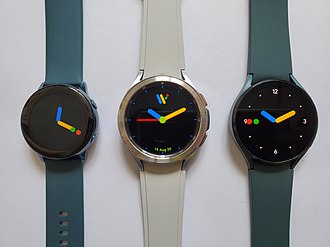
Wear OS, formerly called Android Wear, is smartwatch software made by Google Inc.
For children and the elderly
In China, since around 2015, smartwatches have become popular with schoolchildren. They are often colorful and made of plastic. They usually show the time or let children make and receive calls when a button is pressed. These smartwatches cost between US$100 and US$200.
These watches are also sold in other countries. Some smartwatches can help older or disabled people by letting a caregiver know their location if they fall or get lost.
Smart strap
A smart strap is a special band that can make a smartwatch even smarter. It has built-in sensors that can add new features. For example, a smart strap might include a small camera, a heart sensor, and tools to measure body information.
Images
Related articles



This article is a child-friendly adaptation of the Wikipedia article on Smartwatch, available under CC BY-SA 4.0.
Images from Wikimedia Commons. Tap any image to view credits and license.