
Submersible
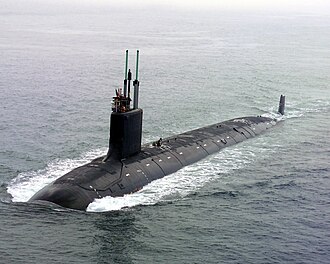
A submersible is an underwater vehicle that needs help from a bigger watercraft or platform. This makes submersibles different from submarines, which can travel on their own for long times.
There are many kinds of submersibles. Some can carry people, and some work without a crew. These craft without a crew are called remotely operated vehicles (ROVs) or unmanned underwater vehicles (UUVs). Submersibles help with many important tasks, like studying the ocean, exploring old underwater places, finding new sea areas, taking tours, fixing things, finding lost items, and filming underwater scenes.
History
See also: Submarine § History
The first underwater vehicle that could move by itself was made in 1620 by Dutch inventor Cornelis Drebbel. It was a small submarine powered by oars. King James I may have even tried it out for himself.
Later, in 1775, American inventor David Bushnell made the first submersible used in war. Called the Turtle, it was built to place explosives on enemy ships during a big war. It could dive by filling tanks with water and come up by pumping the water out. The person inside used hand wheels to move up, down, or sideways underwater.
Today, such vehicles are often used by special forces for special missions.
Operation
A submersible is different from a submarine because it is not fully independent. It often needs help from a bigger boat for power and air. Most submersibles work better underwater and have little use on the surface. Some stay connected to a bigger boat using a long cord.
Submersibles are usually small and can hold only a few people. They do not have spaces to live in for long. They can move quickly underwater using special tools and may have parts that people can control to do tasks.
Technologies
Submersibles use special tools to work underwater. Some important tools include:
- Buoyancy control
- Marine thrusters
- Pressure vessel with external pressure load
- Life support systems
- Through-water communications
- Manipulator arm
- Submarine navigation
When something is underwater, it pushes away the water around it. This creates an upward force called buoyancy. If the object weighs more than the water it pushes away, it will sink. If it weighs the same, it will stay still. If it weighs less, it will float up.
Submersibles can change their weight underwater to move up or down. They can make themselves heavier to sink or lighter to float on the surface. Some can even let water inside, so the crew needs special breathing equipment to stay safe underwater.
Deep-diving crewed submersibles
Main article: Deep-submergence vehicle
Some special underwater vehicles can dive very deep. The bathyscaphe Trieste was the first to reach the deepest part of the ocean, in the Mariana Trench in 1960.
China, with its Jiaolong project, sent a person over 3,500 meters below sea level. In 2012, the Jiaolong submersible went down over 6,900 meters.
One famous underwater research vehicle is the DSV Alvin. It can take three people to depths of up to 4,500 meters. It is owned by the United States Navy and operated by WHOI.
In 2012, James Cameron dove to the bottom of Challenger Deep in the Mariana Trench using his submersible named Deepsea Challenger.
The DSV Limiting Factor, now called Bakunawa, holds records for the deepest dives in all five oceans. It was first used by Victor Vescovo and his organization Caladan Oceanic, and is now operated by Gabe Newell's Inkfish research group. The vehicle has helped find shipwrecks and explore deep ocean areas.
Commercial submersibles
Private companies like Triton Submarines, LLC, SEAmagine Hydrospace, Sub Aviator Systems, and Netherlands-based U-boat Worx make small submersibles for tourism, exploration, and adventure travel.
In British Columbia, a company named Sportsub has been building personal recreational submersibles since 1986.
Another private U.S. company, OceanGate, also worked on building submersibles.
Marine remotely operated vehicles
Main article: Remotely operated underwater vehicle
Small uncrewed submersibles, called marine remotely operated vehicles (MROVs) or remotely operated underwater vehicles (ROUVs), are used when water is too deep or dangerous for divers. These vehicles help fix offshore oil platforms and attach cables to lift sunken ships. They are connected to a ship by a thick cable that gives them power and lets operators control them. People on the ship watch video or images from the vehicle and steer it using controls. Famous wrecks like the Titanic have been explored using these vehicles, along with crewed ships.
Autonomous underwater vehicles
Main article: Autonomous underwater vehicle
An autonomous underwater vehicle (AUV) is a robot that can move underwater by itself, without someone needing to control it all the time. AUVs are part of a group called unmanned underwater vehicles, which also includes vehicles that a person controls from far away. In the military, these are sometimes called unmanned undersea vehicles (UUVs). Underwater gliders are a special type of AUV.
Diver lock-out submersible
A diver lock-out submersible is a special underwater vehicle. It has an airlock and a built-in diving chamber. This lets underwater divers get in and out of the submersible while it is underwater. Examples include the Deep Diver, a research submersible, and the Antipodes (submersible), a commercial submarine built in 1973.
Keep exploring


This article is a child-friendly adaptation of the Wikipedia article on Submersible, available under CC BY-SA 4.0.
Images from Wikimedia Commons. Tap any image to view credits and license.