 Safekipedia
Synthesizer
Adapted from Wikipedia · Adventurer experience
A synthesizer is a special kind of electronic musical instrument that makes sounds by creating audio signals. Instead of using strings or wind like old instruments, synthesizers use electricity to make music. They can create many different sounds by changing waveforms in many ways, like subtractive synthesis, additive synthesis, and frequency modulation synthesis. These sounds can be adjusted using parts like filters, which change how the sound feels, and envelopes, which control how notes begin and end.
Synthesizers are usually played with keyboards and can also be controlled by computers or other devices using a system called MIDI. They became popular in the middle of the last century, with early models like the RCA Mark II using many vacuum tubes. The Moog synthesizer, made by Robert Moog in 1964, helped make synthesizers more common. Over time, they changed from big, complicated machines to smaller, easier-to-use instruments.
Today, synthesizers are used in almost every kind of music, from pop and rock to electronic and hip hop. They have helped shape the sound of modern music and are very important tools for musicians everywhere.
History
Precursors
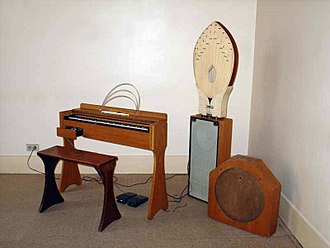
When electricity became common, new electronic musical instruments started to appear in the early 1900s. These included the Telharmonium, Trautonium, ondes Martenot, and theremin. In the late 1930s, the Hammond Organ Company made the Novachord, a big instrument that helped shape sound. In 1948, a Canadian engineer made the electronic sackbut, which could change how notes sounded.
In 1957, two engineers finished the RCA Mark II Sound Synthesizer. This machine used paper tape to control sounds. It was mostly used by a composer at Princeton University.
1960s: Early years
The story of synthesizers really began between 1964 and the mid-1970s with the Moog synthesizer, made by American engineer Robert Moog. The Moog had separate parts connected by cables that could create and change sounds. Moog also made a way to control pitch using electricity. Around the same time, another engineer, Don Buchla, made a system that used touchplates instead of keys. But the Moog’s keyboard made it easier for musicians to use, so keyboards became the normal way to control synthesizers.
1970s: Portability, polyphony and patch memory
In 1970, Moog made a smaller, cheaper synthesizer called the Minimoog. It was easier to carry and use for performances. Soon after, other companies started making synthesizers too. At first, synthesizers could only play one note at a time. But later, some could play many notes together. One important change was that sounds could now be saved and reused, making it easier to create consistent music.
1980s: Digital technology
The 1980s brought big changes to synthesizers. A new way to connect electronic instruments called MIDI was introduced in 1982. Some synthesizers could now record and play back sounds at different pitches. In 1983, Yamaha made the DX7, a digital synthesizer that became very popular. It had a different sound compared to older synthesizers. Other companies also made digital synthesizers with many new features.
1990s–present: Software synthesizers and analog revival
In the late 1990s and 2000s, computers could run synthesizers as software. Older analog synthesizers became popular again because people liked their natural sounds. New, affordable analog synthesizers were made by companies like Moog and Korg.
Impact
Early synthesizers were special and liked in the 1960s because they could make unusual sounds. An album from 1968 showed that synthesizers could make beautiful music, not just strange noises. But some people still thought they were not right for serious classical music.
Today, synthesizers are very important in music. They are used in almost every kind of music. Some say they are as important as the electric guitar.
Synthesizers became popular in rock music in the 1960s. They were used by famous bands and musicians. In the 1970s and 1980s, more portable synthesizers made it easy for bands to use them during live shows.
Synthesizers also became common in many other types of music, like jazz, disco, and electronic music. They helped create new styles and sounds. In pop music, synthesizers were used in many big hits. They also appear in movies and TV shows, adding exciting sounds to the action.
Sound synthesis
Synthesizers make sounds in different ways. One way is called subtractive synthesis, where parts of a sound are changed by filters. Another way is additive synthesis, which mixes simple waves to make new sounds. There is also a method where one wave changes another to make a special sound. Other ways include wavetable synthesis, where sounds change smoothly, and sample-based synthesis, where recorded sounds are used and changed.
Components
Oscillators
Oscillators make different sounds, like sawtooth or sine waves. These sounds give each note its special tone.
Voltage-controlled amplifiers
Voltage-controlled amplifiers help control how loud or soft the sound is. They can be changed by other parts of the synthesizer.
Envelopes
Envelopes change how a sound behaves over time. The ADSR envelope controls four things: attack (how fast the sound starts), decay (how quickly it softens), sustain (how long it stays loud), and release (how quickly it ends).
Low-frequency oscillators
Low-frequency oscillators change parts of the sound, like making notes wobble in pitch.
Filters
Filters change the sound by removing some frequencies. This can make the sound smoother or sharper.
Arpeggiators
Arpeggiators turn chords into a quick series of notes, making fun musical patterns.
Controllers
Synthesizers can be played using keyboards, either built-in or connected. Other controllers include touch-sensitive strips, wind instruments, drum pads, and touchscreens on tablets or smartphones.
Clones
Synthesizer clones are copies of older synthesizers made without permission, often sold at lower prices. These clones come as real instruments and as computer programs. Companies like Arturia and Native Instruments sell software clones. Behringer makes instruments that look like famous ones, such as the Minimoog, Pro-One, and TB-303, along with drum machines like the TR-808. Other examples include the MiniMOD, which copies the Minimoog and uses Eurorack modules, the Intellijel Atlantis, which copies the SH-101, and the x0x Heart, which copies the TB-303.
Making these clones is allowed when the original patents have ended. In 1997, Mackie lost a lawsuit against Behringer because copyright law in the United States did not protect their circuit board designs.
Images
Related articles




This article is a child-friendly adaptation of the Wikipedia article on Synthesizer, available under CC BY-SA 4.0.
Images from Wikimedia Commons. Tap any image to view credits and license.