 Safekipedia
Tabulata
Adapted from Wikipedia · Adventurer experience
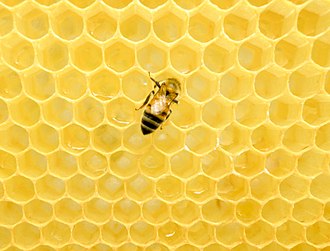
Tabulata, or tabulate corals, were a class of corals that no longer exist today. They usually grew in groups of tiny, six-sided spaces called corallites. These spaces had a hard outer layer made of calcite and looked like a honeycomb, with small holes connecting the spaces next to each other.
A special feature of tabulate corals was flat layers called tabulae inside each space. Unlike other corals, they did not have many vertical walls inside.
Scientists have found about 300 different kinds of tabulate corals as fossils. Some common ones are Aulopora, Favosites, Halysites, Heliolites, Pleurodictyum, Sarcinula, and Syringopora. These corals only lived during the Paleozoic era, from the Ordovician to the Permian periods. They were most often seen in shallow seas during the Silurian and Devonian periods. Later, when sea levels rose in the Devonian, tabulate corals became rarer and they disappeared forever in the Permian–Triassic extinction event.
Images
Related articles



This article is a child-friendly adaptation of the Wikipedia article on Tabulata, available under CC BY-SA 4.0.
Images from Wikimedia Commons. Tap any image to view credits and license.