
Transparency and translucency
In the field of optics, transparency is a special property that lets light pass through a material without much scattering. Materials that are transparent, like plate glass and clean water, let most light go straight through them and reflect very little. This makes them look clear and bright.
Translucency is similar but different. It also lets light pass through, but the light may scatter as it moves through the material. This means the light does not always follow the same path, and the material might look cloudy or milky instead of clear.
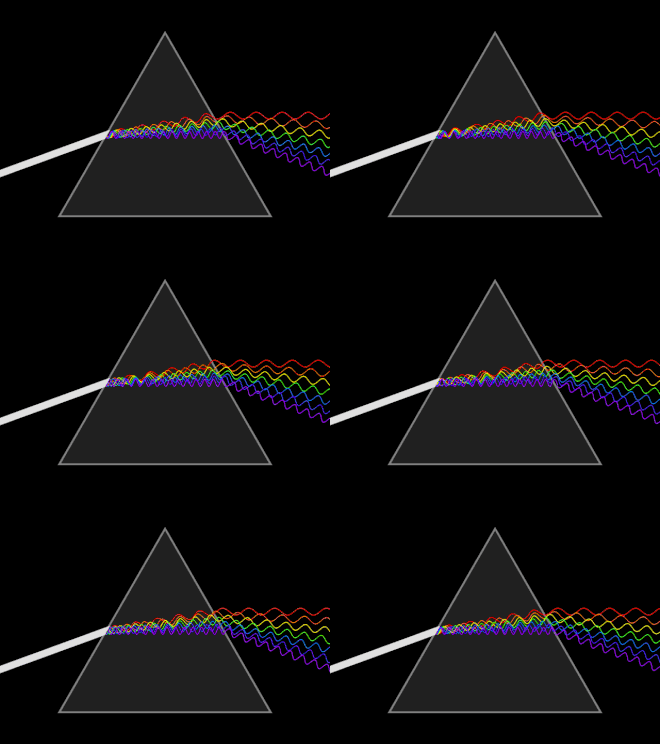
When light meets a material, it can reflect, absorb, or transmit depending on the material and the light's wavelength. Materials that do not let light through are called opaque. The way light interacts with a material gives us the colors and appearances we see every day.
Some marine animals, like jellyfish, are highly transparent, which helps them hide in the water. Transparency can act like camouflage, especially in dim or murky seawater, making it harder for others to see them.
Etymology
The words for see-through materials have long histories. The word "transparent" comes from old Latin words meaning "visible through." The word "translucent" also comes from Latin and means "shining through." The word "opaque," meaning not see-through, also has Latin roots.
Introduction
When we look at objects, we see them because light bounces off them. Some materials let light pass through clearly. We call these transparent. Other materials let light pass but make things look fuzzy. We call this translucent.
Materials let light through based on how their tiny parts are arranged. For example, pure glass lets light pass easily. But if there are tiny bumps or spots inside a material, they can scatter the light, making it look less clear. Scientists study these tiny details to create clear materials.
Absorption of light in solids
When light hits an object, it usually has many different colors. Objects can absorb, reflect, or let some colors of light pass through. For example, one object might reflect green light but absorb all other colors, while another might let blue light pass through but absorb the rest.
Some materials let most light pass through without reflecting it. These are called optically transparent materials. Pure glass and clean water are good examples. Materials that don’t let any light through are called opaque. Most materials absorb only certain colors, which is why we see different colors — the colors we see are the ones not absorbed.
Different things can cause absorption. In one type, light can change the energy levels of electrons in atoms. In another type, the light’s energy matches the natural movements of atoms or molecules, turning light into heat. Metals usually reflect most light because of their free electrons, while many non-metal materials let visible light pass through unless they have added colorants. Most liquids, like water or oil, are clear because their structure allows light to pass through easily.
Optical waveguides
Main article: Optical fiber
Materials that let light pass through are important for how light waves behave. Special glass can carry many different colors of light at once without mixing them up. This helps send information over long distances.
An optical fiber is a thin glass tube that guides light by keeping it bouncing inside. It has a center part called the core and a surrounding layer called the cladding. Light stays in the core because it moves slower there than in the cladding. When light hits the edge of the core at a sharp angle, it bounces back inside, which keeps it moving along the fiber.
Mechanisms of attenuation
When light travels through a fiber, its strength can get weaker over distance. This happens mainly because of tiny bumps in the glass and because some light gets caught by small bits of material inside the fiber. Bending the fiber or connecting pieces together can also make the light weaker.
As camouflage
Further information: List of camouflage methods
Many sea animals that float near the surface are very clear, which helps them hide. But being clear is tricky for animals that see light differently than seawater does. Some sea animals like jellyfish have bodies mostly made of water, which makes them see-through. This helps them stay up in the water, but it also means they are big compared to their muscles and cannot swim fast.
Small floating sea animals are often clear. Being about half clear is enough to hide from a fish like cod deep in the water, but clearer is needed closer to the surface where there is more light and predators can see better. For example, a cod can see food that is very clear in shallow water with good light. Because of this, hiding by being clear works better in deep water. Being clear in air is even harder, but some glass frogs in South American rain forests have skin you can see through, as well as pale green legs. Some butterflies in Central America and many dragonflies and other insects also have wings that are mostly clear, which helps them hide from animals that might eat them.
Pictures
Keep exploring



This article is a child-friendly adaptation of the Wikipedia article on Transparency and translucency, available under CC BY-SA 4.0.
Images from Wikimedia Commons. Tap any image to view credits and license.