 Safekipedia
Tsimshian
Adapted from Wikipedia · Adventurer experience
The Tsimshian (/ˈsɪmʃiən/; Tsimshian: Tsʼmsyen, lit. 'Inside the Skeena River') are an Indigenous people of the Pacific Northwest Coast of North America. Their communities are mostly in coastal British Columbia in Terrace and Prince Rupert, and Metlakatla, Alaska on Annette Island, the only reservation in Alaska.
The Tsimshian estimate there are 45,000 Tsimshian people and approximately 10,000 members are federally registered in eight First Nations communities: Kitselas, Kitsumkalum, Gitxaala, Gitga'at, Kitasoo, Lax Kw'Alaams, and Metlakatla. The Tsimshian are one of the largest First Nations peoples in northwest British Columbia. Some Tsimshian migrated to the Annette Islands in Alaska, and today approximately 1,450 Alaska Tsimshian people are enrolled in the federally recognized Metlakatla Indian Community, sometimes also called the Annette Island Reserve.
Tsimshian society is matrilineal kinship-based, which means identity, clans and property pass through the maternal line. Their moiety-based societal structure is further divided into sub clans for certain lineages. The Tsimshian language has some 27 different terms for 'chief' likely because it is a stratified and ranked society.
History
The word Tsimshian means "Inside the Skeena River". Long ago, the Tsimshian lived far up the Skeena River near today's Hazelton, in British Columbia. A chief led many Tsimshian to the coast, where they built Kitkatla Village. This village stayed very traditional. Other Tsimshian moved down the river and settled in the lower Skeena valley. Over time, they developed their own way of speaking and became known as the Tsimshian-proper. They kept many traditions with their relatives, the Gitxsan.
The Tsimshian had winter homes around Prince Rupert Harbour and Venn Pass (Metlakatla). In summer, they traveled back to the lower Skeena River for salmon. Evidence shows they lived in the Prince Rupert area for about 5,000 years. In 1787, Europeans first met the Tsimshian at Gitxaala. Later, many Tsimshian moved to trade with the Hudson's Bay Company. Sadly, diseases brought by Europeans made many Tsimshian very ill. By the late 1800s, their numbers dropped sharply.
In the 1880s, a missionary named William Duncan led some Tsimshian from British Columbia to Annette Island in Alaska, where they founded New Metlakatla. They received special land rights there, making it the only reservation in Alaska. Today, most Tsimshian live near Prince Rupert in British Columbia, with some in Alaska and other places.
Culture
The Tsimshian have families, houses, and clans that are very important. They pass down rights and property through families. Special leaders called hereditary chiefs get their roles from their mothers’ families.
They had formal ways of marrying, often arranging marriages to protect land and resources. Some old rules about food still exist today.
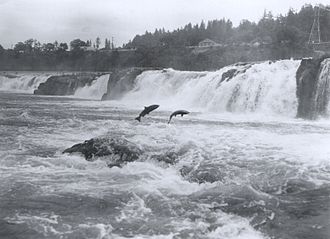
The Tsimshian are good at fishing, especially for salmon, which is important to them. They built big homes called longhouses from cedar wood to stay safe in rainy weather.
Their beliefs focused on a “Lord of Heaven” who helped people. They thought being kind and keeping clean led to a good life after death.
They have special feasts called potlatches to honor important events like deaths and leadership changes. These feasts have many rules and traditions.
The Tsimshian still fish, hunt, and create beautiful art. They use cedar wood for many things, like tools and clothes, and tell stories through their art.
Ethnobotany
The Tsimshian used cedar wood for many things, like tools and clothes. They also used berries from plants as food.
Tribes
The Tsimshian people of British Columbia have fifteen different tribes. Some of these tribes are the Kitasoo, who are part of the Kitasoo/Xaixais First Nation at Klemtu. The Gitga'at live at Hartley Bay as their own First Nation. The Gitxaala Nation lives in the village of Kitkatla. The Kitsumkalum First Nation is located in Terrace, as is the Kitselas First Nation.
Some chiefs from these tribes were at Fort Simpson, which later became Lax Kw'alaams. Others were at the mission community of Metlakatla, with some moving to Metlakatla in Alaska. This is the newest Tsimshian tribe and includes members from all the other tribes.
Clans
The Tsimshian people have four main clans:
- Gispwudwada (Killer Whale Clan)
- Ganhada (Raven Clan)
- Laxgibuu (Wolf Clan)
- Laxsgiik (Eagle Clan)
Treaty process
The Tsimshian have wanted to protect their villages and fishing spots along the Skeena River and Nass River since 1879. They began talking with the Canadian government about a treaty in July 1983. Fourteen tribes joined together in 1993 as the Tsimshian Tribal Council. They signed an agreement in 1997, but some legal problems over fishing rights happened. Some Tsimshian groups continue to work with the BC Treaty Commission to make progress.
Language
The Tsimshian people speak a language called Sm'algyax, which means "real or true tongue." Some Tsimshian also speak a language similar to Gitxsan and Nisga’a, but it is different from the main Tsimshian language.
Some language experts think the Tsimshian language might belong to a larger group called the Penutian languages.
Notable Tsimshian people
- Frederick Alexcee, artist and culture bearer
- Morgan Asoyuf, artist and culture bearer
- William Beynon, Gitlaan and ethnographer
- David A. Boxley, Laxsgiik, carver and culture bearer. First to host a potlatch and raise a totem pole in modern times in Metlakatla, Alaska
- Arthur Wellington Clah, from the House of Tamks of the Gispaxlo'ots. Translator at Fort Simpson, the first to teach Father Duncan the Sm’algyax language
- Marcia Crosby, art historian
- Alfred Dudoward, hereditary chief of the Gitando, and leader of the Port Simpson Methodist Movement
- Phil Gray, artist
- Benjamin Haldane, pioneering photographer from Metlakatla village
- Calvin Helin – lawyer, author, entrepreneur
- William Jeffrey, Gitwilgyoats, hereditary chief, activist, carver
- Rudy Kelly, author and journalist
- Paul Legaic, hereditary chief of the Gispaxlo'ots and trader.
- Charles Menzies, Gitxaała, House of Ts'ibasaa, author and anthropologist.
- Odille Morison, translator and art collector
- William Henry Pierce, missionary and memoirist
- Bilham 'neex Loa Ryan, Gitlan, House of Xpe Hanaax, Ganhada, artist and traditional cedar weaver
- Peter Simpson, Native American rights activist
- Henry W. Tate, Gispakloats, oral historian, tribal headman
- Roy Henry Vickers, artist
- Walter Wright; hereditary chief of the Gits'ilaasü (Kitselas) and oral historian
Anthropologists and other scholars who have worked with the Tsimshian
Many smart people have studied the Tsimshian people. Some of these people include Marius Barbeau, William Beynon, Franz Boas, Philip Drucker, Wilson Duff, Viola Garfield, René Girard, Marjorie Halpin, and Jay Miller. Their work helps us learn more about the Tsimshian's history and culture.
Missionaries who proselytized the Tsimshian
Some missionaries came to share their beliefs with the Tsimshian people. They included William Henry Collison, Thomas Crosby, William Duncan, Edward Marsden, Bishop William Ridley, and Robert Tomlinson.
Images
Related articles


This article is a child-friendly adaptation of the Wikipedia article on Tsimshian, available under CC BY-SA 4.0.
Images from Wikimedia Commons. Tap any image to view credits and license.