 Safekipedia
Vapor pressure
Adapted from Wikipedia · Adventurer experience
Vapor pressure is the force a gas, called a vapor, puts on its liquid or solid form when they are balanced at a certain temperature. This happens in a closed space where the liquid and gas do not change each other.
When a liquid has high vapor pressure, it can easily turn into a gas. We call such liquids volatile.
As temperature rises, more of the liquid turns into gas, and the vapor pressure goes up too. Liquids that stick together well, like water, have lower vapor pressure. Liquids that do not stick as well have higher vapor pressure.
The temperature when a liquid’s vapor pressure matches the air pressure around it is when the liquid boils. At this point, the liquid starts to form bubbles of gas. The air pressure and the depth of the liquid affect when these bubbles start to form. Very small bubbles need a little extra pressure to stay together because of their surface tension.
Measurement and units
Vapor pressure is measured using special units that show us pressure. The most common unit is the pascal (Pa). It measures how much force pushes on an area.
To find vapor pressure, scientists clean the material they test. They put it in a container and measure the pressure of the gas that forms above it at different temperatures. This helps them learn how the material acts in different conditions. Sometimes, doctors use another unit called millimeters of mercury (mmHg) to measure vapor pressure, especially for certain medicines used during surgeries.
Estimating vapor pressures with Antoine equation
The Antoine equation is a math formula that connects vapor pressure with temperature for pure liquids or solids. It shows how vapor pressure usually goes up when temperature goes up.
The basic form looks like this:
log P = A − B / (C + T)
Here’s what each part means:
- P is the vapor pressure of the substance
- T is the temperature
- A, B, and C are special numbers that change depending on the substance
There’s a simpler version too:
log P = A − B / T
Both equations help scientists figure out vapor pressure at different temperatures. But they work best only within certain temperature ranges.
Relation to boiling point of liquids
Further information: Boiling point
Vapor pressure is the pressure of a gas above a liquid or solid at a certain temperature. Liquids with lower boiling points usually have higher vapor pressures at normal temperatures. This means they change into a gas more easily.
At the boiling point of a liquid, its vapor pressure equals the pressure of the air around it. For example, methyl chloride boils at a very low temperature and has a high vapor pressure, so it easily turns into a gas.
Liquid mixtures: Raoult's law
Raoult's law helps us understand the vapor pressure of mixtures of liquids. It tells us that the total vapor pressure of a liquid mixture depends on the vapor pressures of each liquid and how much of each liquid is present.
Sometimes, a mixture has a higher vapor pressure than Raoult's law predicts. This means the liquids in the mixture attract each other less strongly. An example is a mix of ethanol and water, which boils at a lower temperature than either pure liquid.
Sometimes, a mixture has a lower vapor pressure than expected. This happens when the liquids attract each other more strongly. For example, a mix of trichloromethane (chloroform) and 2-propanone (acetone) boils at a higher temperature than either pure liquid.
Solids
When a solid and its vapor are balanced, we call this the equilibrium vapor pressure. For solids like crystals, this happens when the speed at which the solid turns into vapor matches the speed at which the vapor turns back into solid. Most solids have very low vapor pressure, making it hard to measure. Special tools like thermogravimetry can help find these pressures.
There are ways to figure out the vapor pressure of a solid. One way uses the vapor pressure of a liquid that has been cooled below its freezing point. This uses a special math formula to estimate the solid’s vapor pressure.
Boiling point of water
Main article: Vapour pressure of water
Water boils when the pressure of its vapor matches the pressure around it. This is why water boils at lower temperatures on mountains, where the air pressure is lower. There are special formulas for scientists to find the boiling temperature of water based on air pressure, but we don't need to worry about them here.
Dühring's rule
Main article: Dühring's rule
Dühring's rule tells us that for two solutions, the temperatures where they have the same vapor pressure are linked by a straight line. This means if you know the temperature for one solution, you can easily find the temperature for the other using a simple straight-line rule.
Examples
Here is a list of different materials arranged by how much vapor pressure they have, from the lowest to the highest.
| Substance | Vapor pressure | Temperature (°C) | ||
|---|---|---|---|---|
| (Pa) | (bar) | (mmHg) | ||
| BMIM-PF6 | 10−10 Pa | 10−15 | 7.5×10⁻¹³ | 20 |
| Octaethylene glycol | 9.2×10⁻⁸ Pa | 9.2×10⁻¹³ | 6.9×10⁻¹⁰ | 89.85 |
| Glycerol | 0.4 Pa | 0.000004 | 0.003 | 50 |
| Mercury | 1 Pa | 0.00001 | 0.0075 | 41.85 |
| Tungsten | 1 Pa | 0.00001 | 0.0075 | 3203 |
| Xenon difluoride | 600 Pa | 0.006 | 4.50 | 25 |
| Water (H2O) | 2.3 kPa | 0.023 | 17.5 | 20 |
| Propanol | 2.4 kPa | 0.024 | 18.0 | 20 |
| Methyl isobutyl ketone | 2.66 kPa | 0.0266 | 19.95 | 25 |
| Iron pentacarbonyl | 2.80 kPa | 0.028 | 21 | 20 |
| Ethanol | 5.83 kPa | 0.0583 | 43.7 | 20 |
| Freon-113 | 37.9 kPa | 0.379 | 284 | 20 |
| Acetaldehyde | 98.7 kPa | 0.987 | 740 | 20 |
| Butane | 220 kPa | 2.2 | 1650 | 20 |
| Formaldehyde | 435.7 kPa | 4.357 | 3268 | 20 |
| Propane | 997.8 kPa | 9.978 | 7584 | 26.85 |
| Carbonyl sulfide | 1.255 MPa | 12.55 | 9412 | 25 |
| Nitrous oxide | 5.660 MPa | 56.60 | 42453 | 25 |
| Carbon dioxide | 5.7 MPa | 57 | 42753 | 20 |
Estimating vapor pressure from molecular structure
Scientists have ways to guess the vapor pressure of organic molecules by looking at their structure. Some of these methods include the SIMPOL.1 method, the method by Moller and others, and EVAPORATION, which stands for Estimation of VApour Pressure of ORganics. This method looks at things like temperature and molecule structure.
Meaning in meteorology
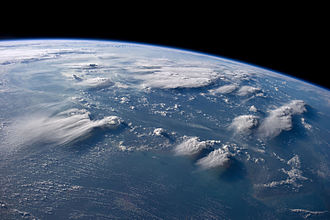
In meteorology, vapor pressure is the amount of water vapor in the air. This is different from how the term is used in other sciences. The saturation vapor pressure is the pressure of water vapor when it is balanced above water or ice, and it depends only on the temperature. Relative humidity is measured compared to this saturation vapor pressure.
The term equilibrium vapor pressure can apply to tiny water droplets, possibly with impurities, such as in a cloud. These terms are sometimes used in different ways by different authors. The idea of saturation vapor pressure comes from an old theory. But according to Dalton's law, the pressure of water vapor depends only on the temperature of the liquid water, not on the air around it.
Images
Related articles




This article is a child-friendly adaptation of the Wikipedia article on Vapor pressure, available under CC BY-SA 4.0.
Images from Wikimedia Commons. Tap any image to view credits and license.