 Safekipedia
Vatican Library
Adapted from Wikipedia · Adventurer experience
The Vatican Apostolic Library, often called the Vatican Library or informally the Vat, is the library of the Holy See and serves as the national library of Vatican City. It was formally established by Pope Sixtus IV in 1475. It is one of the oldest libraries in the world and holds many important historical texts.
The library has 75,000 codices from many different times in history, along with over a million printed books. It is a research library for studying history, law, philosophy, science, and theology. People with the right qualifications and research needs can use the library.
The idea for the library began with Pope Nicholas V, who wanted a place for scholars in Rome. His successor, Pope Sixtus IV, created the library we know today. In 2014, the Vatican Library began a project to digitise some of its manuscripts so people all over the world could see them online. The Vatican Apostolic Archive holds many more items and was separated from the library in the 17th century.
Historical periods
Scholars have divided the history of the Vatican Library into five periods: Pre-Lateran, Lateran, Avignon, Pre-Vatican, and Vatican.
The Pre-Lateran period began with the earliest days of the Church. Only a few important books from this time remain.
The Lateran era started when the library moved to the Lateran Palace. During this time, the library had many beautiful handwritten books, but a fire destroyed some of them.
The Avignon period happened when popes lived in Avignon, France. The library grew with many new books and records.
Before the library moved to the Vatican, books were scattered in different places. By the mid-1400s, one pope had around 340 books.
In 1451, Pope Nicholas V began creating a public library at the Vatican. He added many books in Greek, Latin, and Hebrew. By 1455, the library had 1,200 books.
In 1475, Pope Sixtus IV officially founded the Vatican Library. By then, it had around 3,500 books, making it one of the largest collections in the world. Later popes expanded the building and improved organization.
In the 1900s, the library worked with libraries around the world to improve its organization. This helped make the Vatican Library one of the most modern libraries in Europe.
Location and building
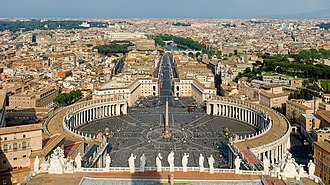
The Vatican Library is inside the Vatican Palace. You can enter through the Belvedere Courtyard. When Pope Sixtus V led from 1585 to 1590, he added a new building to the library. This changed how it looked.
Inside the library, there is a special room for very old pieces of paper called papyrus. There is also a place to keep important old books safe. One floor has a room where experts fix old books, and another floor has pictures in photo archives.
The library has many shelves—enough to stretch for 42 kilometres (26 miles)! It was closed for updates from July 17, 2007, until it opened again on September 20, 2010. During this time, they made special rooms to keep the books safe from weather changes.
Architecture and art
In the main reading room of the Vatican Library, there is a big statue of St Thomas Aquinas. Another copy of this statue is at the entrance of the Pontifical University of St Thomas Aquinas, Angelicum.
Library organization
The Vatican Library has a special way of keeping track of its books. At first, they used small notebooks to list the books. When they had more books, they used shelves and lists. In the 1920s to 1930s, a man named Father Franz Ehrle helped make a new system using cards, like the Library of Congress does. Later, in the 1990s, another man named Rev. Leonard E. Boyle helped put all the information into a computer.
In the past, during a time called the Renaissance, the books were kept on special wooden benches with tables. The books were tied to these benches with chains so they couldn’t be taken away easily. Scholars could borrow books, but they had to follow strict rules. If they broke the rules, they could lose the right to use the library. Today, the Vatican Library welcomes scholars for advanced research.
Collections
The Vatican Library has many important books and documents. It began with Bibles and religious texts but also collected secular books, especially Greek and Latin classics. Some of the oldest documents in the library date back to the first century.
The library started with handwritten books, so it has many more manuscripts than printed books. Printed books were added to help study the manuscripts.
The library also has over 330,000 coins and medals from Greece, Rome, and the popes. Each year, it adds about 6,000 new books. The library has grown through gifts and purchases.
In 1623, the Palatine Library from Heidelberg joined the Vatican Library. It included about 3,500 manuscripts taken during the Thirty Years' War. Most of these manuscripts remain in the Vatican Library today.
In 1689, the library received the collection of Queen Christina of Sweden, which included many valuable books and manuscripts.
One famous item in the library is the Codex Vaticanus Graecus 1209, one of the oldest nearly complete copies of the Bible in Greek. The library also has a school of library science and a film library started in 1959.
The library has many texts about Hinduism, with the oldest dating to 1819. Between 2007 and 2010, the library tagged 70,000 volumes with electronic chips to prevent theft.
Main page: Category:Manuscripts in the Vatican Library
Some notable manuscripts in the library include:
Manuscripts relating to Christianity
- Codex Vaticanus Graecus 1209, one of the oldest existing Bibles in Greek
- Barberini Gospels
- Gelasian Sacramentary, one of the oldest books about Christian worship
- Joshua Roll
- Lorsch Gospels, an illustrated gospel book from 778 to 820
- Menologion of Basil II
- Vatican Croatian Prayer Book
- Three fragments of the Old Saxon Genesis and one fragment of Heliand
- Libri Carolini
Classic Greek and Latin texts
- Vergilius Vaticanus
- Vergilius Romanus
- Vergilius Augusteus
- Codex Vaticanus Ottobonianus Latinus 1829
- Codex Vaticanus Latinus 3868
- Parts of Euclid's Elements
Medieval Greek and Latin texts
- Codex Vaticano Rossi 215
- Vaticanus Graecus 1001
- De arte venandi cum avibus
Others
- Codex Borgia
- Codex Vat. Arabo 368
- Codex Vaticanus 3738
- Borgiani Siriaci 175
Qurans
The library has over 100 Quran manuscripts from different collections.
Digitization projects
In 2012, the Vatican Library planned to digitize a million pages of material with the Bodleian Library. In 2014, it worked with NTT Data Corporation to digitize about 3,000 manuscripts over four years. This project will create high-definition images available online. The library’s digital service is called DigiVatLib, offering free access to digitized manuscripts and early printed books.
The scanning process depends on the materials used in the books. Books with gold and silver need special equipment. Digital copies are shared using a special internet protocol provided by Dell EMC.
Gallery of holdings
Manuscript page with the five-voice "Kyrie" of the Missa Virgo Parens Christi by [Jacques Barbireau](/wiki/Jacques_Barbireau)
[Mappamondo Borgiano](/wiki/Borgia_map)
Month of May from the _Chronography of 354_
[Anton Raphael Mengs](/wiki/Anton_Raphael_Mengs)
Illumination from the legend of [Saint Emeric of Hungary](/wiki/Saint_Emeric_of_Hungary)
Battle between David and Goliath
The ivory panels from the back cover of [Codex Aureus of Lorsch](/wiki/Codex_Aureus_of_Lorsch)
Related libraries
Vatican Apostolic Archive
Main article: Vatican Apostolic Archive
The Vatican Apostolic Archive is in Vatican City. It holds important papers and documents from the Holy See. In the 1600s, a pope named Pope Paul V decided to separate these archives from the Vatican Library. For many years, only a few people could see them. But in 1881, another pope, Pope Leo XIII, allowed researchers to study these documents. Today, many people visit each year to learn from them.
Vatican Film Library
Main article: Vatican Film Library
The Vatican Film Library is in St. Louis, Missouri. It holds microfilms of old books and papers from the Vatican Library. This library is part of the Pius XII Library at Saint Louis University. It was started by a man named Lowrie J. Daly, who got help from the Knights of Columbus. The idea was to make these documents easier for people in North America to study.
Microfilming began in 1951. The library opened in 1953 and moved to Saint Louis University in 1959. It has copies of manuscripts in many languages, including Greek, Latin, Arabic, Hebrew, and Ethiopic.
Staff
The Vatican Library has a special leader called a Cardinal Librarian. Over time, the real managers have been top scholars. In 1883, the title was changed to Prefect by Pope Leo XIII.
Today, about 80 people work at the library in five different areas: handling old writings and records, looking after printed books and drawings, getting new items and organizing them, taking care of coins and museums, and fixing and photographing treasures.
List of librarians
(P) Means the person acted as librarian but was not a cardinal.
| Name | Lifetime | Title | Duration as librarian |
|---|---|---|---|
| Marcello Cervini | 1501–1555 | Bibliothecarius I | 24 May 1550–9 April 1555 |
| Roberto de' Nobili | 1541–1559 | Bibliothecarius II | 1555–18 January 1559 |
| Alfonso Carafa | 1540–1565 | Bibliothecarius III | 1559–29 August 1565 |
| Marcantonio da Mula | 1506–1572 | Bibliothecarius IV | 1565–17 March 1572 |
| Guglielmo Sirleto | 1514–1585 | Bibliothecarius V | 18 March 1572–16 October 1585 |
| Antonio Carafa | 1538–1591 | Bibliothecarius VI | 16 October 1585–13 January 1591 |
| Marco Antonio Colonna | 1523 ca.–1597 | Bibliothecarius VII | 1591–13 March 1597 |
| Cesare Baronio | 1538–1607 | Bibliothecarius VIII | May 1597–30 June 1607 |
| Ludovico de Torres | 1552–1609 | Bibliothecarius IX | 4 July 1607–8 July 1609 |
| Scipione Borghese Caffarelli | 1576–1633 | Bibliothecarius X | 11 June 1609–17 February 1618 |
| Scipione Cobelluzzi | 1564–1626 | Bibliothecarius XI | 17 February 1618–29 June 1626 |
| Francesco Barberini | 1597–1679 | Bibliothecarius XII | 1 July 1626–13 December 1633 |
| Antonio Barberini | 1569–1646 | Bibliothecarius XIII | 13 December 1633–11 September 1646 |
| Orazio Giustiniani | 1580–1649 | Bibliothecarius XIV | 25 September 1646–25 July 1649 |
| Luigi Capponi | 1583–1659 | Bibliothecarius XV | 4 August 1649–6 April 1659 |
| Flavio Chigi | 1631–1693 | Bibliothecarius XVI | 21 June 1659–19 September 1681 |
| Lorenzo Brancati | 1612–1693 | Bibliothecarius XVII | 19 September 1681–30 November 1693 |
| Girolamo Casanate | 1620–1700 | Bibliothecarius XVIII | 2 December 1693–3 March 1700 |
| Enrico Noris | 1631–1704 | Bibliothecarius XIX | 26 March 1700–23 February 1704 |
| Benedetto Pamphili | 1653–1730 | Bibliothecarius XX | 26 February 1704–22 March 1730 |
| Angelo Maria Querini | 1680–1755 | Bibliothecarius XXI | 4 September 1730–6 January 1755 |
| Domenico Passionei | 1682–1761 | Bibliothecarius XXII | 10 July 1741–12 January 1755(P) 12 January 1755–5 July 1761 |
| Alessandro Albani | 1692–1779 | Bibliothecarius XXIII | 12 August 1761–11 December 1779 |
| Francesco Saverio de Zelada | 1717–1801 | Bibliothecarius XXIV | 15 December 1779–29 December 1801 |
| Luigi Valenti Gonzaga | 1725–1808 | Bibliothecarius XXV | 12 January 1802–29 December 1808 |
| Giulio Maria della Somaglia | 1744–1830 | Bibliothecarius XXVI | 26 January 1827–2 April 1830 |
| Giuseppe Albani | 1750–1834 | Bibliothecarius XXVII | 23 April 1830–3 December 1834 |
| Luigi Lambruschini | 1776–1854 | Bibliothecarius XXVIII | 11 December 1834–27 June 1853 |
| Angelo Mai | 1782–1854 | Bibliothecarius XXIX | 27 June 1853–9 September 1854 |
| Antonio Tosti | 1776–1866 | Bibliothecarius XXX | 13 January 1860–20 March 1866 |
| Jean Baptiste François Pitra | 1812–1889 | Bibliothecarius XXXI | 19 January 1869–9 February 1889 |
| Placido Maria Schiaffino | 1829–1889 | Bibliothecarius XXXII | 20 February 1889–23 September 1889 |
| Alfonso Capecelatro | 1824–1912 | Bibliothecarius XXXIII | 29 August 1890–14 November 1912 |
| Mariano Rampolla del Tindaro | 1843–1913 | Bibliothecarius XXXIV | 26 November 1912–16 December 1913 |
| Francesco di Paola Cassetta | 1841–1919 | Bibliothecarius XXXV | 3 January 1914–23 March 1919 |
| Aidan [Francis Neil] Gasquet | 1845–1929 | Bibliothecarius XXXVI | 9 May 1919–5 April 1929 |
| Franz Ehrle | 1845–1934 | Bibliothecarius XXXVII | 17 April 1929–31 March 1934 |
| Giovanni Mercati | 1866–1957 | Bibliothecarius XXXVIII | 18 June 1936–23 August 1957 |
| Eugène Tisserant | 1884–1972 | Bibliothecarius XXXIX | 14 September 1957–27 March 1971 |
| Antonio Samoré | 1905–1983 | Bibliothecarius XL | 25 January 1974–3 February 1983 |
| Alfons Maria Stickler | 1910–2007 | Bibliothecarius XLI | 7 September 1983–27 May 1985(P) 27 May 1985–1 July 1988 |
| Antonio María Javierre Ortas | 1921–2007 | Bibliothecarius XLII | 1 July 1988–24 January 1992 |
| Luigi Poggi | 1917–2010 | Bibliothecarius XLIII | 9 April 1992–29 November 1994(P) 29 November 1994–25 November 1997 |
| Jorge María Mejía | 1923–2014 | Bibliothecarius XLIV | 7 March 1998–24 November 2003 |
| Jean-Louis Tauran | 1943–2018 | Bibliothecarius XLV | 24 November 2003–25 June 2007 |
| Raffaele Farina | 1933– | Bibliothecarius XLVI | 25 June 2007–9 June 2012 |
| Jean-Louis Bruguès | 1943– | Bibliothecarius XLVII | 26 June 2012–1 September 2018 |
| José Tolentino de Mendonça | 1965– | Bibliothecarius XLVIII | 1 September 2018–26 September 2022 |
| Angelo Vincenzo Zani | 1950– | Bibliothecarius XLIX | 26 September 2022–28 March 2025 |
| Giovanni Cesare Pagazzi | 1965– | 28 March 2025– | |
Images
Related articles



This article is a child-friendly adaptation of the Wikipedia article on Vatican Library, available under CC BY-SA 4.0.
Images from Wikimedia Commons. Tap any image to view credits and license.